Raw report: pathway_capability_dependency Feeds into: biosynthetic-prototrophy-and-auxotrophy, biosynthetic-self-sufficiency-and-cultivation, capability-versus-kinetic-predictability, community-metabolic-interdependence, computational-pathway-prediction-validation, condition-dependent-gene-tradeoffs, condition-space-dimensionality, condition-specific-fitness, cross-condition-metabolic-comparability, cross-species-fitness-transferability, ecotype-clustering-validity, ecotype-environment-gene-content, environment-embedding-geography, evidence-triangulation-for-functional-annotation, gene-essentiality, gene-function-acquisition-depth, lab-field-fitness-concordance, laboratory-fitness-versus-natural-selection, metabolic-capacity-specialization, metabolic-model-gapfilling, module-level-coinheritance, pangenome-conservation-fitness-decoupling, pangenome-core-boundary-and-clade-size-bias, pangenome-integration, pangenome-openness-determinants, pathway-versus-reaction-evidence-resolution, phylogenetic-confounding-of-pangenome-associations, respiratory-capacity-and-nadh-load, sampling-depth-and-downsampling-effects, two-speed-bacterial-genome
Overview
This project crossed GapMind pathway-completeness predictions with random barcode transposon sequencing (RB-TnSeq; genome-wide pooled mutant fitness profiling) data from the Fitness Browser to classify 161 organism-pathway combinations across 7 model bacteria. It distinguishes genomic capability from experimentally observed dependency and extends the analysis to 2,810 GTDB species with at least 10 genomes, testing relationships among pathway variation, accessory genes, pangenome openness, and metabolic ecotypes. Its central framing is that a complete pathway in a genome does not guarantee the organism depends on that pathway under any given condition. 1
Key Findings
Capability and dependency are distinct
Of 161 organism-pathway pairs spanning 7 Fitness Browser organisms and 23 GapMind pathways, 57 (35.4%) were Active Dependency pairs, 66 (41.0%) were Latent Capability, 24 (14.9%) were Incomplete but Important, and 14 (8.7%) were Missing. Active Dependency denotes a complete pathway containing fitness-important genes; Latent Capability denotes a complete pathway whose genes showed no significant fitness defects under standard conditions; Incomplete but Important denotes GapMind-incomplete pathways whose mapped genes were fitness-important; and Missing denotes pathways that were neither complete nor important. The report suggests that Incomplete but Important pairs point to annotation gaps or salvage routes. The four-category overview is shown in fig1_four_category_overview.png and the per-pair classification in tier1_classification_heatmap.png. 1
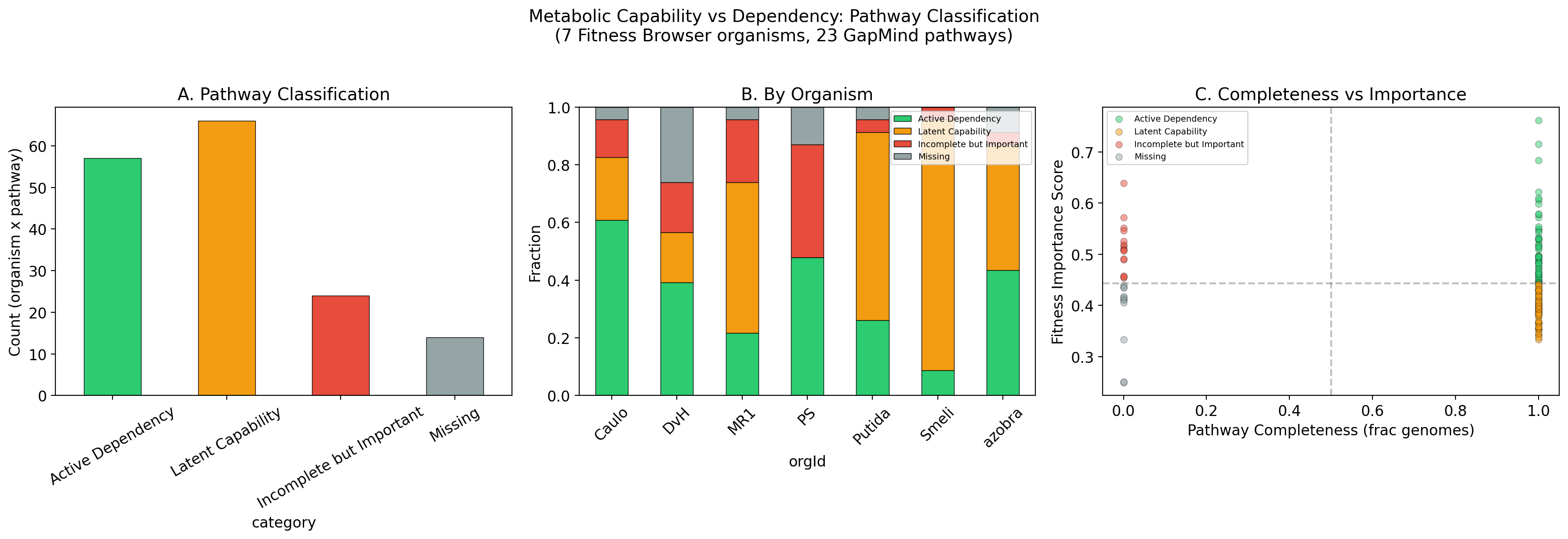 Four-category overview. From pathway_capability_dependency.
The composite importance score weighted essentiality (fraction of pathway genes that are putative essentials) at 40%, fitness breadth (fraction of conditions with significant phenotype) at 30%, and fitness magnitude (severity of the worst fitness defect) at 30%. Breadth was incorporated at 30% because the fitness_effects_conservation project found that fitness breadth predicts conservation better than magnitude. Fitness Browser genes were mapped to GapMind pathways through Fitness Browser-native KEGG annotations using the besthitkegg-to-keggmember-to-EC-to-KEGG-map-to-GapMind pathway route, rather than the pangenome link table approach. A pathway counted as complete when GapMind predicted it complete in >50% of conspecific genomes, and as fitness-important when its composite importance score exceeded the data-driven median threshold. 1
Latent capability is condition-dependent
Condition-type stratification, which separated fitness effects by nitrogen source, carbon source, stress, and other conditions, showed that all 66 Latent Capability organism-pathway pairs in the 7-organism Tier 1 analysis became fitness-important under at least one condition type. Nitrogen limitation, stress, and carbon limitation were the most frequent triggers, indicating that the aggregate laboratory classification reflects tested conditions rather than permanent dispensability. Condition-type shifts are shown in tier1_condition_type_shifts.png and fig5_condition_type_shifts.png. The report states that this stratification was motivated by the core_gene_tradeoffs finding of 28,017 genes costly in the lab but conserved in nature, and that it revealed all Latent Capabilities become important under stress or limitation. The report draws a Black Queen Hypothesis implication that remains a hypothesis: pathway gene loss may be constrained by the breadth of environmental conditions a species encounters, not just mean fitness under any single condition. 1
The report cautions that this result is partly affected by the median-based importance threshold: by construction it splits pathways approximately 50/50 into important and not-important categories, so with enough condition types and a median threshold applied to each subset, some pathways will inevitably cross the threshold. The report proposes that calibrating against an independent validation set, such as known essentials from essential_metabolome, would provide a more defensible threshold; until then, not every reclassification should be treated as biological confirmation. 1
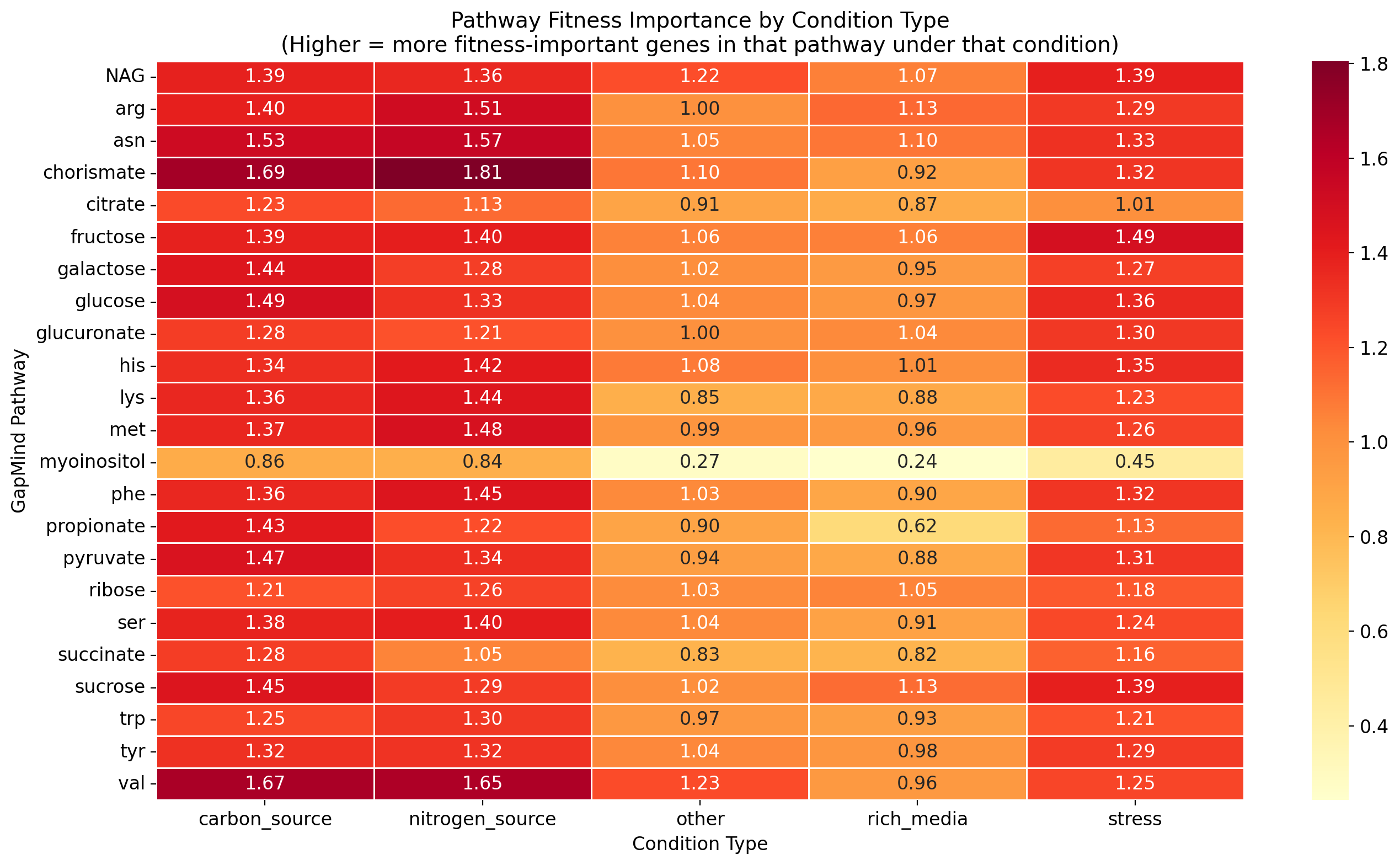 Condition-type shifts. From pathway_capability_dependency.
Active Dependencies are slightly more conserved
Active Dependencies had mean core gene completeness of 0.986, compared with 0.975 for Latent Capabilities. The small difference was attributed partly to the use of well-studied model organisms with near-complete, well-annotated core genomes, which compresses the gap between categories. Conservation by category is shown in fig2_conservation_by_category.png. 1
The Tier 1 organisms were Desulfovibrio vulgaris Hildenborough, Shewanella oneidensis MR-1, Pseudomonas putida KT2440, Pseudomonas stutzeri RCH2, Caulobacter crescentus, Sinorhizobium meliloti, and Azospirillum brasilense. Their Fitness Browser short labels were DvH, MR1, Putida, PS, Caulo, Smeli, and azobra, respectively. Because these 7 are well-studied model organisms with near-complete, well-annotated core genomes, the conservation gap between Active Dependencies and Latent Capabilities is small. Only 7 of the 48 Fitness Browser organisms had matching GapMind genome data, and across them 23 GapMind pathways had sufficient gene-level annotation to classify, which limited the analysis to 161 organism-pathway pairs. The pilot step that identified these 7 organisms also flagged GapMind coverage gaps, noting that Escherichia coli was absent. 1
Variable pathways correlate with open pangenomes
Across 2,810 GTDB species with at least 10 genomes, variable pathway count (pathways present in 10-90% of genomes) had a raw Spearman correlation with pangenome openness (fraction of accessory gene clusters) of rho=0.327, p=7.2e-71. The partial Spearman correlation controlling for genome count was rho=0.530, p=2.83e-203, supporting the hypothesis that species with more pathway variation tend to have more open and fluid pangenomes. The report goes further and suggests that metabolic pathway gain and loss is a major driver of pangenome dynamics; that causal reading remains an inference from correlation, not a tested mechanism. The report treats genome count as a critical confounder because species with more sequenced genomes may appear to have more variable pathways simply from sampling depth. Pathway conservation versus openness is shown in pathway_conservation_vs_openness.png. 1
The pathway-openness signal was positive in 13 of 18 genera tested and statistically significant at p<0.05 in 5 of 18 genera: Clostridium, Eubacterium, Mesorhizobium, Pseudomonas, and Streptomyces. The strongest within-genus correlations were rho=0.534 for Clostridium and rho=0.506 for Eubacterium, and smaller per-genus sample sizes limited statistical power for many groups. 1
The report states that the pathway-openness relationship holds in the majority of genera with sufficient species (≥20 species per genus) and suggests that it reflects a general evolutionary dynamic rather than a clade-specific artifact; this broader reading remains a hypothesis, since significance was reached in only 5 of 18 genera. Full phylum-level stratification was not performed—it would require joining the GTDB taxonomy table—so genus-level grouping from GTDB species clade names served as a conservative phylogenetic control. Pathway conservation by genus is shown in pathway_conservation_by_genus.png. 1
The Tier 2 analysis of 2,810 GTDB species with at least 10 genomes in the pangenome database covered 80 GapMind pathways—18 amino acid biosynthesis pathways and 62 carbon-source utilization pathways—using data extracted from the KBase Data Lakehouse covering 293,000 genomes. The report presents pathway variability as a mechanistically interpretable correlate of pangenome openness, contrasting with the null relationships between openness and broader environment or phylogeny effect sizes reported by the pangenome_openness project. 1
Accessory genes contribute to amino acid biosynthesis
Core-only versus all-gene GapMind completeness showed the largest accessory-dependent gaps for amino acid biosynthesis. Leucine biosynthesis had all-gene completeness 0.614, core-only completeness 0.468, and a gap of 0.146; valine had 0.614, 0.468, and 0.146; arginine had 0.613, 0.472, and 0.141; lysine had 0.804, 0.664, and 0.140; and threonine had 0.803, 0.663, and 0.140. Carbon-source utilization pathways tended to show smaller gaps; the report speculates, without testing, that carbon catabolism genes are either universally present or universally absent rather than variably distributed. Core versus accessory completeness is shown in fig3_core_accessory_pathways.png and core_vs_all_pathway_completeness.png. 1
These exact core-versus-all differences indicate that pathway completeness for these amino acid biosynthesis routes depends partly on genes outside the universally conserved core. The report summarizes that for the top 5 accessory-dependent pathways (leucine, valine, arginine, lysine, threonine), approximately 14% of species-level pathway completeness comes from accessory genes, meaning that different strains within a species have different biosynthetic capabilities. The report interprets this distribution as consistent with Black Queen dynamics and as a potential basis for community-level sharing of leucine, valine, arginine, and lysine biosynthetic capacity, while noting that the analysis does not itself demonstrate metabolite exchange. The report also sets these variable accessory pathways against the metal_fitness_atlas finding that fitness-important genes are enriched in the core genome (OR=2.08). 1
Metabolic ecotypes track pangenome openness
Among 225 species with at least 50 genomes and at least 3 variable pathways, binary completeness profiles across 80 pathways were clustered using hierarchical clustering with Jaccard distance. The median number of metabolic ecotypes was 4 per species, and the maximum was 8, observed in Alistipes onderdonkii and Barnesiella intestinihominis, both gut commensals with substantial intraspecific metabolic diversity. The number of ecotypes per species was set by cutting each dendrogram at 50% of maximum distance. 1
Ecotype count correlated with pangenome openness at raw Spearman rho=0.262, p=6.8e-05, and at partial rho=0.322, p=8.0e-07 after controlling for genome count. This supports the interpretation that within-species metabolic diversity is associated with genome fluidity rather than being explained only by sampling depth. In the report’s summary, within-species pathway variation defines 2-8 metabolic ecotypes per species. Ecotype count versus openness is shown in fig4_ecotype_openness.png and ecotype_count_vs_openness.png. 1
Relationship to fitness conservation
The report connects its findings to prior KBase Data Lakehouse results: 87.4% of metal-fitness genes were core, with OR=2.08 for enrichment; 28,017 genes were costly in laboratory conditions but conserved in nature; and field-important genes were 83.6% core compared with a 76.3% baseline. These comparisons frame Active Dependencies and accessory-dependent pathways as pathway-level extensions of broader fitness-conservation and condition-dependent-fitness patterns. 1
The report records how prior results shaped its methods. From the finding that 87.4% of metal-fitness genes are core (OR=2.08), it adopted an OR-based conservation validation and cross-species aggregation framework. It cites a 16pp fitness-conservation gradient as establishing that conserved genes are functionally active, not inert. From the finding that field-important genes are 83.6% core versus a 76.3% baseline, it adopted condition-type stratification (carbon/nitrogen/stress) for fitness aggregation. 1
At the module level, the report cites co-inheritance with co-fitness in 73% of accessory modules as validating pathway-level fitness aggregation. It contrasts a prior null result, that module family breadth does not predict conservation, with its own pathway-level analysis, in which variability rather than breadth is the informative metric. 1
Data and Workflow
The analysis drew on kbase_ke_pangenome.gapmind_pathways (305M rows), kescience_fitnessbrowser.genefitness (27M rows), kescience_fitnessbrowser.experiment (7.5K experiments), and kescience_fitnessbrowser.besthitkegg (KEGG annotations), with ~3.9 GB cached locally across all extracts. The work ran in 5 notebooks (NB01 on JupyterHub, NB02-05 local) and produced 5 publication-quality synthesis figures plus supporting visualizations. The report authors are Dileep Kishore and Paramvir Dehal. 1
Caveats
- Fitness Browser coverage limited Tier 1 to 7 of 48 organisms with matching GapMind data, and these model organisms had near-complete core genomes that compressed the conservation-validation signal. 1
- GapMind covered 80 pathways—18 amino acid biosynthesis pathways and 62 carbon-source utilization pathways—but did not assess cofactor biosynthesis, lipid metabolism, or secondary metabolism. 1
- Laboratory fitness does not capture the full range of natural selective pressures; the report specifically notes that 28,017 genes were costly in laboratory conditions but conserved in nature. 1
- KEGG-based mapping can miss genes lacking KEGG annotations or carrying incorrect annotations, potentially underestimating the number of genes assigned to a pathway. 1
- Ecotype counts depend on hierarchical clustering with a fixed 50% maximum-distance cut; different thresholds would produce different counts, so the median of 4 should be treated as an order-of-magnitude estimate. 1
- Correlations were controlled for genome count and checked within taxonomic groups, but full phylogenetic independent contrasts were not computed. The related ecotype_analysis project found that phylogeny dominates gene content in 60.5% of species, and the report cautions that metabolic ecotypes may partially reflect intra-species phylogenetic structure. 1
- Species with more sequenced genomes are more likely to show pathway variation and more ecotypes; partial correlations reduce but do not eliminate this sampling bias. 1
- The median-based importance threshold is circular for condition-specific reclassification, because applying a median threshold to each subset can cause pathways to cross it. An independent validation set, such as known essentials from essential_metabolome, would provide a more defensible threshold. 1
- The proposed correlation between metabolic ecotypes and AlphaEarth environmental niche breadth was not executed. AlphaEarth embeddings covered 28% of genomes, or 83K/293K, which would limit the available sample size. 1
Slots Into
- condition-specific-fitness — the finding that all 66 aggregate Latent Capability pairs became fitness-important under at least one condition type, while the threshold caveat motivates independent validation. 1
- metabolic-model-gapfilling — the comparison of GapMind pathway completeness with fitness evidence, including 24 Incomplete but Important pairs that may reflect annotation gaps or salvage routes. 1
- pangenome-integration — the partial Spearman relationship between variable pathway count and pangenome openness, rho=0.530 and p=2.83e-203 after controlling for genome count. 1
- ecotype-environment-gene-content — the identification of 2–8 metabolic ecotypes per species and the partial ecotype-openness correlation of rho=0.322, p=8.0e-07. 1
- gene-essentiality — the four-way classification combining pathway completeness with gene-level essentiality and fitness breadth. 1
- computational-pathway-prediction-validation — GapMind completeness checked against fitness evidence across 161 pairs, with >50% completeness and median-importance thresholds and 24 Incomplete but Important pairs. 1
- biosynthetic-prototrophy-and-auxotrophy — accessory-dependent amino acid biosynthesis completeness and the Incomplete but Important category. 1
- laboratory-fitness-versus-natural-selection — the cited 28,017 lab-costly but nature-conserved genes and the condition-breadth hypothesis for pathway gene loss. 1
- condition-dependent-gene-tradeoffs — the hypothesis that condition breadth, not mean single-condition fitness, constrains pathway gene loss. 1
- pangenome-conservation-fitness-decoupling — Active Dependency versus Latent Capability core completeness of 0.986 versus 0.975, compared with OR=2.08 for metal-fitness genes. 1
- pangenome-core-boundary-and-clade-size-bias — near-complete model-organism core genomes compressing the conservation contrast. 1
- pangenome-openness-determinants — pathway variation (partial rho=0.530) and ecotype count (partial rho=0.322) as openness correlates, against the cited null for environment and phylogeny effect sizes. 1
- phylogenetic-confounding-of-pangenome-associations — genus-level controls (significant in 5 of 18 genera) without phylum-level stratification or phylogenetic independent contrasts. 1
- two-speed-bacterial-genome — larger core-versus-all completeness gaps for amino acid biosynthesis than for carbon-source utilization. 1
- community-metabolic-interdependence — leucine, valine, arginine, and lysine proposed as candidates for community-level sharing, not demonstrated exchange. 1
- ecotype-clustering-validity — ecotype counts depending on Jaccard hierarchical clustering with a 50% of maximum distance cut. 1
- gene-function-acquisition-depth — the evidence that accessory genes contribute to pathway completeness, with exact gaps of 0.146 for leucine and valine and 0.141–0.140 for arginine, lysine, and threonine biosynthesis. 1
- sampling-depth-and-downsampling-effects — species with more sequenced genomes are more likely to show pathway variation and more ecotypes, and genome-count partial correlations mitigate but do not fully eliminate this bias. 1
- environment-embedding-geography — the planned correlation of metabolic ecotypes with AlphaEarth environmental niche breadth was not executed, and AlphaEarth embeddings cover only 28% of genomes (83K/293K). 1
- lab-field-fitness-concordance — the cited finding that field-important genes are 83.6% core versus a 76.3% baseline, which motivated carbon/nitrogen/stress condition-type stratification. 1
- module-level-coinheritance — co-inheritance with co-fitness in 73% of accessory modules cited as validating pathway-level aggregation, alongside the null result that module family breadth does not predict conservation. 1