Two pathway-level analyses disagree on whether metabolic pathways that organisms actively depend on are more conserved across their pangenomes than pathways they carry but do not depend on (latent capabilities). Gene-level work associates essentiality and strong fitness effects with higher core fractions. 1,2,3,4 The disagreement decides whether that gradient carries over to whole pathways, or whether pathway carriage follows a different logic, such as pathway variability tracking pangenome openness, the degree to which a species’ pangenome keeps acquiring new genes. It bears on condition-specific-fitness, gene-essentiality, ecotype-environment-gene-content and pangenome-conservation-fitness-decoupling.
Evidence Sides
Latent capabilities are no less conserved than active dependencies. Latent complete pathways had mean conservation 0.869 versus 0.829 for active dependencies. The test of active greater than latent was not significant (p = 0.94; a p-value is the probability, assuming no true difference, of a result at least this extreme in the tested direction). 1 This null result runs against gene-level analyses, which associate essentiality and strong fitness effects with higher core fractions. 1,2,3,4 In the same study, the latent rate tracked openness. 1,5,6 The metric here is complete-pathway carriage across species genomes. 1,5
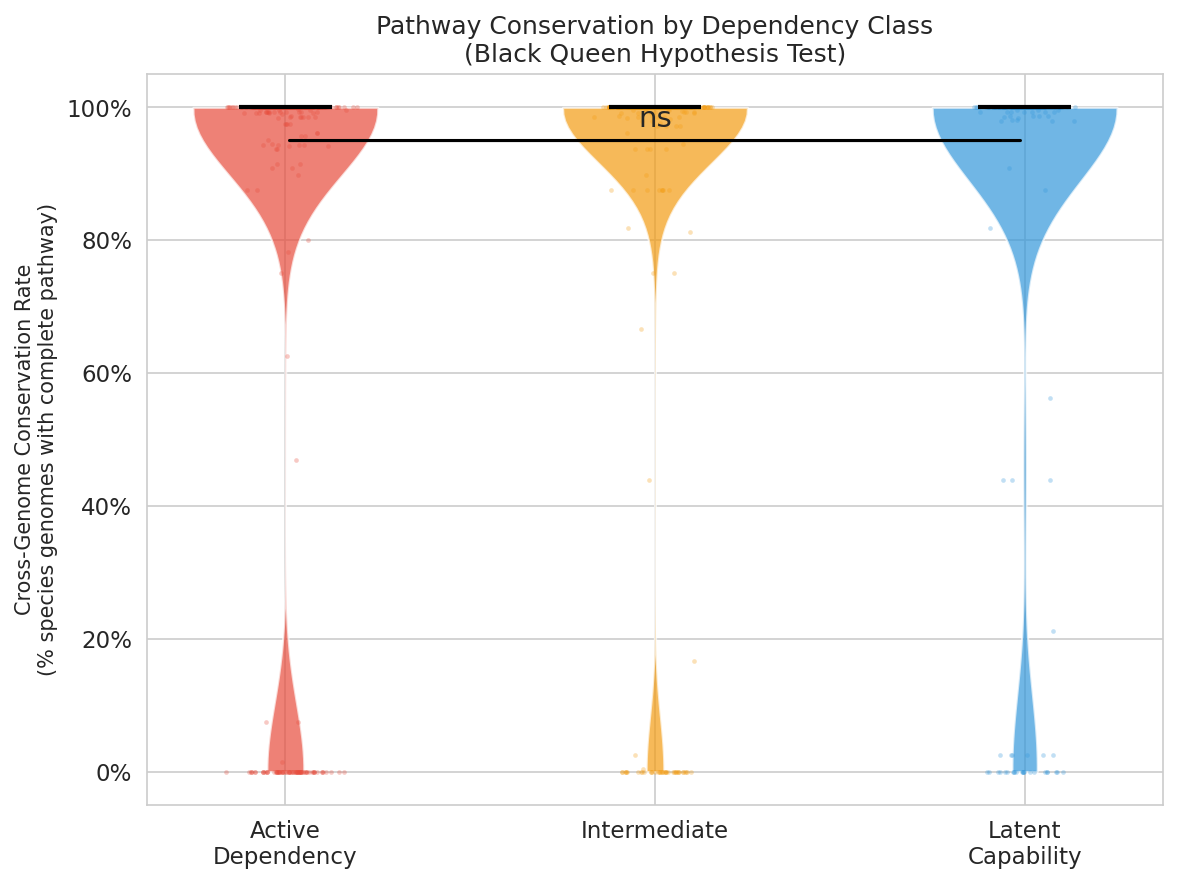 Pathway conservation by dependency class. From metabolic_capability_dependency.
Active dependencies are slightly more core. A newer analysis found mean core gene completeness of 0.986 for Active Dependencies versus 0.975 for Latent Capabilities. 5 This comparison covered only 7 matched model organisms with near-complete core genomes, which compresses the comparison. 5 The larger analysis in that work links pathway variability, not pathway dependency, to openness. 5 Separately, plant growth-promoting (PGP) genes were mostly more core than the 46.8% baseline. 1,5,6
Evidence that does not settle it. National Microbiome Data Collaborative (NMDC) community data showed negative leucine and arginine associations. These do not resolve the tension, because GapMind, a pathway-completeness predictor, measures genomic potential rather than expression or essentiality, and abiotic controls were unavailable. 7
The two sides use different metrics, and both differences are small. Neither side is preferred here. 1,5
Possible Reconciliations
- Hypothesis: the sides disagree because they measure different things. Complete-pathway carriage across genomes and the core completeness of a pathway’s genes may diverge even when the underlying biology is the same.
- Hypothesis: the near-complete core genomes of the 7 model organisms leave little room for any difference, so the newer direction may not generalize. 5
- Hypothesis: the gene-level gradient holds for individual genes but is diluted at the pathway level, where pangenome openness drives pathway variability more than dependency does.
Resolving Work
- Apply both metrics, complete-pathway carriage and core gene completeness, to the same organism set. This would test whether the opposite directions are an artifact of metric choice.
- Extend the dependency classification beyond model organisms to species with open, incompletely annotated pangenomes. This would test whether near-complete genomes compress the active-versus-latent gap.
- Within each organism, compare core fraction for genes in active-dependency pathways against genes in latent pathways, matched by fitness category. This would test whether the gene-level gradient survives aggregation into pathways.
- Model latent rate jointly on pangenome openness and dependency class. This would test whether openness, not dependency, explains conservation differences.
- Pair NMDC GapMind completeness with metatranscriptomic data (community-wide RNA sequencing that measures which genes are expressed) and abiotic covariates. This would test whether the leucine and arginine associations reflect dependency or only genomic potential.