Two lines of evidence in ecotype-environment-gene-content diverge on what pangenome openness signals. Openness is the share of a species’ gene content that is accessory (variable between strains) rather than core 1,2,3. Metabolic-capability analyses report that more open pangenomes carry more latent or variable metabolic pathways 1,2,3. These correlations do not directly measure ongoing gene gain or loss. They only suggest the hypothesis that open pangenomes are where metabolic gene content is actively reshuffled 1,2,3. The openness analysis reports that openness does not predict environment or phylogeny effect sizes 1,2,3. This matters because the concept page treats environment-linked gene content as a core theme. If openness reflected metabolic turnover that follows habitat, it should mark species whose gene content tracks environment. On the effect-size metrics tested, it does not.
Evidence Sides
Side A: openness correlates with latent and variable metabolic pathways. Latent capability rate is the fraction of complete pathways that are fitness-neutral 1,2,3. It correlated with openness at ρ = 0.69, p = 0.0004, n = 22 1,2,3. Here ρ is the Spearman rank correlation, a nonparametric measure of monotonic association. The p-value (p) is the probability of a correlation at least this strong if no association existed, and n is the number of units analysed. Variable pathway count also correlated with openness, with partial rho=0.530, p=2.83e-203 1,2,3. A partial correlation is one computed after controlling for a confounding covariate. The tension text gives no sample size for this second correlation. Neither correlation directly measures gene turnover over time.
Side B: openness does not predict environmental or phylogenetic structuring. Openness did not predict environment or phylogeny effect sizes, with rho = -0.05 and 0.03 and p-values 0.54 and 0.73 1,2,3. These are null results. They show no detectable association; they do not establish that none exists. The tension text gives no sample size for this comparison.
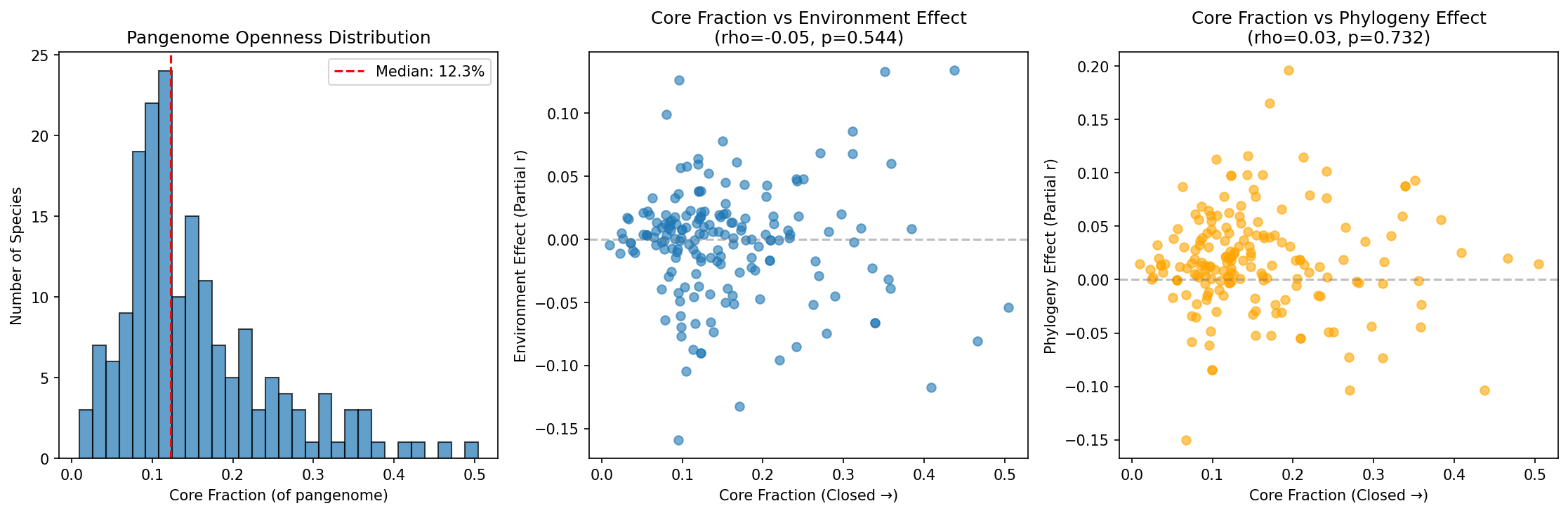 Pangenome Openness vs Effects. From pangenome_openness.
Possible Reconciliations
- Hypothesis 1: Metabolic turnover in open pangenomes may be driven by community context or nutrient availability, not by the habitat categories behind the environment effect-size metric. If so, openness could track pathway variation without tracking environmental structuring.
- Hypothesis 2: The analyses may differ in scale and sampling. Side A includes an estimate with n = 22 1,2,3. Side B’s sample size is not stated in the tension text. The divergence may partly reflect different species sets rather than a biological conflict.
Resolving Work
- On the same species set, use a Spearman correlation and a partial correlation adjusted for genome count to test whether variable pathway count predicts the environment effect size directly. This would show whether the two sides disagree on matched data.
- Split the environment effect size into metabolic and non-metabolic accessory gene families, then regress each on openness. This would test whether a metabolic signal is diluted when all gene families are pooled.
- Restrict to the clades that have both fitness data and environment metadata, and test whether latent capability rate predicts environment effect size. This would show whether fitness-neutral pathways are environment-linked.
- Within single species, group strains by shared pathway-presence profiles and compare those groups against sample habitat labels. This would ask whether pathway variants in open pangenomes sort by environment at finer scale than species-level effect sizes capture.