On metabolic-model-gapfilling, latent capabilities are genomically complete pathways that show no detectable fitness importance under the conditions tested. 1,2 Pangenome openness is the share of a species’ gene clusters that are accessory rather than core. 1,2 The two lines of evidence point in different directions. Conservation did not differ significantly between active and latent pathways (p-value, the probability of a result this extreme under no effect, p = 0.94). Openness did track latent and variable pathways. The supporting statistics are a Spearman rank correlation (ρ or rho, a measure of how consistently two quantities rise together in rank order) and a partial correlation, which adjusts for a covariate (ρ = 0.69, p = 0.0004, n = 22, where n is sample size; partial rho=0.530, p=2.83e-203). 1,2 The tension matters for whether a complete pathway can be read as one an organism depends on. The corpus also reports three latent fractions, 41.0%, 35.4%, and 15.8%, which come from different analyses and must not be averaged. 3,2,1
Evidence Sides
Conservation side: no statistically significant active-versus-latent difference. Comparing the conservation of active and latent pathways gave a non-significant result (p = 0.94). 1,2 This is a null result. It neither shows that conservation is equal nor that latent pathways are less conserved than pathways the organism depends on.
Openness side: latency and pathway variability track openness. The latent rate correlated with pangenome openness (ρ = 0.69, p = 0.0004, n = 22 species clades). 1,2 Variable pathway count also correlated with openness in a partial correlation (partial rho=0.530, p=2.83e-203). 1,2
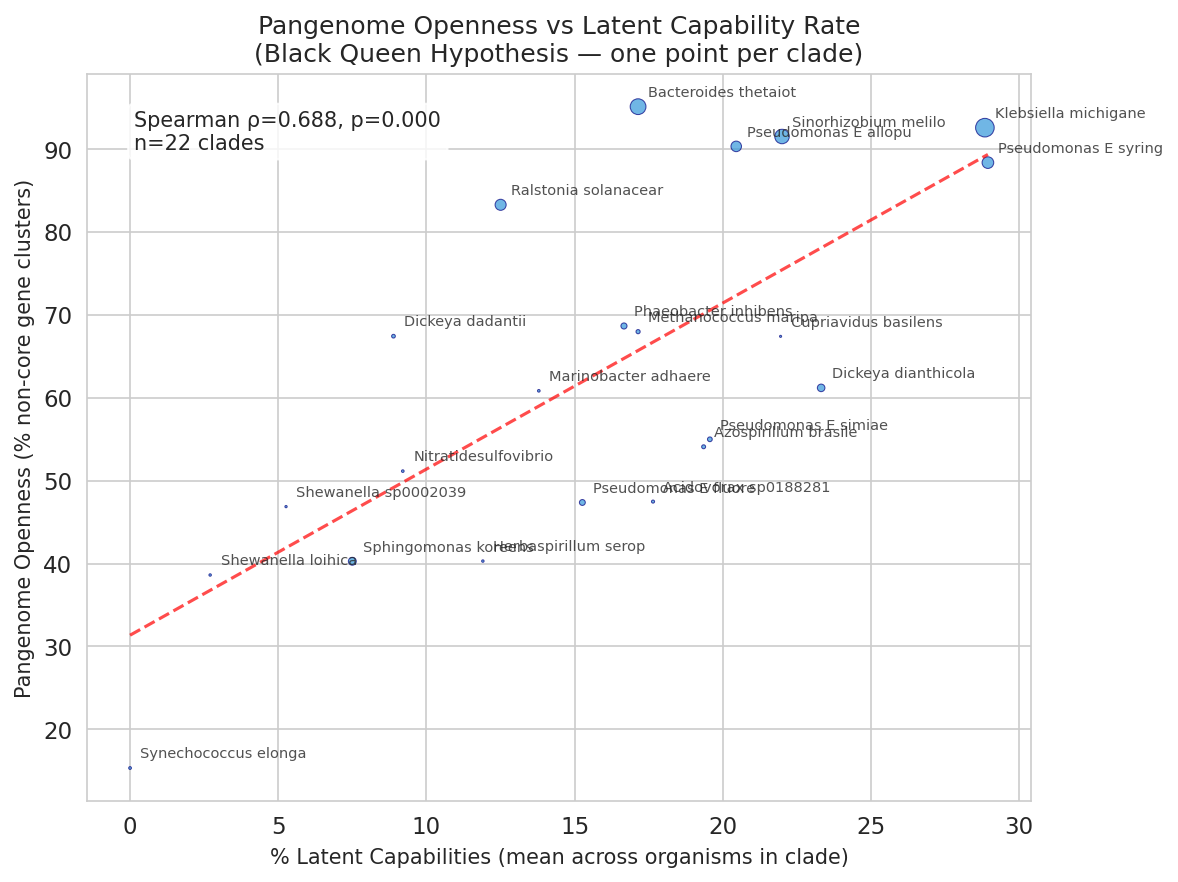 Pangenome openness vs latent capability rate. From metabolic_capability_dependency.
Non-comparable latent fractions. The figures 41.0%, 35.4%, and 15.8% are reported as latent fractions from different analyses and must not be averaged. 3,2,1 The source excerpts do not label 35.4% as a latent share. This page records that discrepancy and does not resolve it.
Possible Reconciliations
- Hypothesis: the analyses work at different scales. Conservation was compared across pathway-organism pairs, while openness was correlated across species clades or species. 1,2 A clade-level pattern need not appear as a pathway-level conservation difference.
- Hypothesis: “latent” depends on context. A pathway that is neutral under the tested conditions may matter under stress or nutrient limitation. That could blur a conservation contrast without removing the openness correlations.
- Hypothesis: the latent fractions differ because the projects used different organism sets, pathway sets, and classification thresholds, not because they disagree about biology.
Resolving Work
- Data: the per-pair classifications from both pathway projects. Method: re-run the active-versus-latent conservation test within each clade, with the same unit of analysis as the openness correlation. Question: does a conservation difference appear once the scale matches?
- Data: Fitness Browser stress, nitrogen-limitation, and carbon-limitation experiments. Method: reclassify latent pathways by condition type. Question: does the conservation null persist when the label is specific to a condition?
- Data: the classification rules of all three analyses. Method: audit which category each of 41.0%, 35.4%, and 15.8% denotes, with its denominator and thresholds. Question: are these three figures actually comparable latent fractions? 3,2,1
- Data: pangenome openness together with per-gene core or accessory status. Method: model the latent rate against openness and gene-level conservation jointly. Question: does openness predict latency independently of conservation?