This hub covers how the corpus reads metabolic traits from genomes. It asks which biosynthetic and catabolic pathways organisms encode, where pathway gaps suggest auxotrophy (dependence on an externally supplied nutrient), and whether communities share metabolites so that members can lose costly functions. The corpus pairs GapMind, a predictor of pathway completeness, with measured gene-fitness data 1,2. It also draws on growth curves 3, community metabolomics 4 and environmental occurrence surveys 5. The recurring lesson is that a complete pathway is evidence of potential, not of use or need 6,2.
Literature Context
Work outside this corpus treats metabolite exchange as common among bacteria, while noting that it sits uneasily with evolutionary theory. A review of literature from the early 2000s to late 2017 describes bacteria exchanging vitamins, amino acids, nucleotides and growth factors, often in obligate interactions, and asks why an organism would pay to benefit others. It cites empirical work showing that trading genotypes can outperform non-trading cells PMID 29799048. Experimental support comes from Escherichia coli mutants lacking biosynthetic genes for one, two or three amino acids. In competition with prototrophic wild type, the fitness of these mutants depended strongly on environment and genetic background, and the gains decelerated as more functions were lost. In the same study, analysis of 1,432 eubacterial metabolic networks found that pairs of auxotrophies co-occurred more often than expected by chance PMID 25765095.
Up to half of Arabidopsis thaliana leaf isolates required biotin, niacin, pantothenate and/or thiamine. Most auxotrophs stored enough coenzyme for 1-3 doublings without supplementation, and one strain reached up to 9 doublings on biotin PMID 35987782. In methanogenic alkane-degrading consortia, vitamin and amino-acid auxotrophy was inferred from metagenome-assembled genomes rather than growth tests. The authors propose that “public goods” shape the assembly of these consortia PMID 29104938. Isotope tracing in a yeast–Lactococcus lactis co-culture confirmed essential amino-acid supply to the bacterium and revealed a more complex amino-acid exchange PMID 36779294. In Synechococcus sp. PCC 7002, bioinformatics suggests that only the methionine synthase MetH needs cobalamin. Heterologous metE relieved the auxotrophy, suggesting that methionine synthesis is probably its sole use of cobalamin PMID 27457714. Phenotype MicroArray protocols advise screening strains for auxotrophies before profiling PMID 25343861.
The corpus’s central lesson, that a complete pathway shows potential rather than use, is consistent with these studies. The environment-dependent fitness of E. coli auxotrophs PMID 25765095 fits the corpus split in biosynthetic-prototrophy-and-auxotrophy. That split separates Active Dependency (complete, fitness-important pathways) from Latent Capability (complete pathways without significant fitness defects under standard conditions). The cobalamin complementation PMID 27457714 illustrates the kind of test needed for the inferred serine gap in Desulfovibrio vulgaris Hildenborough, which the corpus treats as a computational hypothesis. The NMDC result in community-metabolic-interdependence extends the literature. It tests the Black Queen Hypothesis, which holds that costly functions can be lost when community members supply them as public goods, in environmental samples rather than in defined co-cultures. However, 125 of 131 samples (95%) come from one study. In 11 of 13 testable pathways, community pathway completeness correlated negatively with ambient amino-acid intensity (sign-test p = 0.011). Only leucine and arginine survived FDR (false-discovery-rate) correction, and in a soil-only re-run arginine lost significance (q = 0.117, n = 78) while leucine was unchanged.
A pristine-estuary study (n = 50 sediments) offers context rather than a direct test. Its 24 correlated gene-metabolite pathways correlated positively with community metabolic outputs, including tryptophan and histidine PMID 33798899. That study measured different quantities in a different habitat, so it neither confirms nor contradicts the corpus signal. Within the corpus, tyrosine also ran positive (r = +0.419, n = 26, q = 0.117, not significant).
What the Corpus Shows
Pathway completeness is potential, not dependence. A seven-organism pilot found 17 of 18 amino-acid biosynthesis pathways complete in all 7 organisms 6. The exception was serine, missing only in Desulfovibrio vulgaris Hildenborough (17/18 pathways, 94.4%) 6. That apparent serine auxotrophy is a computational hypothesis that may reflect pathway-detection limits 6. Pairing completeness with fitness data shows why completeness alone is insufficient. Complete pathways split into Active Dependency (fitness-important) and Latent Capability (no significant fitness defects under standard conditions), while incomplete pathways could still contain fitness-important genes 1. Across 161 organism–pathway pairs, 57 (35.4%) were Active Dependency, 66 (41.0%) Latent Capability, 24 (14.9%) Incomplete but Important and 14 (8.7%) Missing 1. A broader analysis of 1,695 complete pairs from 48 organisms supports this split: 267 (15.8%) were latent, 547 (32.3%) intermediate and 881 (51.9%) active 2. Carbon-source pathways were latent more often than amino-acid pathways (24.3% versus 6.5%), and the latent fraction ranged from 4.7% to 21.1% across 16 threshold combinations 2. Details are in biosynthetic-prototrophy-and-auxotrophy.
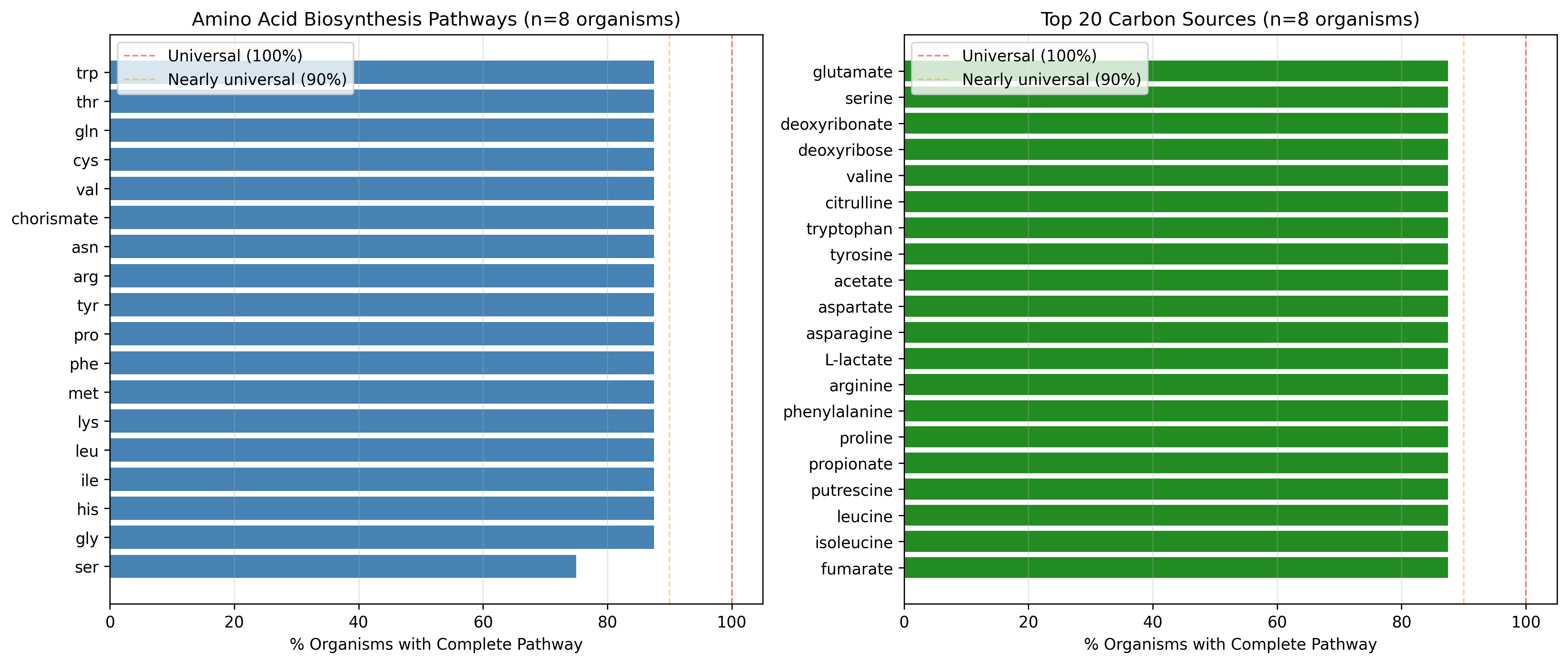 Pathway completeness visualization. From essential_metabolome.
Cultured collections may miss the most self-sufficient lineages. biosynthetic-self-sufficiency-and-cultivation tests whether cultured deep-clay genomes are unusually biosynthetically self-sufficient. Unfiltered, the 9-genome deep cohort averaged 16.22/18 complete amino-acid pathways against 16.66/18 for a 150-genome soil baseline, not significant (p = 0.153; Cohen’s d, a standardized effect size, = −0.17) 7. After CheckM filtering (a genome quality screen) for completeness ≥80% and contamination ≤5%, the 6 remaining deep genomes scored lower than the 137 baseline genomes: 15.50/18 versus 17.14/18, p = 0.009, d = −0.84 7. The report does not read this as evidence against subsurface self-sufficiency 7. It suggests the hypothesis that the cultured KBase Data Lakehouse cohort lacks extreme lineages such as Ca. Desulforudis audaxviator 7, which are typically recovered as MAGs (metagenome-assembled genomes) or single-cell genomes 7. The shallow cohort scored higher (17.87/18), which the report attributes to cultivation-quality selection while noting the metric saturates near 18 7.
Community dependence shows a directional Black Queen signal. The Black Queen Hypothesis (Morris et al. 2012) holds that costly genes can be lost when community members provide their functions as public goods 8. In NMDC metabolomics, 11 of 13 testable amino-acid pathways showed negative correlations between community pathway completeness and ambient amino-acid intensity (sign-test p = 0.011) 4. Only two survived FDR (false-discovery-rate) correction: leucine (r = −0.390, q = 0.022, n = 62) and arginine (r = −0.297, q = 0.049, n = 80) 4. Methionine had the largest effect (r = −0.496) but was underpowered at n = 18, q = 0.117 9. In a soil-only re-run, leucine was unchanged while arginine lost significance (q = 0.117, n = 78) 4. Leucine costs 37 ATP equivalents and arginine 26; linking that cost to gene loss is an untested interpretation 9. Habitat also structures community potential. In PCA (principal component analysis, projecting samples onto orthogonal axes of maximal variance) of a 220-sample × 80-pathway matrix, PC1 captured 49.4% of variance and separated Soil from Freshwater, mainly along carbon-utilization pathways 4. Seventeen of 18 amino-acid pathways differed across ecosystems (q < 0.05); tyrosine did not (q = 0.71) 4. See community-metabolic-interdependence and habitat-structured-community-metabolic-potential.
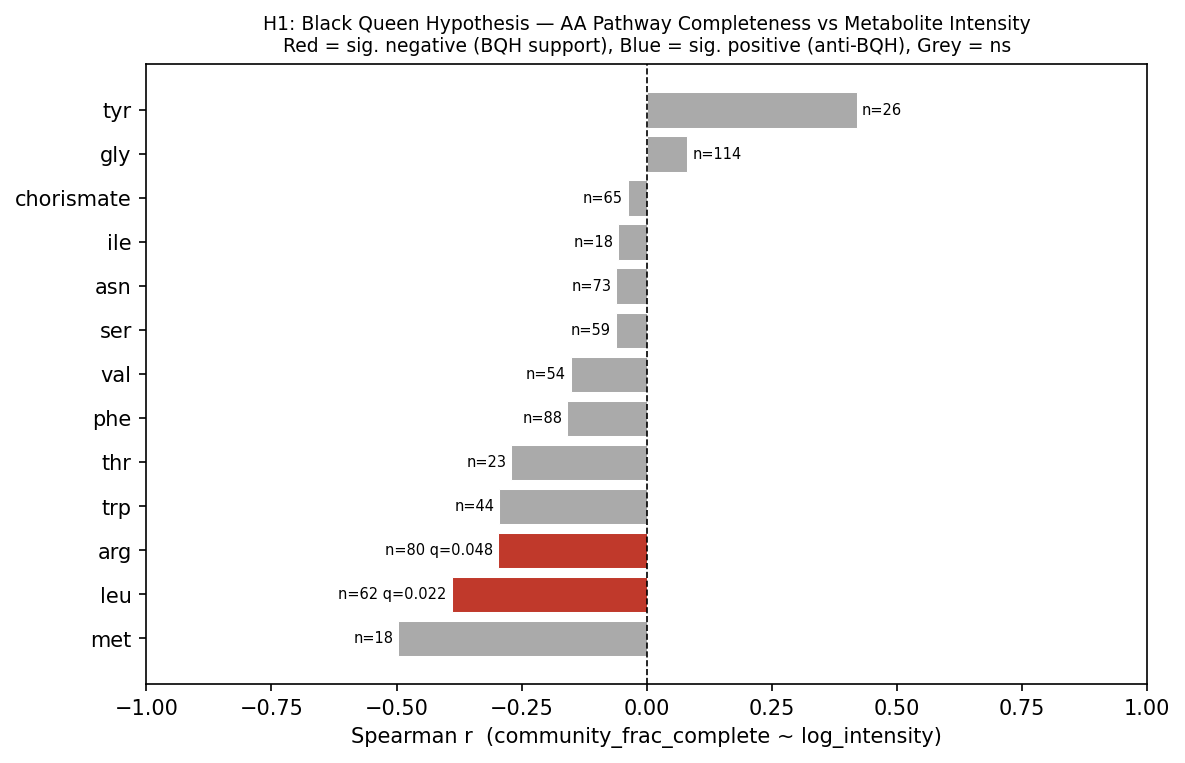 H1 BQH correlation barplot. From nmdc_community_metabolic_ecology.
Catabolic capacity is specialist and only partly callable. In the ENIGMA carbon census, among genomes carrying at least one of 8 ENIGMA-isolate-callable aromatic or alkaloid capacities, 675 carried exactly 1 and 18 carried at least 3, with a maximum of 4 5. These statistics still include xanthine, later recognized as mis-scored because its reaction represents nitrogen acquisition, not carbon catabolism; the tables were not regenerated 5. Capacity concentrated in Burkholderiales 5; see metabolic-capacity-specialization. Of 83 census compounds, 74 (89%) were “organism-dark”, unlinkable to a degrader through the queried resources, which the report treats as resource-darkness, not absence 5; see organism-dark-compounds. The census detected 83/86 genera in 1719 NMDC metagenomes but did not measure catabolic activity 5, as occurrence-versus-catabolic-activity explains. phaC, the polyhydroxybutyrate (PHB) synthase marker, occurred in 21.9% of 27,690 species in GTDB (the Genome Taxonomy Database), and PHB’s apparent link to niche breadth is largely explained by genome size 10. Its feast/famine tests are correlational and do not control for phylogeny 10; see phb-granule-ecology.
Predicting phenotype: capability more than kinetics, with explicit denominators. A gradient-boosted model reached a genus-blocked growth AUC (area under the receiver-operating-characteristic curve) of 0.620 on 46,389 genome × condition pairs from 727 genomes 3. Continuous kinetics carried little cross-genus signal 3; see capability-versus-kinetic-predictability. Pseudomonas anchors grew in 43-61% of tested conditions, against 23.5% for Pedobacter and 22.4% for Acidovorax 3. Active learning proposed 50 next conditions, but the benefit is unvalidated 3; see active-learning-experiment-selection. BacDive utilization counts ranged from 1 to 51 strains, and duplicate records per strain are not independent, so per-strain consensus (majority vote among each strain’s duplicates before computing species rates) is required 11; see sample-size-aware-phenotype-consensus. In Acinetobacter baylyi ADP1, Complex I (respiratory NADH:ubiquinone oxidoreductase; NADH is reduced nicotinamide adenine dinucleotide) accounted for 21/51 quinate-specific genes (41%), yet the strongest defects occurred on acetate and succinate 12. This supports the hypothesis that respiratory demand tracks NADH load rather than aromatic chemistry 12; see respiratory-capacity-and-nadh-load.
Tensions and Caveats
- What “latent” means. One account says all Latent Capabilities became fitness-important under some condition 9. The median-based threshold can produce that result by construction 1. A broader analysis instead finds a threshold-sensitive latent fraction 2. See conflicts/conflict—community-metabolic-interdependence—cdc57135.
- Weight of the 11/13 signal. One reading treats it as supportive 9. The other notes that sparse compound annotation and proxy metabolites leave it coverage-limited 9. See conflicts/conflict—community-metabolic-interdependence—732543c8. Separately, 125 of 131 samples (95%) come from one study 9, though the project argues the leucine and arginine results are not artefacts of study mixing 4. See conflicts/conflict—community-metabolic-interdependence—96c2ce9b.
- Tyrosine runs positive (r = +0.419, n = 26), though it did not survive FDR correction (q = 0.117) 4. This may reflect a different exchange regime or mapping limits 9. See conflicts/conflict—community-metabolic-interdependence—e7db3c77.
- Plant co-occurrence redundancy. The digest’s Cohen’s d = −7.54 9 is described by the project as largely a formula error 13. See conflicts/conflict—community-metabolic-interdependence—6a81cf0f.
- Deep-subsurface self-sufficiency. Bacillota_B gene-content expansion fits a self-sufficiency model, but GapMind completeness does not 14,7. The projects also disagree on whether Ca. Desulforudis audaxviator is in the analysed cohorts 14,7. See conflicts/conflict—biosynthetic-self-sufficiency-and-cultivation—0f75deea and conflicts/conflict—biosynthetic-self-sufficiency-and-cultivation—c7d73f43.
- NDH-2 compensation. One project reads Complex I dispensability on glucose and lactate as consistent with compensation by NDH-2, an alternative NADH dehydrogenase 12. An ADP1-specific analysis finds no significant cross-species compensation pattern 15. See conflicts/conflict—respiratory-capacity-and-nadh-load—3d728916.
- Load-bearing limits. Fitness-based classification covers only 48 organisms against approximately 293,000 genomes with pathway predictions 2. The active-learning rationale calls the “other” class (AUC 0.654) among the worst, although its own table ranks antibiotics (0.619) and metals (0.605) lower 3.
Where to Go Deeper
- biosynthetic-prototrophy-and-auxotrophy — start here for the capability-versus-dependency classification and the serine case.
- community-metabolic-interdependence — the full Black Queen test table and its caveats.
- biosynthetic-self-sufficiency-and-cultivation — cultivation bias and the deep-clay null.
- occurrence-versus-catabolic-activity — why detection of an organism does not show that it degrades a compound.
- capability-versus-kinetic-predictability — the limits of genotype-to-phenotype prediction.
- metabolic-capacity-specialization — the specialist structure of catabolic capacity.
- respiratory-capacity-and-nadh-load — energetic constraints on dependence.
Key entities: gapmind, kescience-fitnessbrowser, bacdive, gtdb, acinetobacter-baylyi-adp1.
Reports: Essential Metabolome: GapMind Pathway Analysis Across Essential-Gene Organisms, Metabolic Capability vs Dependency, Metabolic Capability vs Metabolic Dependency, Community Metabolic Ecology via NMDC × Pangenome Integration, Self-Sufficiency, Anaerobic Toolkit, and Cultivation Bias in Clay-Confined Cultured Bacterial Genomes, ENIGMA Carbon Census — Tiered Knowledge Census of 83 Enrichment Compounds, Genotype × Condition to Phenotype Prediction from ENIGMA Growth Curves.