Projects in this corpus applied formal phylogenetic corrections to pangenome association analyses, and the corrected results did not move in one consistent direction. In one project a corrected estimate grew stronger than the naive pooled estimate. In another, correction removed the enrichments. In a third, a positive but small effect remained 1,2,3. The projects also used different controls, so their outcomes are not directly comparable 4,5,1,3,6. This matters for phylogenetic-confounding-of-pangenome-associations. If the direction of the correction depends on the trait or on the control chosen, then no single corrected or uncorrected result can be taken as the default reading of a pangenome association.
Evidence Sides
Side 1: correction strengthened the association. The lanthanide atlas fitted a mixed model, a regression combining fixed effects with random effects for grouping levels, here phylum and family. This model gave a stronger estimate of xoxF dominance than naive pooling did. xoxF is the gene for the lanthanide-dependent methanol dehydrogenase 1,2,3.
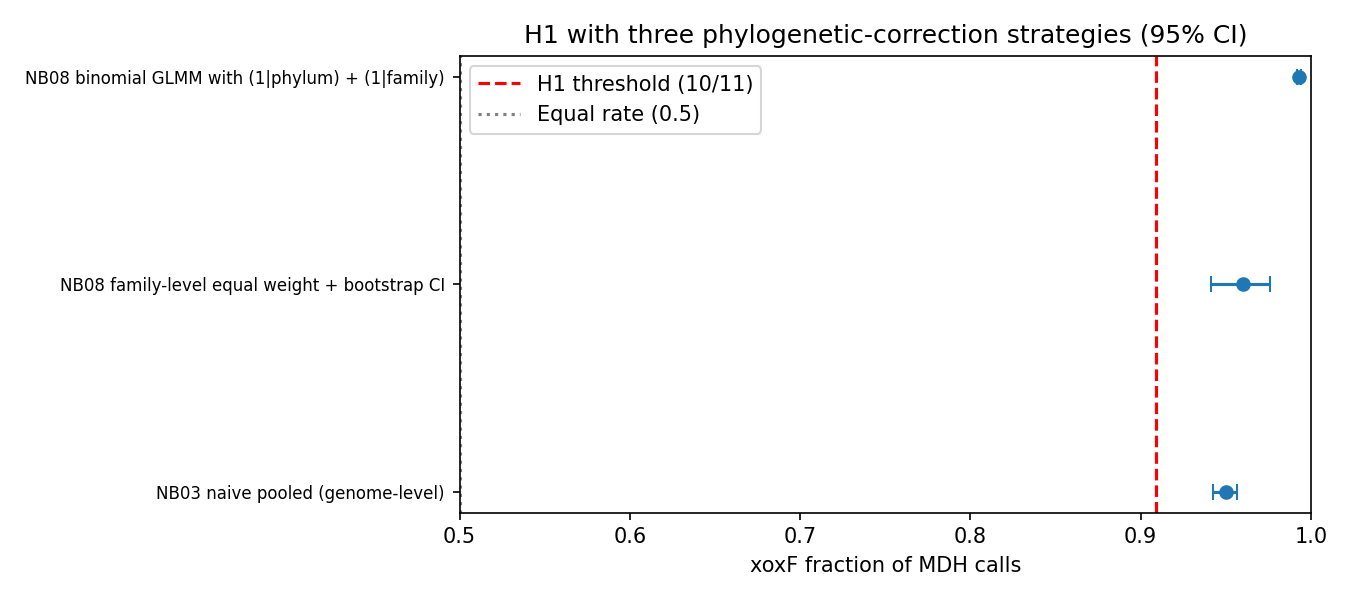 Phylogenetic-correction strategies — 95% CI comparison. From lanthanide_methylotrophy_atlas.
Side 2: correction removed the association. The clay study controlled for phylum by comparing genomes within each phylum. Under this control, the enrichments of the Wood–Ljungdahl pathway (anaerobic CO₂ fixation via acetyl-CoA) and of [NiFe]-hydrogenase (a hydrogen-cycling enzyme with a nickel–iron active site) disappeared 1,2,3.
Side 3: correction retained a small association. The metal ecology project used PGLS (phylogenetic generalized least squares, a regression whose error structure follows the phylogeny). PGLS kept a positive but small coefficient linking metal-type diversity to niche breadth 1,2,3.
Cross-cutting caveat: the controls differ. Across projects, the controls were:
- genus grouping;
- phylum fixed effects (a separate model term estimated for each phylum);
- family equal weighting;
- mixed models;
- PGLS;
- Sankoff parsimony, a method that reconstructs ancestral states by minimizing weighted change costs on a tree.
These controls make different assumptions, so the three outcomes above are not directly comparable 4,5,1,3,6.
Possible Reconciliations
- Hypothesis A: trait-specific confounding. Phylogenetic structure may hide a real signal for some traits, as with xoxF. For other traits it may create apparent signal, as with the Wood–Ljungdahl pathway and [NiFe]-hydrogenase. On this reading, the opposite directions reflect the biology of each trait, not the methods.
- Hypothesis B: method dependence. The direction may follow from the control used. Within-phylum stratification, mixed models and PGLS partition variance differently, so the same data could shift differently under each.
- Hypothesis C: grouping rank matters. Controls at the genus, family or phylum rank absorb different amounts of between-lineage variance. This could explain divergent outcomes without any real difference in biology.
Resolving Work
- Re-run the lanthanide xoxF dominance analysis with within-phylum stratification. This would test whether the strengthening survives the control that removed the clay enrichments.
- Fit phylum-and-family mixed models and PGLS to the clay study’s Wood–Ljungdahl and [NiFe]-hydrogenase enrichments. This would test whether their removal is specific to within-phylum control.
- Apply family equal weighting and genus grouping to the metal-type versus niche-breadth association. This would ask whether the small PGLS coefficient is stable across control choices.
- Build a shared benchmark that applies every control in the list above to the same set of traits. This would separate trait-driven differences from method-driven ones.