Projects in this corpus disagree about what explains pangenome openness, meaning how far a species’ gene repertoire keeps expanding as more genomes are sampled. Metabolic pathway variability looks like a reproducible candidate determinant or proxy of openness 1. Direct environmental and phylogenetic effects remain specification-dependent. Only 6.8% of species had sufficient coverage for the AlphaEarth environmental associations 1. A further question is whether conservation explains openness. Conservation is what divides genes into core genes, shared across a species’ genomes, and accessory genes, which vary between genomes. The answer decides which mechanisms deserve functional testing. The framing comes from pangenome-openness-determinants.
Evidence Sides
Side A: metabolic variability is a candidate determinant or proxy of openness
The strongest current interpretation is that metabolic pathway variability is a reproducible candidate determinant or proxy of openness 1. Ecotypes are within-species clusters with distinct metabolic profiles. The association between ecotype count and openness supports metabolic diversification as an additional correlate. However, it depends on clustering thresholds and genome-count eligibility, so it cannot establish causality 2. Latent capabilities are complete pathways with no detected fitness importance under tested conditions. A positive association with latent capabilities further supports this correlate. It leaves open three possibilities: openness may promote fitness-neutral capabilities, shared ecological context may produce both, or sampling and community interactions may affect both 3.
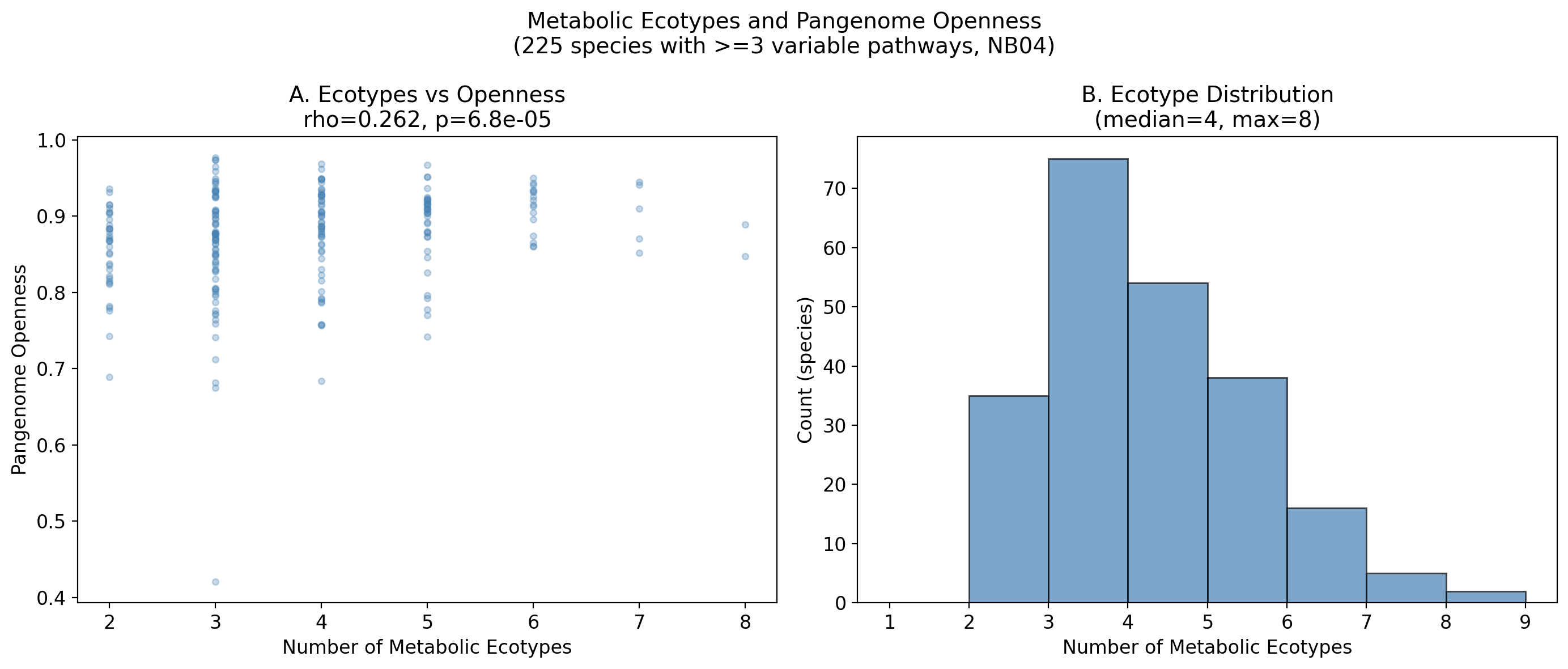 Ecotype count vs openness. From pathway_capability_dependency.
Side B: environmental and phylogenetic effects do not clearly predict openness
Direct environmental and phylogenetic effects remain specification-dependent 1. The AlphaEarth associations rely on embeddings, which are numerical summaries of the environment at each genome’s sampling location. They should be treated as coverage-limited, not as population-wide causal estimates, because only 6.8% of species had sufficient coverage 1. Two explanations of the null correlations remain hypotheses that need functional and transfer-specific tests. Neither is an established consequence of the nulls:
- HGT (horizontal gene transfer, the movement of genes between organisms other than by descent) may not track environmental similarity 4.
- The core/accessory classification may not capture functional adaptation 4.
Side C: core and accessory genes differ functionally, but conservation alone may not explain openness
The fitness study supports a functional distinction between core and accessory genes. It also refines any interpretation that conservation alone explains pangenome openness. Its conservation gradient was statistically robust yet weak, and core genes also showed condition-specific and opposing fitness effects 5.
Possible Reconciliations
- Hypothesis 1: The AlphaEarth associations may change once coverage extends beyond the 6.8% of species with sufficient data 1.
- Hypothesis 2: Shared ecological context, or sampling and community interactions, may affect both metabolic capabilities and openness 3. That would make metabolic variability a proxy rather than a determinant.
- Hypothesis 3: Gene acquisition through HGT may not track environmental similarity 4. This could leave openness unrelated to environmental effects while metabolic correlates persist.
Resolving Work
- Using the ecotype clustering outputs, rerun the ecotype–openness test across a range of clustering thresholds and genome-count eligibility cutoffs. This would show whether the association survives these specification changes.
- Using environmental metadata for species outside the AlphaEarth-covered subset, re-estimate the environment–openness association with coverage-matched comparisons. This would show whether the AlphaEarth results depend on coverage.
- Apply phylogenetic reconciliation to accessory genes. This method compares gene trees with species trees to infer transfer events. Test whether acquired genes track environmental similarity.
- Using condition-stratified fitness data, test whether the latent-capability–openness association persists after adjusting for ecological context and sampling depth.
- Using core genes with condition-specific or opposing fitness effects, test whether a functional classification predicts openness better than conservation alone.