This topic asks how far genome-derived metabolic predictions can be trusted. It covers two kinds of prediction. Genome-scale models are run with flux balance analysis (FBA), a constraint-based method that predicts feasible metabolic fluxes and growth. Pathway-completeness calls come from GapMind, a resource that checks whether an organism carries the genes for each step of a pathway. Metabolic models can be completed by gapfilling, which adds reactions or functions so that the model can simulate growth. 1 The corpus covers this topic because several projects test these predictions against experimental evidence. That evidence includes transposon-mutant fitness, exometabolomics (measurement of the metabolites an organism releases or increases outside the cell), species-level utilization phenotypes and gene knockouts. Together those tests show where agreement is informative and where it is built into the comparison. 2,3,4
Literature Context
Constraint-based modelling is well established, but its experimental grounding is thinner than its reach. A review of genome-scale metabolic networks notes that although many models have been reconstructed, “few networks have been extensively validated and tested experimentally” (PMID 20835998). Gapfilling is presented as both a repair step and a discovery engine. Computational methods use growth phenotypes or essentiality data to predict missing reactions, and experimental follow-up can reveal new gene functions (PMID 20589842). Even the well-curated E. coli iJO1366 reconstruction contained 208 blocked metabolites. Gapfilling against Keio essentiality data proposed fixes, but validating all predictions remains “a substantial but important undertaking” (PMID 22548736). A sequence-based completion study found that gap-filling choices influence model predictions. In E. coli, 3,270 reactions could take part in a gap-filling solution, and no network could be completed without orphaned enzymes (PMID 26041773). One pipeline, ChiMera, generates gap-filled drafts that produce growth predictions using flux balance analysis (FBA), a constraint-based method that predicts feasible fluxes and growth (PMID 36451100).
The corpus’s warning that gapfilling repairs a model without validating it is consistent with this literature. The sensitivity of predictions to gap-filling choices (PMID 26041773) is related to, but distinct from, the circularity in circularity-in-metabolic-model-validation, where gapfilled reactions are tested in models that cannot grow without them. The ADP1 finding that 87% of growth predictions required at least one gapfilled reaction puts a corpus-scale figure on that dependence. The orphaned-enzyme result (PMID 26041773) is also consistent with the corpus’s treatment of reactions lacking EC numbers as a barrier. EC numbers are enzyme-classification identifiers that link reactions to candidate genes (ec-less-reaction-annotation). Whether the two reflect the same gap is untested.
Reported accuracy is in tension with the corpus. An Azotobacter vinelandii model reached 89% and 91% accuracy across 180 carbon and 95 nitrogen sources (PMID 32551229). That is a single-organism result, whereas the corpus reports 42.5% across 574 organism–carbon-source combinations from draft models. The reason for the gap is unresolved. For essentiality, transposon insertion frequency analysis in Shewanella oneidensis accounted for genome and sequence-motif bias. Its calls agreed well with FBA predictions, and substantially better than FBA agreed with direct essentiality assignments (PMID 25233219). This is again one organism. The pattern resembles the 73.8% ADP1 concordance with TnSeq (transposon-insertion sequencing used to assess essentiality), but not the second ADP1 project’s moderate knockout agreement. The same study cautions that genes without insertions are not necessarily essential (PMID 25233219).
For pathway calls, the GapMind authors report high-confidence paths for 85% of utilized carbon sources in 29 bacteria with fitness data, across 62 compounds. In diverse bacteria and archaea the figure is 38%, improved from 27% by fitness-based annotations and curation (PMID 35417463). The corpus’s 13/13 FW300-N2E3 match is consistent with the higher figure. The corpus nonetheless treats that match as partly structural, because Fitness Browser growth on sole sources and GapMind’s complete calls for common amino acids leave little room for disagreement. This supports the caveat in computational-pathway-prediction-validation. The corpus’s latent-capability analyses extend the literature. The cited work asks whether complete paths exist for utilized substrates, whereas the corpus asks whether complete pathways are fitness-important. All literature figures come from abstracts, not full texts.
What the Corpus Shows
Gapfilling repairs a model; it does not validate it. In the annotation-gap study, baseline FBA achieved 42.5% overall accuracy across 574 organism–carbon-source combinations. The models produced 330 false positives, which the report attributes to overly permissive draft models. 2 The study then inserted 23 gene–protein–reaction (GPR) rules, which formally link genes to the reactions they catalyse. Knockout simulations on carbon-source minimal media produced zero wildtype growth. The report calls this validation inconclusive and circular, because the models cannot grow without the gapfilled reactions under test. 2 This is developed in circularity-in-metabolic-model-validation. The Acinetobacter baylyi ADP1 explorer widens the concern. In that project, 105,376 (87%) of 121,519 growth predictions across 14 genomes required at least one gapfilled reaction. 1 Taken together, these results suggest the hypothesis that agreement with growth partly evaluates the gapfilling itself rather than the annotated network. This is a cross-project inference, not a measurement. 1,2 The broader framing sits in metabolic-model-gapfilling.
Pathway completeness signals capability, not dependency. For Pseudomonas FW300-N2E3, GapMind predicted complete pathways for all 13 matched metabolites, and all 13 showed growth in Fitness Browser experiments. 3 The report treats this as supportive rather than definitive, because it covers only 13 metabolites. 3 Larger analyses refine that support. Some analyses cross GapMind with RB-TnSeq (random barcode transposon sequencing, a pooled mutant-fitness assay). In one, 66/161 organism–pathway pairs (41.0%) were Latent Capability: complete pathways without aggregate fitness importance. 4 A separate analysis classified 267 of 1,695 complete pairs (15.8%) as latent. Carbon-source pathways were latent more often (217 of 892, 24.3%) than amino-acid biosynthesis pathways (48 of 735, 6.5%). 5 All 66 aggregate Latent Capability pairs became fitness-important under at least one condition type. 4 The validation argument is in computational-pathway-prediction-validation.
High cross-database concordance can be structural. The FW300-N2E3 study tested 21 metabolites. Of these, 17/21 (81%) were fully concordant, and the mean concordance score was 0.94. 3 Both the report and the digest describe this as largely structural, for two reasons. Fitness Browser always shows growth for metabolites used as sole carbon or nitrogen sources, and GapMind predicts complete pathways for common amino acids. That leaves BacDive, at 3/7 utilized, as the only component that varies. 3,6 A binomial test found that the BacDive rate did not differ significantly from the P. fluorescens baseline of 22/80 (27.5%) (p = 0.40). The report reads this as utilization at a rate consistent with the species norm. 3 Assays also measure different endpoints in different media. Web of Microbes used R2A rich medium, while the Fitness Browser used minimal medium with single carbon or nitrogen sources. 3 The 2018 Web of Microbes snapshot records no organism consumption action. 7 See cross-condition-metabolic-comparability.
 Consistency heatmap across WoM, Fitness Browser, BacDive, and GapMind. From fw300_metabolic_consistency.
Pathway-level calls do not resolve reaction-level genes. Across 104 GapMind–gapfill pathway pairings, GapMind partially corroborated ModelSEED gapfilling. The available records, however, report step counts rather than the identities of missing steps. 2 Assigning genes to reactions required combining evidence streams, including BLAST, a sequence-homology search method. Of 201 gapfilled enzymatic reaction–organism pairs, the full pipeline resolved 96 (47.8%). Without BLAST it resolved 73 (36.3%), and BLAST alone resolved 70 (34.8%). 2 GapMind covers ~80 carbon and amino acid pathways, not full metabolism. 2 In the dark-gene analysis, 1,256 organism–pathway co-occurrences of dark genes and gaps are organism-level associations, not gene-to-step assignments. 8 See pathway-versus-reaction-evidence-resolution.
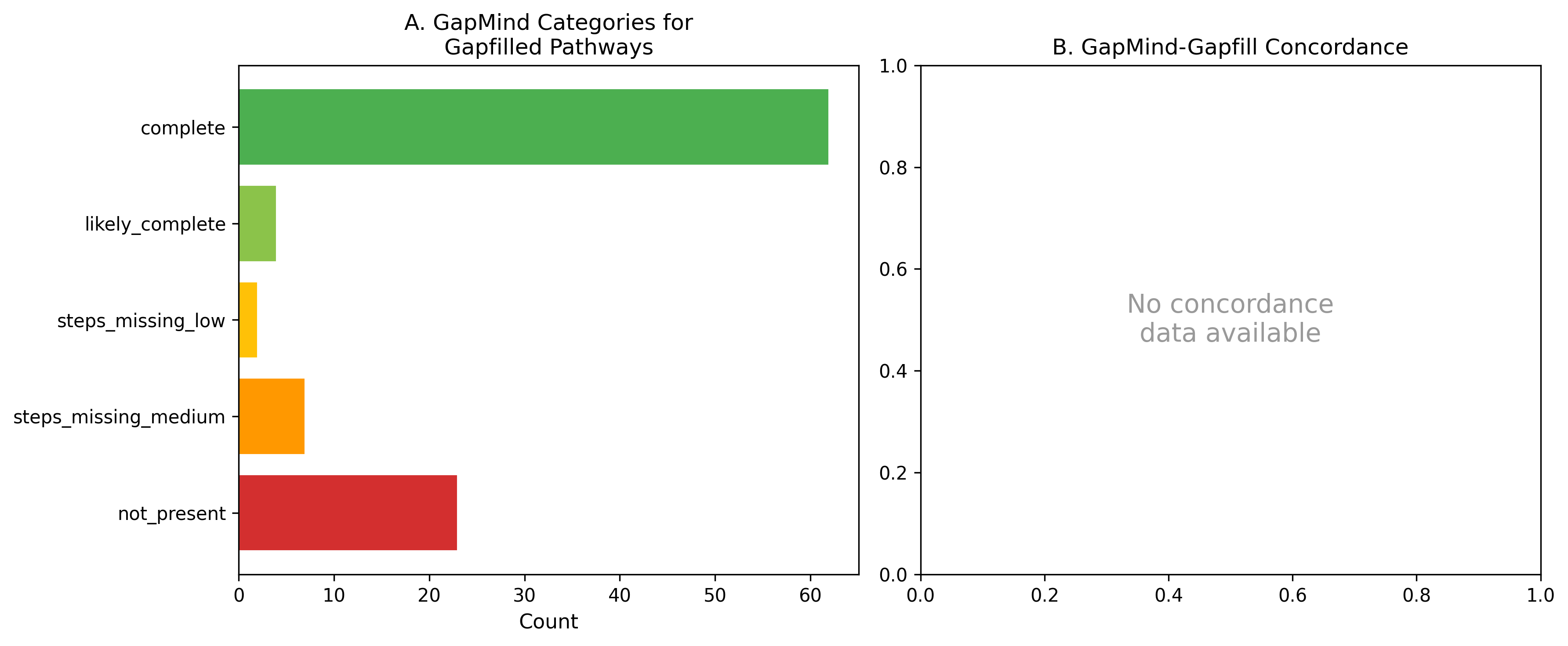 GapMind concordance with gapfilling. From annotation_gap_discovery.
Missing EC numbers are a measurable barrier. An EC number is the enzyme-classification identifier that links a reaction to candidate genes. Of 201 gapfilled enzymatic pairs, 50 (24.9%) lacked an EC number in ModelSEED. Only 8 of these 50 (16%) received assignments, against 88 of 151 (58.3%) EC-annotated reactions. 2 The platform compounds the problem. The KBase Data Lakehouse reaction table has no EC column, and only ~80% of reactions populate reaction.abbreviation (44,904 / 56,012). 9 Whether the EC-less reactions fall disproportionately in the unlinked fraction is untested. 2,9 See ec-less-reaction-annotation.
Tensions and Caveats
- Independent validation, or agreement by construction? The 13/13 FW300-N2E3 match may carry little information if agreement was nearly guaranteed by design. The digest attributes it partly to the metabolites being well-characterized amino and organic acids, and it restates the project’s result rather than confirming it independently. 6,3 See conflicts/conflict—computational-pathway-prediction-validation—104f87cf.
- Concordance versus latency. Full Fitness Browser and GapMind concordance for FW300-N2E3 sits beside broader findings that many complete pathways stay latent. This is framed as a scope difference, not a numerical contradiction. 3,5,4 See conflicts/conflict—cross-condition-metabolic-comparability—c3fb4a47 and conflicts/conflict—cross-condition-metabolic-comparability—e6421a5b.
- Latent fractions are not comparable. The 41.0% and 15.8% latent figures come from analyses with different organism sets, pathways, mappings and thresholds. They are unresolved and must not be averaged. 5,4 The 161-pair classification rests on only 7 of 48 Fitness Browser organisms with matching GapMind data. Applying a median importance threshold to each condition subset can make pathways cross it by construction, which qualifies the finding that all 66 latent pairs became fitness-important under some condition. 4
- Conservation or openness? Pangenome openness is the share of a species’ gene clusters that are accessory rather than core. 5,4 Conservation did not separate active from latent pathways (p = 0.94). The latent-capability rate, by contrast, correlated with openness (Spearman ρ, a rank-correlation measure, = 0.69, p = 0.0004, n = 22 clades). 5 See conflicts/conflict—metabolic-model-gapfilling—09788ff7.
- How reliable is FBA? Against the 42.5% multi-organism accuracy, ADP1 evidence reports a 73.8% concordance with TnSeq, transposon-insertion essentiality data. 2,1 A second ADP1 project reports only moderate agreement with knockouts. 10 See conflicts/conflict—metabolic-model-gapfilling—c50aa829 and conflicts/conflict—metabolic-model-gapfilling—68690ec7.
- Flux as a bottleneck signal. Complex I oxidises NADH, a cellular electron carrier, and an operon is a set of genes transcribed together. One reading treats Complex I as an aromatic-specific requirement that the FBA model detects as 1.76× higher flux but misses as essentiality, alongside 10/13 operon-subunit growth defects. 11 The other reading places the strongest defects on non-aromatic substrates and in ACIAD3522, a gene through which the model routes no flux, with ratios of 0.013 on acetate and 1.39 on quinate and glucose. 6 See conflicts/conflict—metabolic-model-gapfilling—bf4946ce.
- Endpoint mismatch. Production data from Web of Microbes and growth or utilization data may not validate one another. 7,6,3 See conflicts/conflict—metabolic-model-gapfilling—9cf52c50, and also conflicts/conflict—metabolic-model-gapfilling—cf98e361.
- Unreconciled counts. Conditional gapfilling reportedly added 219 reactions, broken down as 201 enzymatic, 14 transport and 12 exchange, which does not sum to the total. 2 Tryptophan utilization is 0+/50− in the report and 0/52 in the digest. 3,6
Where to Go Deeper
- circularity-in-metabolic-model-validation — read first to see why repaired models cannot validate their own repairs.
- metabolic-model-gapfilling — the broad synthesis of gapfilling burden, evidence ceilings and the capability/dependency analyses.
- computational-pathway-prediction-validation — what matched growth and benchmarks say about GapMind as a predictor.
- cross-condition-metabolic-comparability — why production, utilization and fitness assays measure different endpoints.
- pathway-versus-reaction-evidence-resolution — why pathway calls stop short of gene-to-reaction assignments.
- ec-less-reaction-annotation — the identifier-linkage barrier behind the hardest unresolved reactions.
Key entities: gapmind, flux-balance-analysis, kescience-fitnessbrowser, acinetobacter-baylyi-adp1, tnseq, kbase-ke-pangenome, bakta.
Key reports: Annotation-Gap Discovery via Phenotype-Fitness-Pangenome-Gapfilling Integration, Metabolic Capability vs Dependency, Metabolic Capability vs Metabolic Dependency, Metabolic Consistency of Pseudomonas FW300-N2E3 Across Four KBase Data Lakehouse Databases, Acinetobacter baylyi ADP1 Data Explorer, Essential Metabolome: GapMind Pathway Analysis Across Essential-Gene Organisms.