Bacteria carry overlapping systems for surviving chemical and biological attack: antimicrobial-resistance (AMR) genes, metal-tolerance determinants, anti-phage defense systems, and the mobile genetic elements (prophages, plasmids, integrative elements) that can move these functions between genomes. This hub draws together seven member concept pages built on different measurement angles — genome-wide fitness assays, pangenome conservation statistics, phenotype databases, co-occurrence tests, ecological metadata. The same resources recur across them: 83,008 AMRFinderPlus hits across 14,723 species 1, 452 metal experiments across 37 organisms and 14 metals 2, and defense markers in 27,626 of 27,690 species-level pangenomes (99.8%) 3. The five sub-themes below move from resistance fitness cost to pangenome compartment, metals, defense systems, and mobile elements, keeping presence, conservation and fitness evidence separate at each step.
Literature Context
The candidate literature is mainly reviews of clinical pathogens, and it agrees that multiresistance is assembled by acquiring preexisting resistance determinants through mobile genetic elements — insertion sequences, transposons, gene cassettes/integrons, plasmids and integrative conjugative elements — as reviewed for the ESKAPEE hospital pathogens (Enterococcus faecium, Staphylococcus aureus, Klebsiella pneumoniae, Acinetobacter baumannii, Pseudomonas aeruginosa, Enterobacter spp., Escherichia coli) (PMID 30068738). Exchange of discrete preformed genes drives staphylococcal multiresistance, with chromosomal mutation catalysing novel determinants (PMID 19492967), and transduction — phages packaging resistance-carrying host DNA — is described as a crucial dissemination route in Gram-negative bacteria (PMID 40370256). In E. coli, co-selection and persistence of resistance to antimicrobials critically important in human medicine is attributed to massive veterinary use of agents such as tetracyclines or sulfonamides, as long as those determinants are located on the same genetic elements (PMID 30003866). In P. aeruginosa, acquisition of mobile elements imposes a fitness cost that compensatory mutations can ease over time (PMID 31492517). A screen of 1725 animal-origin Salmonella enterica isolates predicted putative composite transposons that could mobilize antimicrobial resistance (AMR) and metal-resistance genes together (PMID 33009809). Phage–bacteria interplay is framed as including “prophage domestication” alongside lysis (PMID 28412903). These are abstract-level readings of reviews and single-genus studies, not pan-bacterial measurements.
Several corpus findings are consistent with this picture and extend its scale. The co-inheritance of resistance islands, most of which span multiple mechanisms, supports the co-selection-on-shared-elements account, which in the literature is tied to sustained antimicrobial selection pressure in E. coli (PMID 30003866) (resistance-island-coinheritance). The skew of metal-resistance genes toward the accessory compartment — present in only some genomes of a species — relative to efflux genes (drug-expelling pumps) is compatible with composite transposons predicted, not demonstrated, to mobilize metal and antimicrobial resistance genes together in a single species (PMID 33009809). Prophage annotations present in every analysed species refine the domestication framing (PMID 28412903): the corpus attributes that universality to counting domesticated remnants rather than active phages.
On mobile elements the corpus refines rather than contradicts these reviews. The global correlation between prophage density and AMR repertoire breadth agrees with phage-mediated spread, while local proximity odds ratios fall below 1 at 3 and 5 genes, so a species-scale association does not translate into gene-neighbourhood linkage (scale-dependent-mobile-element-associations). On fitness, the literature’s cost concerns acquisition of a mobile element in P. aeruginosa (PMID 31492517); the corpus result is a relative knockout contrast, AMR-gene knockouts being fitter than a non-AMR knockout background rather than beating an unperturbed reference (antimicrobial-resistance-fitness-cost). The two are therefore not directly comparable, and the corpus’s null result for cost differences among mechanisms has no counterpart in these papers. The corpus catalogue also spans environmental and stress-resistance genes, unlike these clinically oriented papers.
None of the candidate papers addresses anti-phage defense-system prevalence, co-occurrence syndromes, or annotation sensitivity. The corpus results in phage-defense-syndromes-and-arms-race therefore stand without literature context from this set, and should not be described as confirmed by it.
What the Corpus Shows
Resistance carries a relative baseline burden that becomes a conditional benefit. Genome-wide transposon fitness data identified 1,352 AMR genes across 43 organisms, 25 of them testable per organism; under non-antibiotic conditions AMR-gene knockouts had systematically higher fitness than non-AMR-gene knockouts, a pooled random-effects shift of +0.086 [95% CI: +0.074, +0.098], z = 14.3, p ~ 0 4. The comparator is load-bearing: AMR knockouts averaged −0.024 against a non-AMR knockout background of approximately −0.11, and a one-sample Wilcoxon test of absolute AMR-knockout fitness against zero gave p = 0.999, so removing AMR genes reduced burden relative to that background rather than beating an unperturbed reference 4. Under any-antibiotic exposure 57.0% of records flipped toward greater importance — flip being non-antibiotic minus antibiotic fitness — at N = 797, mean flip +0.045, Wilcoxon signed-rank p = 0.0001; the member page’s prose calls that denominator genes while its table labels the same 797 as gene-antibiotic pairs, so it is not safely a per-gene rate 4. Broad-spectrum efflux genes flipped +0.094 versus −0.001 for enzymatic inactivation (Mann-Whitney U p = 0.007) 4,5, yet class-matched validation was null: 157 gene-antibiotic pairs gave mean flip +0.113, flip rate 54.8%, Wilcoxon p = 0.14, and only 4 AMR classes have matched antibiotic experiments at all 4. See antimicrobial-resistance-fitness-cost.
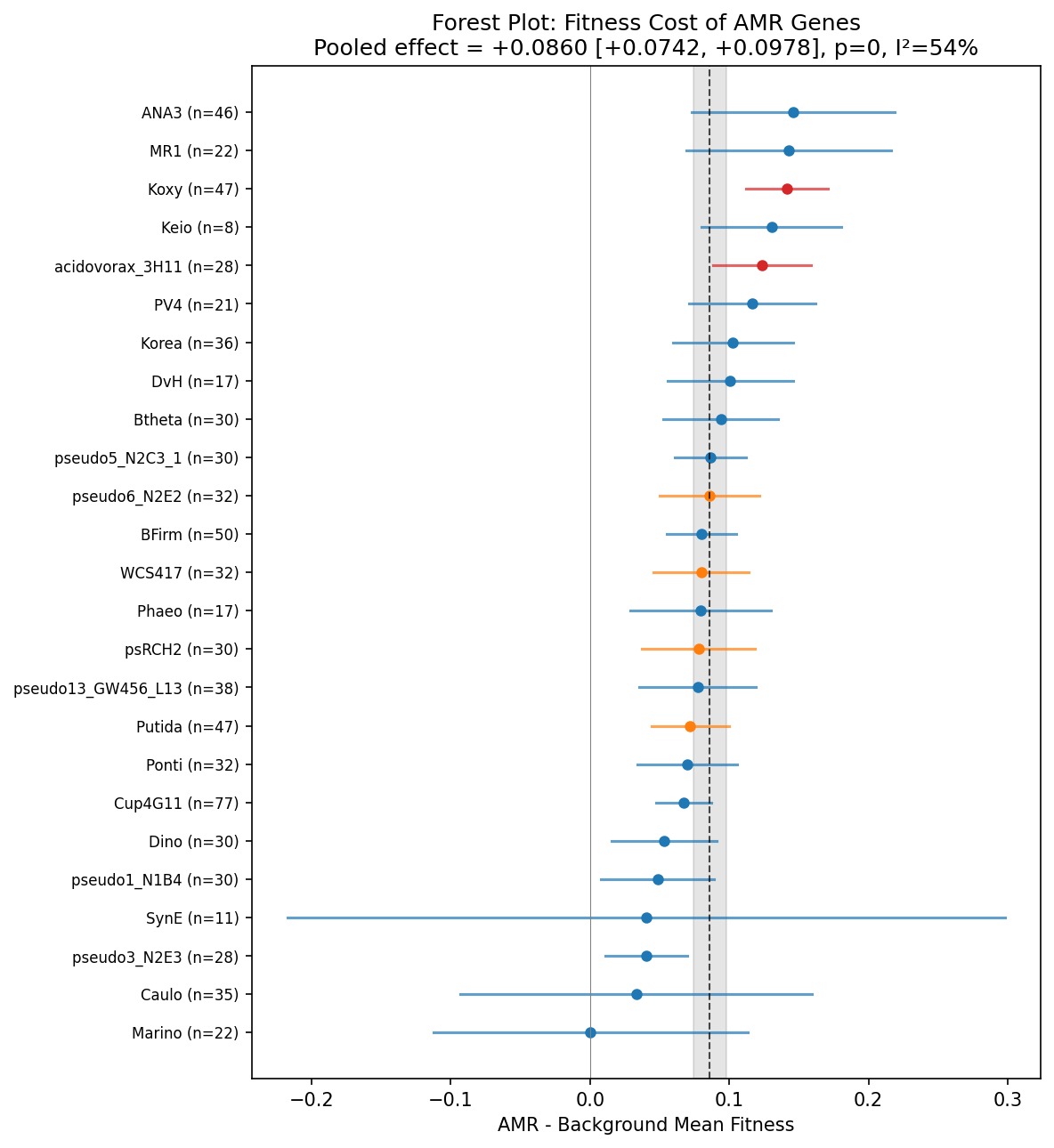 Forest plot showing positive fitness shift for AMR gene knockouts across all 25 organisms. From amr_fitness_cost.
Mechanism predicts where a resistance gene lives in the pangenome — the combined gene repertoire across a species’ genomes — but not what it costs. Baseline fitness cost did not differ among efflux (N=254), enzymatic inactivation (N=304), metal resistance (N=144), and unknown (N=74) mechanisms (Kruskal-Wallis H = 0.65, p = 0.89) 4. Yet mechanism was strongly associated with conservation status (χ² = 69.3, p = 1.4×10⁻¹³): metal-resistance genes were accessory — present in only some genomes of a species — in 44% of cases versus 13% of efflux genes 4. Only 30.3% of AMR genes were core, present in nearly all genomes, versus 46.8% for the pangenome baseline, while the partially shared auxiliary compartment was 2.2x enriched for AMR 1. Conservation is graded: across 1,305 species and 180,025 genomes, 51.3% of AMR gene-species occurrences were rare (≤5% of strains), 41.3% variable (5–95%), and 7.5% fixed (≥95%) 6,5. environmental-resistome develops the environment dimension.
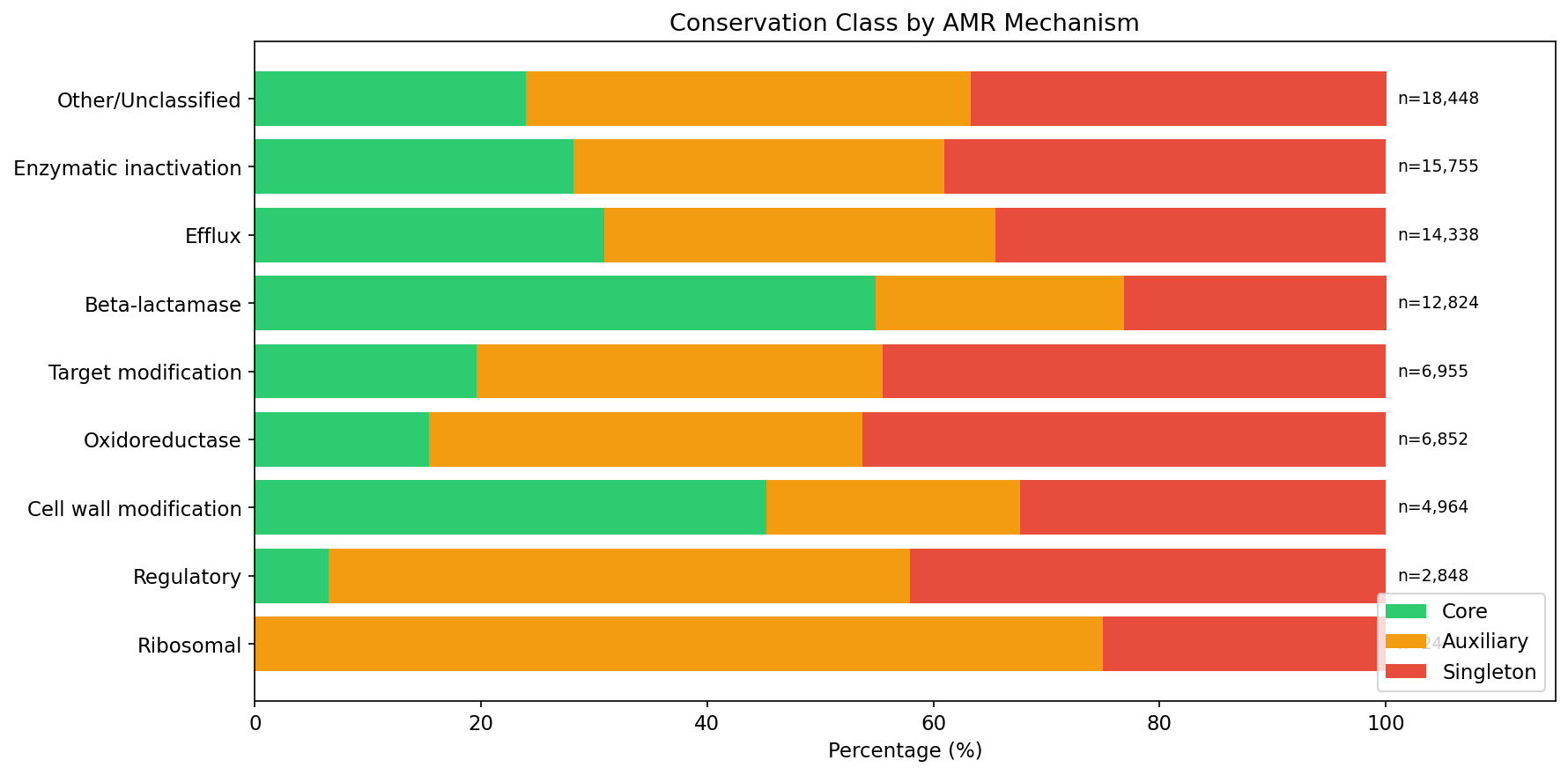 Conservation by AMR mechanism. From amr_pangenome_atlas.
Metal fitness responses share direction across metals, and metal-important genes skew core. Across 317 organism–metal-pair observations spanning 28 organisms and 85 unique metal pairs, 98.1% of gene-level fitness correlations were positive (311/317), and no metal pair showed systematically negative cross-resistance in any organism 2. Magnitudes vary by chemistry — Fe–Zn at mean r = 0.61 (n = 6) versus aluminium, the most independent metal, at mean r = 0.34 2. Metal-important genes were 87.4% core versus 76.9% for baseline genes (odds ratio, OR, = 2.08, p = 4.3e-162) 7, and of 7,609 metal-important gene records, 4,177 (54.9%) were metal-specific — a metal fitness defect with a <5% sick rate across non-metal experiments — while 2,888 (38.0%) were generally sick 8. metal-cross-resistance holds the pairwise evidence; composite-resistance-score-limitations shows that an aggregate score cannot identify which component explains tolerance to a particular metal, its strongest univariate phenotype association being Gram stain (Cohen’s d = -0.61, p < 1e-60, n = 3,272 species), which the report itself calls statistically confounded with phylogeny 8,9.
Anti-phage defense markers are near-universal, co-occurring, and annotation-sensitive. Among the 27,626 pangenome species with at least one defense hit, prevalence across these anti-phage defense families ranged from 7.2% for CBASS (cyclic-oligonucleotide-based anti-phage signalling system) to 96.1% for CRISPR-Cas, with BREX (bacteriophage exclusion) at 80.1% and restriction-modification (R-M) Type I, which cleaves unmethylated foreign DNA, at 76.8% 3. Among 7,323 species with at least five genomes, 27 of 28 defense-system pairs co-occurred positively at q < 0.05 under phylum-stratified permutation with Benjamini–Hochberg false-discovery-rate correction; the strongest, R-M Type II × Gabija, had z = 46.1 and odds ratio 24.0 3. Detection method matters: EggNOG (a database of orthologous gene groups) description matching gave CRISPR-Cas 96% prevalence, while the Cas1 marker PF01867 from Pfam (protein-domain families) gave approximately 55% on the same pangenome 3. SNIPE — an anti-phage nuclease system that cleaves phage DNA entering through the ManYZ mannose transporter pore — shows the same caveat: its DUF4041/PF13250 marker occurred in 4,572 gene clusters across 1,696 species, 86.7% accessory or singleton, but only 54 carried the Mug113 description tied to its nuclease domain 10. phage-defense-syndromes-and-arms-race covers these.
Mobile-element evidence is scale-dependent. Across 4,770 species, density of prophage markers — prophages being phage genomes integrated into a bacterial chromosome — tracked AMR repertoire breadth at Spearman rho=0.572, p<10^-300, holding at partial rho=0.464 after controlling for genome count 11. Locally the signal is weaker and uneven: among 36,041 AMR gene instances from 1,953 genomes sampled across the top-100 AMR-burdened species, 20,073 (55.7%) sat on contigs (assembled DNA fragments) carrying strict prophage markers but only 1,991 (5.5%) within 5 genes of one, and the proximity odds ratio ran 0.78 at 3 genes, 0.92 at 5, 1.10 at 10 and 1.28 at 50, with a median species-level odds ratio of 0.85 11. Meanwhile 1,517 resistance islands across 705 species showed tight co-inheritance (mean phi, a pairwise co-occurrence coefficient, 0.827), 1,343 (88%) spanning multiple mechanisms 6,5. scale-dependent-mobile-element-associations and resistance-island-coinheritance treat these scales as complementary measurements that refine mobilization inference rather than establish it.
Tensions and Caveats
The most load-bearing disagreement is whether universal positive metal cross-resistance reflects metal-specific biology or a general-stress response: no non-metal stress controls were included, and the specificity analysis finds a substantial metal-specific component alongside 38.0% general-sick and 7.2% metal+stress records, leaving the cause open (conflicts/conflict—metal-cross-resistance—59068bf5) 2,8. Relatedly, core-genome fractions for metal-fitness genes differ across projects — 87.4% core in the atlas versus 71.2% for D. vulgaris heavy-metal genes — under different definitions and thresholds that cannot be averaged (conflicts/conflict—condition-specific-fitness—369569e8, conflicts/conflict—composite-resistance-score-limitations—ba02b0ad) 7,12.
A second tension concerns what genomic compartment means. The environmental-resistome reading treats core/accessory as intrinsic/acquired, but fitness evidence does not separate the two groups, so compartment may track only mode of maintenance (conflicts/conflict—environmental-resistome—1585d18c) 1,4. Within AMR genes specifically, core and accessory classes had indistinguishable baseline fitness distributions even though all-gene analyses show a fitness–conservation gradient (conflicts/conflict—antimicrobial-resistance-fitness-cost—3139de09) 13,4. Whether co-inheritance and cofitness — correlation of gene-knockout fitness profiles across experiments — measure the same architecture is likewise unsettled (conflicts/conflict—antimicrobial-resistance-fitness-cost—cded18a3) 6,14.
Catalog scope is pervasive: the AMRFinderPlus reference catalog includes stress-response genes alongside classical antibiotic-resistance genes, mercury-resistance families alone contributing approximately 15,000 hits and 18% of annotations, so “AMR” here is partly a stress-resistance landscape; 18,448 hits (22.2%) were Other/Unclassified under keyword matching rather than CARD (Comprehensive Antibiotic Resistance Database) ontology terms (conflicts/conflict—environmental-resistome—ecbc42fd) 1. Defense calls carry a parallel permissive-annotation-versus-marker-ambiguity problem (conflicts/conflict—phage-defense-syndromes-and-arms-race—d33388e9) 3,10, and prophage annotations appeared in all 27,702 analyzed species against Touchon et al.’s (2016) ~46% estimate, because the definition counts domesticated remnants 15. AMR repertoire similarity tracked phylogenetic distance in 701/1,261 species, and lineage-associated acquisition cannot be separated from uneven lineage sampling (conflicts/conflict—environmental-resistome—4d25f7e8, conflicts/conflict—environmental-resistome—86566e6b) 6,16. Whether composite tolerance scores track isolation ecology is unsettled: an isolate-level BacDive comparison reports higher scores among contamination-associated isolates while a species-scale analysis finds no correlation (conflicts/conflict—environmental-resistome—9415d508, conflicts/conflict—composite-resistance-score-limitations—be666d4d) 17,2. For metal resistance and type IV secretion systems (T4SS, conjugative transfer machinery), a shared MAG (metagenome-assembled genome) denominator has not been established, so global-prevalence and local-neighbourhood readings may not be in direct conflict (conflicts/conflict—scale-dependent-mobile-element-associations—3657d682, conflicts/conflict—environmental-resistome—e8ac0fe1) 18,19.
Where to Go Deeper
- antimicrobial-resistance-fitness-cost — the quantitative cost/benefit argument, and why a relative knockout contrast is not an absolute cost.
- environmental-resistome — how catalog scope, COG (Cluster of Orthologous Groups) enrichment, and environment class structure the resistome inventory.
- metal-cross-resistance — pairwise metal correlations and the two-layer model: universal direction, chemistry-specific magnitude.
- composite-resistance-score-limitations — why aggregate tolerance scores cannot be read mechanistically, with the urease and catalase reversals.
- phage-defense-syndromes-and-arms-race — defense prevalence, co-occurrence syndromes, and the SNIPE/ManYZ entry-route mechanism.
- resistance-island-coinheritance — multi-mechanism co-inheritance and the limits of co-occurrence as evidence of co-selection.
- scale-dependent-mobile-element-associations — the scale-dependence that disciplines every mobilization claim above.
Key entities: kescience-fitnessbrowser, metal-fitness-atlas, bacdive, gtdb, kbase-ke-pangenome, eggnog, copper, nickel, alph-aearth, ncbi-environment-metadata.
Key reports: Fitness Cost of Antimicrobial Resistance Genes, Pan-Bacterial AMR Gene Landscape, Within-Species AMR Strain Variation, Environmental Resistome at Pangenome Scale, Gene-Resolution Metal Cross-Resistance Across Diverse Bacteria, Pan-Bacterial Metal Fitness Atlas, Metal-Specific vs General Stress Genes, Pan-Bacterial Anti-Phage Defense Arsenal, SNIPE Defense System in the KBase Data Lakehouse Pangenome, Prophage-AMR Co-mobilization Atlas, Prophage Gene Modules and Terminase-Defined Lineages Across Bacterial Phylogeny and Environmental Gradients, AMR Co-Fitness Support Networks.