Raw report: field_vs_lab_fitness Feeds into: condition-dependent-gene-tradeoffs, condition-specific-fitness, cross-tenant-data-bridging, data-landscape-ownership-and-coverage-bias, environmental-resistome, experimental-prioritization-of-functional-dark-matter, fitness-condition-coverage-prioritization-bias, gene-essentiality, lab-field-fitness-concordance, laboratory-fitness-versus-natural-selection, metal-cross-resistance, module-level-coinheritance, ontology-and-category-schema-sensitivity, pangenome-conservation-fitness-decoupling, pangenome-core-boundary-and-clade-size-bias, pangenome-integration, scale-dependent-mobile-element-associations, selection-on-outcome-leakage, shared-stress-versus-stressor-specific-fitness, transposon-callability-bias
Overview
This analysis tested whether ecological relevance of experimental conditions changes the relationship between RB-TnSeq (random barcode transposon sequencing) fitness effects and pangenome conservation in Desulfovibrio vulgaris Hildenborough (DvH). It classified 757 Fitness Browser experiments, compared condition-specific gene importance with core/auxiliary status, and analyzed 52 ICA (independent component analysis) fitness modules. The main result is that condition type matters less than fitness importance for predicting conservation. Genes important under antibiotic and heavy-metal conditions trended below the core baseline, but neither deficit was significant after FDR correction, so the report’s reading that resistance functions are disproportionately accessory is a single-organism hypothesis rather than an established finding. 1
Key Findings
ENIGMA CORAL lacks DvH fitness data
A survey of the 47-table ENIGMA CORAL database, run for complementary data, found that DvH is completely absent from it. Its single TnSeq library is for FW300-N2E2 (Pseudomonas), and DubSeq libraries cover E. coli, P. putida, and B. thetaiotaomicron. All 6,705 genomes and 15,015 genes in the database are environmental isolates from Oak Ridge, not DvH. The database also contains 4,346 field samples with geochemistry data (uranium, metals) across 596 Oak Ridge locations and 213,044 ASVs (amplicon sequence variants) for community composition; the report describes these as potentially useful for future analyses but not for gene-level fitness analysis. 1
Condition classification
The 757 DvH experiments were assigned to six categories: lab-nutrient, 237 experiments (31.3%); field-core, 204 (26.9%); lab-other, 140 (18.5%); field-stress, 78 (10.3%); heavy-metals, 55 (7.3%); and lab-antibiotic, 43 (5.7%). The broad split was 337 field experiments (44.5%) versus 420 lab experiments (55.5%). Field-core conditions covered sulfate, lactate, formate, pyruvate, and H2 metabolism; field-stress conditions included uranium, mercury, nitrate, nitrite, oxygen, and NO; heavy-metals included cobalt, nickel, zinc, copper, manganese, selenium, molybdate, tungstate, and aluminum. 1
Field-important genes are enriched in the core genome
Among 2,725 non-essential genes with both fitness data and pangenome links, 76.3% were core overall. A further 678 essential genes were 80.1% core but lacked fitness data because no transposon mutants were recovered. Genes classified as important at fitness < -2 showed the following conservation: field-stress, 298 genes and 83.6% core (OR=1.58 versus baseline, FDR q=0.026); field-core, 376 and 82.4% (OR=1.46, q=0.026); lab-other, 292 and 81.5% (OR=1.37, q=0.073); lab-nutrient, 452 and 81.4% (OR=1.36, q=0.037); lab-antibiotic, 109 and 73.4% (OR=0.86, q=0.49); and heavy-metals, 198 and 71.2% (OR=0.77, q=0.14). FDR means false discovery rate; after BH-FDR correction, field-stress, field-core, and lab-nutrient genes were significantly enriched in the core genome, while heavy-metals and lab-antibiotic genes were not significantly below baseline. 1
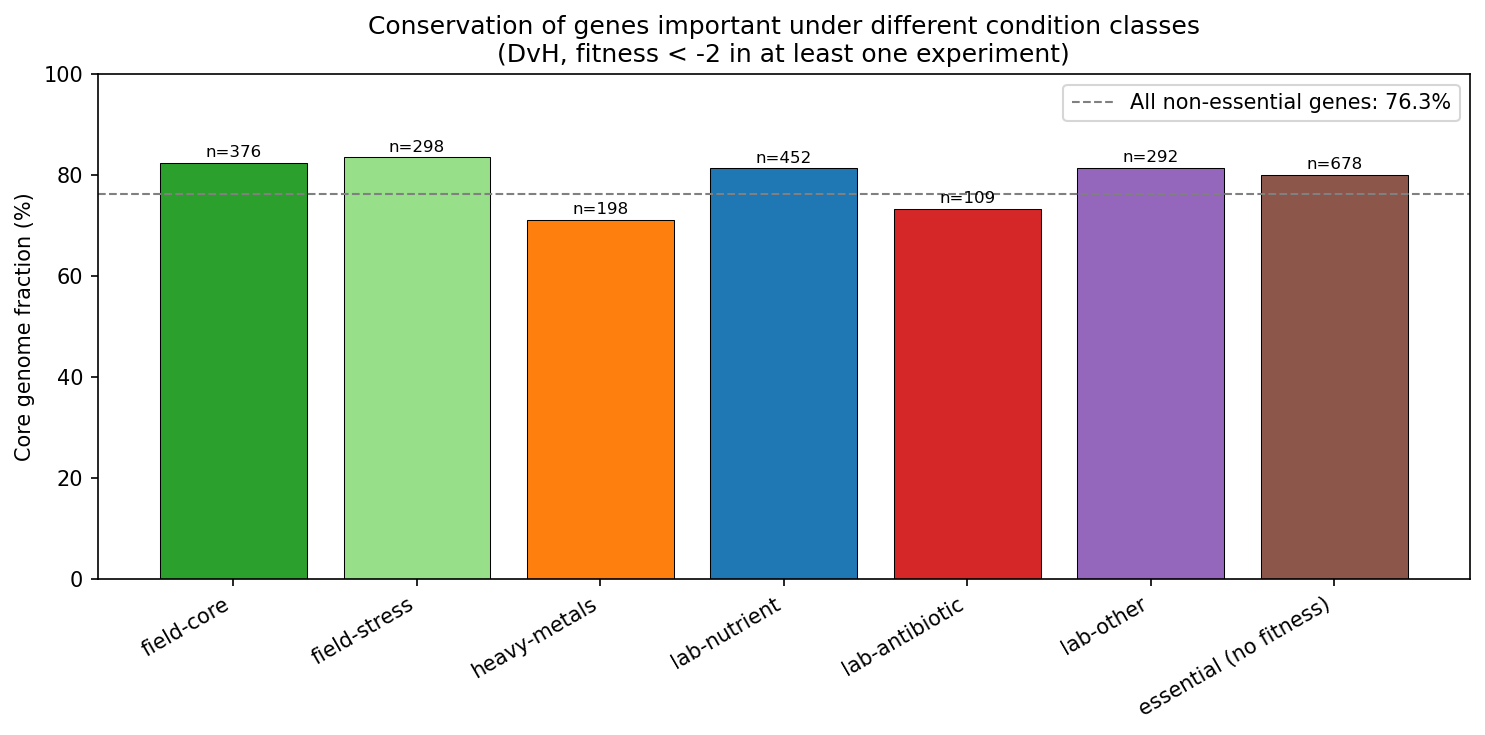 Core genome percentage for genes important under each condition class, with baseline. From field_vs_lab_fitness.
Fitness importance, rather than ecological context, best explains conservation
The specificity analysis identified 50 lab-specific genes that were 96.0% core, 52 field-specific genes that were 88.5% core, 89 field-biased genes that were 83.1% core, 352 universal genes that were 79.8% core, and 2,083 neutral genes that were 74.5% core. Lab-specific genes were therefore more core than field-specific genes, counter to H1, but the comparison was not statistically significant (Fisher exact OR=0.32, p=0.27). Universal genes were significantly more core than neutral genes (OR=1.35, p=0.033), supporting the interpretation that any strong fitness importance predicts conservation more consistently than whether the condition is classified as field or lab. 1 Lab-nutrient genes were also significantly enriched in the core genome (81.4%, q=0.037). Together with the nonsignificant field-specific versus lab-specific comparison (Fisher exact OR=0.32, p=0.27, n=50-52 per group), this limits the hypothesis that ecological specificity drives conservation. 1
Logistic regression with 10-fold cross-validated AUC found weak predictive performance for field fitness alone (CV-AUC 0.517, standard deviation 0.052), lab fitness alone (0.531, 0.052), and field plus lab fitness (0.548, 0.053). A full model that also included gene length reached 0.645 (0.068), indicating that gene length was substantially more predictive of core status than either fitness dimension, while neither fitness dimension alone was informative (CV-AUC near 0.5). 1
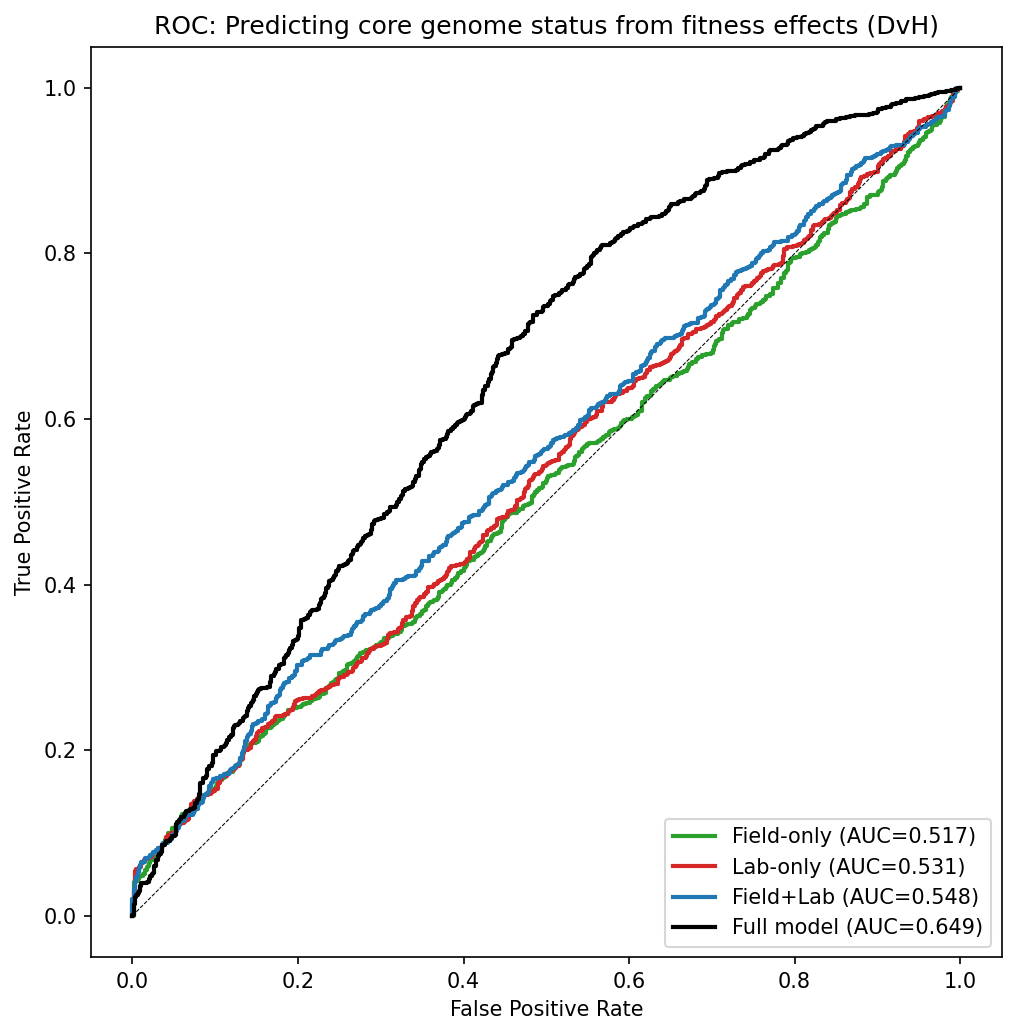 ROC curves comparing field-only, lab-only, combined, and full models for predicting core genome status. From field_vs_lab_fitness.
The conservation pattern was robust across fitness thresholds from -1 to -3. Field-stress genes were 89.4%, 83.6%, 84.0%, and 82.1% core at thresholds -3.0, -2.0, -1.5, and -1.0, respectively; field-core genes were 84.4%, 82.4%, 81.9%, and 79.0%; lab-nutrient genes were 83.5%, 81.4%, 81.0%, and 79.5%; lab-other genes were 85.2%, 81.5%, 80.1%, and 77.5%; lab-antibiotic genes were 82.2%, 73.4%, 77.3%, and 76.2%; and heavy-metals genes were 70.6%, 71.2%, 76.7%, and 76.7%. Field-stress was highest at every listed threshold. The report states that heavy-metals was consistently the lowest, but its own table contradicts this at -1.0, where lab-antibiotic genes were 76.2% core versus 76.7% for heavy-metals genes. The report attributes the lab-antibiotic dip at -2 to a small sample (n=109 at -2 vs n=45 at -3). 1
Module-level analysis does not separate field and lab conservation
Across 52 ICA fitness modules, the mean core fraction was 0.886 and the median was 1.000. Module conservation did not significantly correlate with field-condition activity (Spearman rho=0.071, p=0.62). Using the mean core fraction of 0.886 as the classification threshold, 21 ecological modules (field-active + conserved) had a mean core fraction of 0.980, 17 conserved-quiet modules (low field activity + conserved) had 0.983, 5 field-variable modules (field-active + less conserved) had 0.829, and 9 lab modules (low field activity + less conserved) had 0.516. The “lab” label therefore means low field activity combined with lower conservation, not demonstrated lab-specific activity. The ecological modules contained 239 member genes, including 52 unannotated genes that are candidates for environmental-adaptation functions. 1
The module results did not support H2: field activity and module conservation were not correlated. H3 was partially supported because the 21 field-active, conserved ecological modules were distinguishable from the 9 lower-conservation lab modules, although this classification does not establish that the unannotated genes mediate environmental adaptation. Because module types were defined using the mean core fraction (0.886) rather than the median (1.000) as the conservation threshold, the low conservation of the 9 lab modules is partly a consequence of the classification criterion, not an independent result. 1
Biological interpretation
Lab-antibiotic and heavy-metal resistance genes had the lowest conservation values, 73.4% and 71.2%, respectively, compared with the 76.3% all-gene baseline, although neither class was significantly below baseline after BH-FDR correction. The report interprets this as consistent with resistance functions being disproportionately accessory and potentially associated with recently acquired mobile genetic elements. In contrast, genes involved in sulfate reduction, lactate/formate/pyruvate utilization, and FRC-relevant stress responses were more conserved, consistent with their importance to DvH ecology; this interpretation is an inference from the conservation pattern rather than a direct mobile-element measurement. 1
The heavy-metals category was treated as field-relevant because DvH encounters those metals at Oak Ridge FRC sites, yet its 71.2% core fraction contrasted with the 83.6% core fraction for uranium/mercury-related field-stress genes. The report suggests the hypothesis that specific metal-resistance mechanisms such as efflux pumps and metal-binding proteins are accessory, whereas uranium and mercury responses may involve more fundamental stress pathways, including DNA repair and sulfate reduction. 1 The report also cites prior literature identifying the chromate transporter DVU0426 as crucial for Cr(VI) resistance, and presents it as a specific example of accessory-genome-encoded environmental adaptation. The present analysis did not test this gene. 1
Data and Supporting Evidence
The analysis used kescience_fitnessbrowser RB-TnSeq data for 757 DvH experiments and 2,741 genes, plus kbase_ke_pangenome gene clusters classified as core, auxiliary, or singleton. Generated data included experiment_classification.csv, gene_fitness_conservation.csv for 2,725 genes, and module_characterization.csv for 52 ICA modules. Supporting notebooks covered ENIGMA discovery, condition classification, fitness-conservation analysis, and module analysis. 1
Report figures include a heatmap of gene importance (fitness < -2) by condition class and conservation status (fig_condition_importance_heatmap.png), core-genome percentages for genes important under each condition class against the baseline (fig_conservation_by_condition_class.png), a scatter plot of mean field versus mean lab fitness per gene colored by core/auxiliary status (fig_field_vs_lab_specificity.png), and ROC curves comparing field-only, lab-only, combined, and full models for predicting core-genome status (fig_roc_conservation_prediction.png). Module-level figures include a two-panel scatter of module core fraction against field and lab condition activity (fig_module_conservation_vs_activity.png) and a box-plus-scatter summary of module conservation and activity by module type classification (fig_ecological_vs_lab_modules.png). 1
Caveats
The fitness analysis excludes 678 essential genes, 80.1% of which are core, because they lacked transposon mutants. Including them would raise the overall baseline slightly but would not change condition-class comparisons among non-essential genes. 1
This is a single-organism analysis of DvH, so generalizability is limited, particularly to organisms with larger accessory genomes. The Nitratidesulfovibrio vulgaris pangenome contains relatively few genomes, producing a coarse core/auxiliary classification with a high 76.3% baseline core fraction that compresses effect sizes. 1
Condition classification was manually mapped from condition_1 labels, and edge cases such as zinc sulfate as a metal versus sulfate source required subjective judgment. The primary fitness threshold was < -2, although sensitivity analysis from -1 to -3 supported the reported pattern. 1
Gene length is confounded with both fitness-measurement quality, because short genes receive fewer transposon insertions, and core status, because core genes tend to be longer. The field-specific and lab-specific gene sets were small (n=50-52 per group), limiting power for their comparison. Field and lab fitness effects were correlated (r ~ 0.7 from the scatter plot), so most genes that were sick in one context were also sick in the other. 1
The ENIGMA CORAL field samples and ASVs may enable future community and geochemistry analyses, but the current database survey does not provide DvH gene-level fitness data. The report proposes several extensions but does not report results for any of them. They include applying the classification to other ENIGMA organisms with environmental relevance and Fitness Browser data; replacing binary core/auxiliary status with quantitative conservation (fraction of genomes carrying the gene cluster) to increase statistical power; using the 213K ASVs and 4,346 field samples in ENIGMA CORAL to ask whether Desulfovibrio abundance at Oak Ridge sites correlates with the geochemistry conditions tested in the Fitness Browser; deeper analysis of the accessory-genome antibiotic and heavy-metal resistance genes, asking whether they are on mobile elements, recently acquired, or shared with co-occurring species at Oak Ridge, questions that remain unresolved; and replacing binary important/not-important calls with continuous fitness scores (e.g., mean or minimum fitness per condition class) as logistic-regression predictors. The report’s reference list also names Desulfovibrio vulgaris Hildenborough, Pseudomonas aeruginosa, Mycobacterium abscessus, and Shewanella algae in cited literature. 1
Slots Into
- condition-specific-fitness — field, lab, and stress-condition fitness effects show that fitness importance predicts conservation more strongly than ecological condition class. 1
- gene-essentiality — the analysis separates 678 essential genes lacking transposon fitness data from conditionally important non-essential genes and tests condition-dependent importance. 1
- pangenome-integration — pangenome core/auxiliary status is integrated with fitness effects, revealing 76.3% baseline core conservation and context-specific enrichment. 1
- environmental-resistome — lab-antibiotic and heavy-metal-important genes show low core fractions of 73.4% and 71.2%, motivating analysis of accessory resistance functions. 1
- cross-tenant-data-bridging — the ENIGMA CORAL survey establishes that its field geochemistry and community datasets are available for future integration but contain no DvH gene-level fitness data. 1
- lab-field-fitness-concordance — 757 experiments were split into field and lab classes. Field and lab fitness correlated (r ~ 0.7), and in this single-organism test, conservation did not differ significantly between field-specific and lab-specific genes. 1
- module-level-coinheritance — a threshold-based scheme classified the 52 ICA modules as ecological (field-active + conserved; 21, mean core 0.980), conserved-quiet (low field activity + conserved; 17, 0.983), field-variable (field-active + less conserved; 5, 0.829), and lab (low field activity + less conserved; 9, 0.516). 1
- experimental-prioritization-of-functional-dark-matter — 52 unannotated genes among the 239 ecological-module members are candidates for environmental-adaptation functions. 1
- metal-cross-resistance — heavy-metal-important genes (71.2% core) contrast with uranium/mercury field-stress genes (83.6% core); the report offers only a tentative mechanistic explanation. 1
- pangenome-conservation-fitness-decoupling — gene length predicted core status better than fitness did, and the accessory enrichment of resistance classes was not significant versus baseline. 1
- pangenome-core-boundary-and-clade-size-bias — a small pangenome with a 76.3% core baseline gives a coarse core/auxiliary split that compresses effect sizes. 1
- ontology-and-category-schema-sensitivity — manual condition classification required subjective edge-case calls such as zinc sulfate. 1
- transposon-callability-bias — short genes receive fewer transposon insertions, confounding fitness measurement with core status. 1
- shared-stress-versus-stressor-specific-fitness — correlated field and lab fitness effects mean most genes sick in one context are sick in the other. 1
- scale-dependent-mobile-element-associations — whether accessory resistance genes are mobile or recently acquired remains untested. 1
- laboratory-fitness-versus-natural-selection — the proposed continuous-fitness regression would give a finer test of lab fitness as a predictor of conservation. 1