Raw report: prophage_ecology Feeds into: confirmatory-exploratory-ecological-association-discordance, cross-tenant-data-bridging, cultivation-collection-bias-in-ecological-genomics, ecotype-clustering-validity, ecotype-environment-gene-content, environment-embedding-geography, functional-marker-validation, genomic-dispersal-functional-coupling, horizontal-gene-transfer-driven-innovation, multi-omics-integration, phage-defense-syndromes-and-arms-race, phb-granule-ecology, phylogenetic-confounding-of-pangenome-associations, taxonomic-resolution-dependent-functional-inference, two-speed-bacterial-genome
Overview
This report analyzes prophage-associated gene modules across 27,702 bacterial species using 4,005,537 eggNOG-annotated gene clusters, environmental and phylogenetic metadata, TerL lineage clustering, module co-occurrence tests, and taxonomy-based validation in 6,365 NMDC metagenomic samples. It finds that prophage-associated annotations are nearly universal but structurally variable, that environment explains module composition beyond host phylogeny and genome size, and that environmental signals are concentrated in structural and anti-defense modules rather than in near-universal core modules. The authors describe the work as the first systematic, module-level analysis of prophage architecture across >27,000 bacterial species and 10 environment categories. They contrast it with earlier whole-prophage presence/absence work (Touchon et al. 2016) and with studies of specific phage types (Camarillo-Guerrero et al. 2021). This priority claim is the authors’ own characterization, not an independently checked result. 1
Key Findings
1. Prophage modules are widespread but structurally variable
All 27,702 analyzed bacterial species carried prophage-associated gene clusters, totaling 4,005,537 clusters. Packaging (module A) and lysogenic regulation (module F) were present in 100.0% of species, lysis (module D) in 99.9%, integration (module E) in 99.1%, anti-defense (module G) in 64.3%, head morphogenesis (module B) in 56.1%, and tail (module C) in 55.6%; 34.9% of species carried all 7 modules. These clusters were identified by querying 93M eggNOG annotations with 112 WHERE clause conditions, which yielded 4,005,537 prophage-associated gene clusters across 27,702 species; eggNOG is an orthology-based functional annotation resource. Validation against 8 well-characterized prophage-carrying species (E. coli, S. enterica, S. aureus, P. aeruginosa, M. tuberculosis, B. subtilis, V. cholerae, S. pyogenes) confirmed detection of all 7 modules in every case. This is a sensitivity check on known carriers, not an estimate of the false-positive rate. The report also presents a figure of prophage gene cluster counts, species presence, and module richness. 1
The module cluster counts, with species prevalence, were 707,217 for packaging (100.0%), 87,336 for head morphogenesis (56.1%), 189,271 for tail (55.6%), 724,499 for lysis (99.9%), 773,417 for integration (99.1%), 1,682,902 for lysogenic regulation (100.0%), and 63,508 for anti-defense (64.3%). Modules D and A were predominantly core genes, with 62.6% and 57.0% core status respectively, whereas E and B were predominantly singletons, with 59.3% and 56.0% singleton status respectively. The report reads this as consistent with the expectation that phage structural genes diversify rapidly while regulatory and lysis genes are more conserved. A figure in the report shows the core, accessory, and singleton status of prophage gene clusters by module. 1
The report interprets modules A, D, and F as potentially containing many domesticated, defective prophage remnants, while modules B, C, and G are more structurally variable and therefore more informative for ecological analyses of relatively complete prophage elements. This interpretation is an inference from annotation patterns and is limited by the absence of dedicated prophage detection. In its discussion the report states that not all prophage functions respond equally to environment. The ubiquitous modules A, D, and F show minimal environmental variation, while the structurally variable modules B, C, and G carry the environmental signal. 1
Module prevalence was mapped across 142 GTDB phyla, where GTDB is the Genome Taxonomy Database. Modules A, D, and F were uniform, all ≥99% in the top 15 phyla. The most variable modules were head morphogenesis, ranging from 10.2% (Thermoplasmatota) to 81% (human_associated species); tail, ranging from 6.5% (Thermoplasmatota) to 82% (food-associated species); and anti-defense, ranging from 3.1% (Patescibacteria) to 97.8% (Campylobacterota). As reported, these ranges mix phylum-level and environment-level groupings. A figure in the report shows prophage module prevalence by phylum. 1
2. Environment explains prophage composition beyond phylogeny
PERMANOVA, a permutation-based multivariate analysis of variance, on Bray-Curtis prophage-module composition across a 1,773-species subsample with 99 permutations found significant effects for genome-size quartile, environment, and family-level phylogeny, each with p=0.01. Genome size was dominant (F=212.99), followed by environment (F=30.04) and phylogeny (F=6.17); genome size also correlated with prophage cluster count at rho=0.717. A figure in the report shows the PERMANOVA F-statistics (variance partitioning) and module prevalence by environment. 1
Genome size was the dominant predictor of prophage burden (rho=0.717 with prophage cluster count), followed by environment and then phylogeny. Even so, Kruskal-Wallis tests within every genome-size quartile found significant environmental effects on prophage module count, with all p < 6.5e-78, indicating that the environmental signal was not explained solely by genome size. AlphaEarth embedding analysis of 2,008 species with at least 5 embedded genomes found a partial Spearman correlation of rho=0.468 between environmental niche breadth and prophage module count after controlling for genome size, with p=8.41e-110. A separate figure in the report, the genome-size confound analysis, shows genome size versus prophage burden together with the genome-size-stratified analysis. 1
The report therefore rejects the hypothesis that phylogeny alone explains prophage distribution: environment affected module composition beyond phylogeny, and the environmental effect was stronger than the family-level phylogenetic effect in the reported PERMANOVA comparison. 1
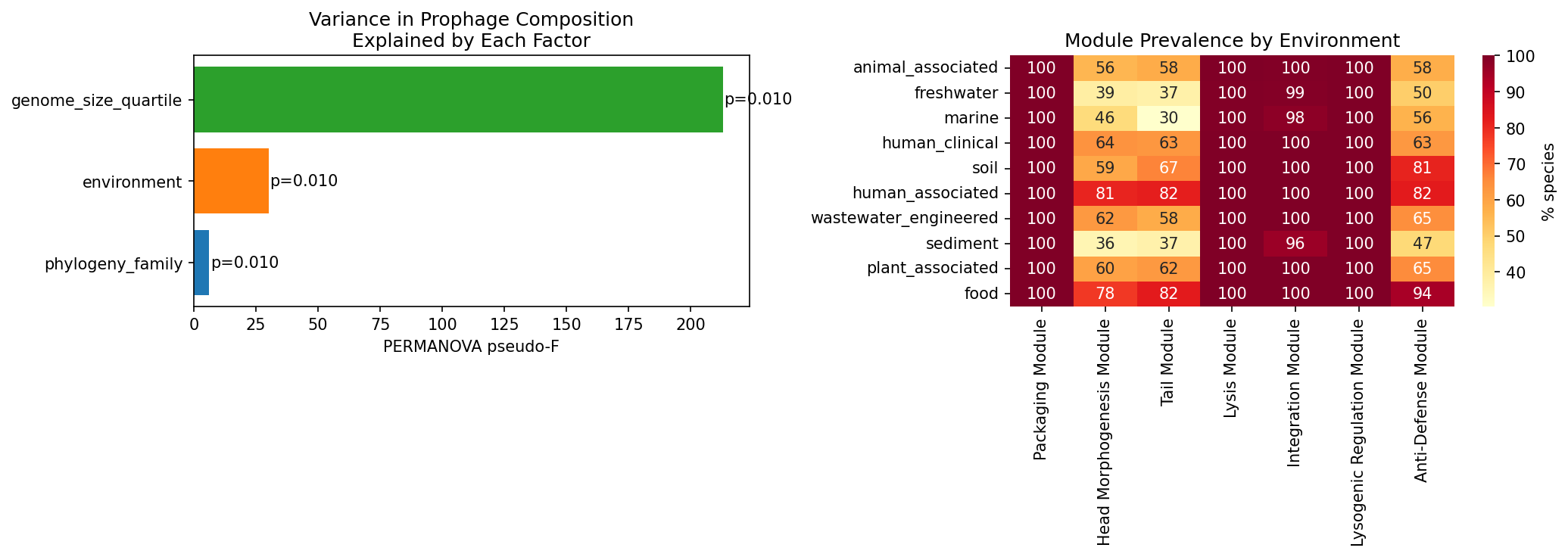 Variance partitioning and module prevalence by environment. From prophage_ecology.
Environment classification of 293,050 genomes via NCBI isolation_source metadata yielded 10 categories with ≥30 species. Chi-squared tests found significant environment-by-module associations for head morphogenesis (chi2=1,051, p=1.72e-220), tail (chi2=1,749, p≈0), and anti-defense (chi2=818, p=2.58e-170). 1
3. Structural and anti-defense modules are enriched in human-associated environments
Constrained permutation null models, using 500 permutations that preserved host-family and genome-size-quartile strata across 18,031 species, identified 8 significant module-by-environment enrichments at FDR < 0.05, where FDR means false discovery rate. In human-associated environments, tail had log2(OR)=2.21 and Z-score=10.86, head morphogenesis had log2(OR)=1.98 and Z-score=10.00, and anti-defense had log2(OR)=1.70 and Z-score=8.76. In human-clinical environments, anti-defense was enriched with log2(OR)=0.14 and Z-score=5.14, tail with log2(OR)=0.77 and Z-score=3.90, and head morphogenesis with log2(OR)=0.70 and Z-score=3.59. Anti-defense was depleted in freshwater with log2(OR)=-0.74 and Z-score=-4.74 and in animal-associated environments with log2(OR)=-0.24 and Z-score=-8.77. A figure in the report shows module-by-environment enrichment. 1
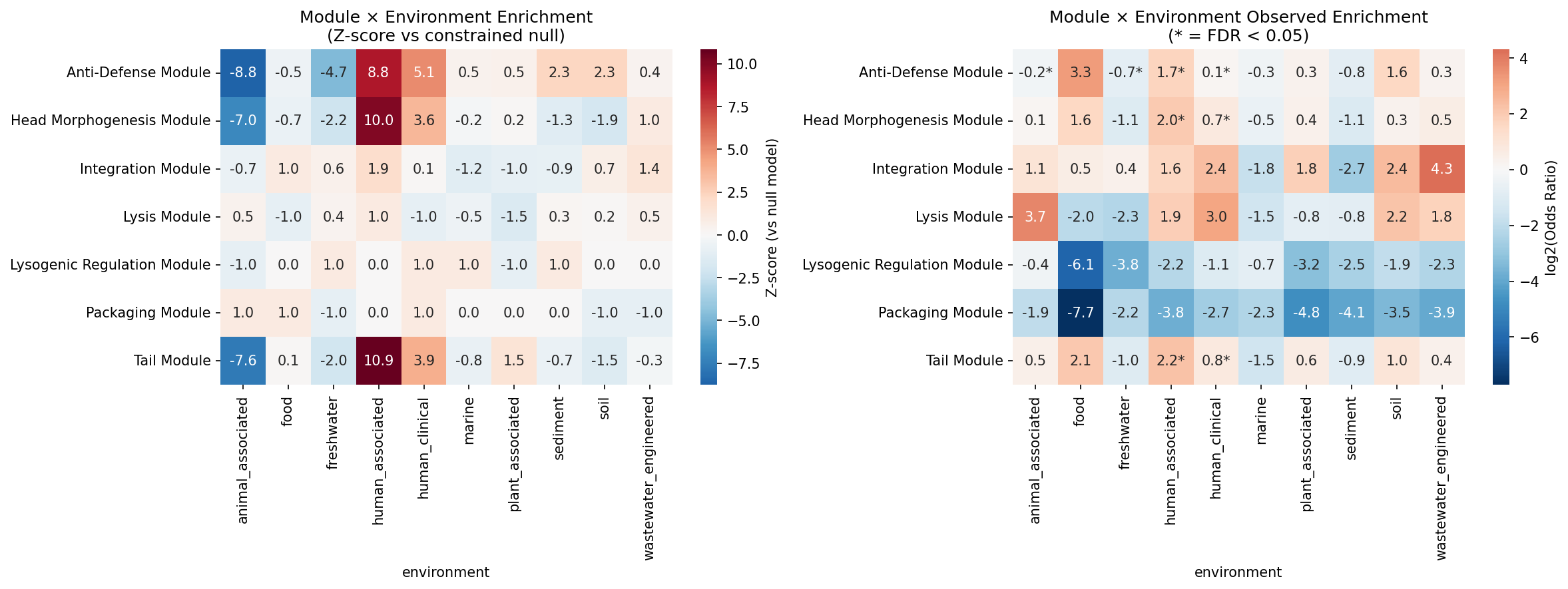 Module × environment enrichment. From prophage_ecology.
These results support the phage-defense-syndromes-and-arms-race interpretation that human-associated bacteria may experience stronger phage-mediated selection for structurally complete prophages and counter-defense functions, but the report presents this as a consistency with coevolutionary theory rather than a direct mechanistic demonstration. The report’s summary calls anti-defense the most environmentally responsive module, describing it as showing the strongest enrichment (human-associated) and depletion (freshwater, animal-associated) signals. The depletion signals are the anti-defense results listed above. The enrichment claim, however, contradicts the report’s own table. In human-associated environments, tail (log2(OR)=2.21, Z-score=10.86) and head morphogenesis (log2(OR)=1.98, Z-score=10.00) both exceed anti-defense (log2(OR)=1.70, Z-score=8.76). Anti-defense is therefore not the strongest human-associated enrichment by either listed measure. 1
The report cites two studies as supporting literature; neither is a measurement from this project. Low et al. (2024) demonstrated enrichment of prophage-encoded cargo genes in human-impacted environments across 38,605 genomes. Tesson et al. (2024) found that 89% of anti-defense systems localize in mobile genetic elements, predominantly prophages. 1
4. TerL lineages include specialist and generalist strategies without independent lineage-level enrichment
MMseqs2 clustering, using 70% AAI where AAI means amino-acid identity, grouped 38,085 TerL sequences from 11,789 species into 10,991 lineages. The lineage size distribution was highly skewed (median=1). The largest lineage, L_SFJM01000051.1_13, contained 1,094 members across 869 species and represents a cosmopolitan prophage type, while 6,921 lineages (63%) were singletons; threshold sensitivity yielded 4,001 lineages at 50% AAI and 16,283 at 80% AAI. A figure in the report shows TerL lineage size distribution and clustering-threshold sensitivity. 1
No individual TerL lineage showed significant environment-specific enrichment after FDR correction in 0/500 tests. Among 824 lineages with at least 5 species, 325 were classified as specialists by Shannon entropy < 1.0 or a dominant environment > 80%, while 499 were classified as generalists distributed across 3+ environments. Specialist lineages were concentrated in animal-associated, freshwater, and marine environments. A figure in the report shows lineage environmental breadth. 1
The report concludes that module-level ecology and lineage-level ecology are decoupled: modules show environmental effects beyond phylogeny, whereas individual TerL lineages do not exceed the constrained host-phylogeny expectation. This supports a model in which modular exchange contributes to environmental differences without requiring independent whole-lineage adaptation. The report notes that this lineage-level null contrasts with Paez-Espino et al. (2016), who found strong habitat-type specificity for most viral groups. It attributes the difference to its constrained permutations, which preserved host-family composition: under them, the lineage distribution is well explained by host phylogeny alone. The report cites Mavrich & Hatfull (2017), who showed that temperate phage evolution is primarily shaped by host range rather than by environmental selection. Both are cited literature, not measurements from this project. 1
5. NMDC data independently validates module-level environmental associations
Taxonomy-based prophage-burden inference across 6,365 NMDC metagenomic samples achieved 87.2% median matching coverage and identified 57 significant module-abiotic correlations at FDR < 0.05. The strongest reported correlations were packaging with pH (Spearman rho=0.519), all modules with pH (rho=0.474), all modules with temperature (rho=0.399), all modules with depth (rho=0.361), and all modules with total nitrogen (rho=0.333). The report shows these patterns in a figure of NMDC prophage burden versus abiotic variables and in an NMDC module-abiotic correlation heatmap. 1
Cross-validation found concordance between pangenome enrichment and NMDC correlations for head morphogenesis, tail, and anti-defense. Packaging, lysis, integration, and lysogenic regulation were significant in NMDC data but not pangenome-enriched beyond phylogenetic expectation, consistent with their near-universal presence masking environmental variation in the pangenome analysis. 1
The positive pH association (rho=0.519 for packaging, 0.474 overall) is interpreted as suggesting that alkaline environments may favor lysogeny or that prophage burden responds to pH-linked ecological conditions; the report identifies this as a hypothesis requiring mechanistic testing rather than an established causal result. 1
6. Core modules co-occur, while integration and anti-defense functions are more dispersed
Across 15 phylogenetically stratified species (one per phylum, max 300 genomes each), using 200 null permutations, 44/95 module-species tests (46.3%) showed significantly higher within-module gene co-occurrence than expected by chance (z > 1.96, one-tailed), with mean contig co-localization of 0.769. Packaging was significant in 11/15 tests with mean Z-score=3.40 and mean co-localization=0.986; lysis was significant in 13/15 with mean Z-score=4.45 and mean co-localization=0.901; and lysogenic regulation was significant in 10/15 with mean Z-score=2.16 and mean co-localization=1.000. Head morphogenesis was significant in 1/6 tests with mean Z-score=-0.44 and mean co-localization=0.474; tail was significant in 5/12 with mean Z-score=1.43 and mean co-localization=0.752; integration was significant in 1/15 with mean Z-score=-1.93 and mean co-localization=0.420; and anti-defense was significant in 3/11 with mean Z-score=1.50 and mean co-localization=0.281. A figure in the report shows these results as a module co-occurrence heatmap. 1
These results partially support the modular organization of prophage genes and refine it into a core-backbone versus accessory-function model: packaging, lysis, and lysogenic regulation are physically linked more consistently, whereas integration genes are distributed across insertion sites and anti-defense genes are more weakly co-localized, consistent with placement in defense islands separate from the core prophage backbone. The report relates the failure of integration genes to co-occur to Bobay et al. (2014). That study showed that domesticated prophage remnants, which are more common than intact prophages, often retain only integrases while losing the rest of the prophage backbone. The report relates the low co-localization of anti-defense genes (0.281) to Pinilla-Redondo et al. (2020) and Rahimian et al. (2026). Those studies found that anti-defense and defense systems co-localize into functional defense islands that are genomically distinct from the core prophage. The report’s summary goes further and calls integration and anti-defense genes “genomically independent”, which overstates its own results. Significant co-occurrence appeared in 1/15 integration tests and 3/11 anti-defense tests, with mean contig co-localization of 0.420 and 0.281 respectively. These results indicate weaker co-occurrence and more scattered placement, not demonstrated independence. 1
Caveats and Limitations
The analysis identifies prophage-associated genes through eggNOG functional annotations rather than dedicated prophage tools such as geNomad or VIBRANT. Consequently, the reported near-universal prevalence may include domesticated remnants and bacterial homologs of phage genes, including bacterial integrases, and the false-positive rate is uncharacterized. 1
The finding that all 27,702 species carry prophage annotations far exceeds Touchon et al.’s (2016) estimate that ~46% of bacterial genomes harbor prophages. The report attributes this discrepancy to its broader definition: it counts individual prophage-associated gene clusters, including domesticated remnants, rather than intact prophages. The universal-prevalence result is therefore not an intact-prophage prevalence estimate. 1
Genome size was the dominant predictor of prophage burden, with rho=0.717, and residual confounding cannot be excluded despite genome-size stratification and partial correlations because larger genomes contain more genes of all types. 1
NCBI isolation_source metadata were sparse and inconsistently labeled. The 10 environmental categories collapse substantial within-category variation, and the other_unknown category contained 9,659 species (35%), limiting statistical power. 1
NMDC prophage-burden inference was indirect. Genus-level prophage burden scores derived from the pangenome were applied to the 6,365 NMDC metagenomic samples via two-tier taxonomy mapping (a GTDB metadata bridge plus taxonomy_dim genus matching), so burden was not directly measured in the metagenomes. The inference assumed genus-level conservation of prophage content, an assumption that may fail for recently acquired or lost prophages. The approach had been validated for the PHB granule ecology project but had not been independently validated for prophage genes. 1
Module co-occurrence was tested in only 15 species, one per phylum, providing broad phylogenetic coverage but limited within-phylum replication. Head morphogenesis was testable in only 6 species because of sparsity, and the 200-permutation null model was considered adequate but not exhaustive for estimating Z-scores. 1
Only 28% of genomes had AlphaEarth environmental embeddings, producing a biased subsample toward clinically and environmentally well-sampled lineages. 1
The report had not formally quantified the unique variance explained by environment after controlling for phylogeny and genome size simultaneously. Each predictor was tested independently, and the report proposes sequential or partial PERMANOVA as future work. 1
The reported environmental correlations are cross-sectional. Whether prophage burden changes over time within the same site remains untested. The report proposes using NMDC longitudinal samples, if available, to provide causal evidence beyond cross-sectional correlations. 1
Data Sources and Outputs
The kbase-ke-pangenome collection (kbase_ke_pangenome) supplied prophage gene identification, taxonomy, environment metadata, genome size and co-occurrence data. Its tables included eggnog_mapper_annotations, gene_cluster, genome, gtdb_species_clade, gtdb_taxonomy_r214v1, gtdb_metadata, pangenome, ncbi_env, alphaearth_embeddings_all_years, gene, and gene_genecluster_junction. The nmdc-arkin collection (nmdc_arkin), through taxonomy_features, taxonomy_dim, abiotic_features, and study_table, supplied data for metagenomic cross-validation of prophage burden. TerL was clustered at 70% AAI with MMseqs2, including a threshold-sensitivity analysis. 1
data/prophage_gene_clusters.tsv: 4,005,537 rows, all prophage-associated gene clusters with module assignments 1data/species_module_summary.tsv: 27,702 rows, species-level module presence/absence and counts 1data/terL_lineages.tsv: 38,085 rows, gene-cluster-to-lineage mapping at 70% AAI 1data/lineage_summary.tsv: 10,991 rows, lineage-level statistics 1data/nmdc_prophage_prevalence.tsv: 6,365 rows, NMDC sample-level prophage-burden scores 1data/enriched_modules.tsv: 70 rows, module-by-environment enrichment with null-model z-scores 1data/enriched_lineages.tsv: 500 rows, lineage-by-environment enrichment results 1data/module_cooccurrence_stats.tsv: 95 rows, per-species per-module co-occurrence z-scores and p-values 1
Slots Into
- phage-defense-syndromes-and-arms-race — Module G anti-defense enrichment, depletion across environments, defense-island-like genomic placement, and the proposed host-phage arms-race signal feed the synthesis of bacterial defense and counter-defense syndromes. 1
- environment-embedding-geography — AlphaEarth partial-correlation results and environmental module distributions provide evidence for embedding-derived ecological gradients after controlling for genome size. 1
- cross-tenant-data-bridging — The NMDC taxonomy bridge and cross-validation of pangenome-derived prophage burden against metagenomic abiotic correlations demonstrate a cross-collection integration pattern. 1
- multi-omics-integration — Gene-module annotations, environmental metadata, TerL sequences, contig co-localization, and NMDC metagenomic correlations are integrated to test prophage ecology across data modalities. 1
- phylogenetic-confounding-of-pangenome-associations — Genome size dominated the PERMANOVA, and module enrichments were tested against constrained permutations that preserved host family and genome-size strata. The four near-universal modules were NMDC-significant but not pangenome-enriched beyond phylogenetic expectation. 1
- functional-marker-validation — This project relies on annotation-based prophage detection without a dedicated tool. It validated the approach on eight known carriers and contrasted its prevalence with the cited intact-prophage estimate. Co-occurrence tests validate the core-backbone module definitions more strongly than the accessory ones. 1
- taxonomic-resolution-dependent-functional-inference — NMDC prophage burden was inferred by transferring genus-level pangenome scores rather than by direct measurement. 1
- confirmatory-exploratory-ecological-association-discordance — The null result for TerL lineage enrichment (0/500 tests) contrasts with module-level enrichments that were concordant between pangenome and NMDC analyses. 1
- cultivation-collection-bias-in-ecological-genomics — Environment labels came from sparse, inconsistent NCBI isolation_source metadata, and a large other_unknown category limited statistical power. 1
- two-speed-bacterial-genome — Lysis and packaging clusters are predominantly core, whereas integration and head-morphogenesis clusters are predominantly singletons. 1
- horizontal-gene-transfer-driven-innovation — Module-level environmental effects without lineage-level effects lead the report to propose modular exchange rather than whole-phage adaptation. 1
- genomic-dispersal-functional-coupling — Packaging, lysis, and lysogenic-regulation genes are more consistently co-localized than integration and anti-defense genes. The latter are more scattered but not shown to be independent. 1