Across all genes, essential and broadly fitness-active genes showed higher core representation 1. Within antimicrobial-resistance (AMR) genes, however, core or intrinsic and accessory or acquired genes had indistinguishable baseline fitness distributions 1 2. This matters for antimicrobial-resistance-fitness-cost. If AMR genes are an exception, the all-gene gradient does not carry over to the gene class where cost and compensation are argued. If the AMR null reflects only a narrow scope or a small subset, it says little about how AMR genes are maintained.
Evidence Sides
Side A: conservation tracks fitness importance across all genes. An all-gene analysis found higher core representation among essential and broadly fitness-active genes, plus stronger positive and negative fitness tails (the extremes of the fitness distribution) among core genes 1. “Essential” here means genes for which no viable mutants were recovered. “Broadly fitness-active” means genes with fitness effects across many conditions. The analysis spans all genes and is not specific to AMR genes.
Side B: no conservation-linked fitness difference within AMR genes. Core or intrinsic and accessory or acquired AMR genes had indistinguishable baseline fitness distributions (d = 0.002, p = 0.33) 1 2. Here d is a standardized effect size and p is the observed p-value of the comparison. Fitness in the AMR analysis comes from RB-TnSeq (random barcode transposon sequencing), which measures competitive fitness of insertion mutants relative to the pool average 2. This is a null result: it fails to detect a difference, which is not the same as demonstrating equivalence. It also concerns baseline fitness distributions, not fitness under antibiotic exposure.
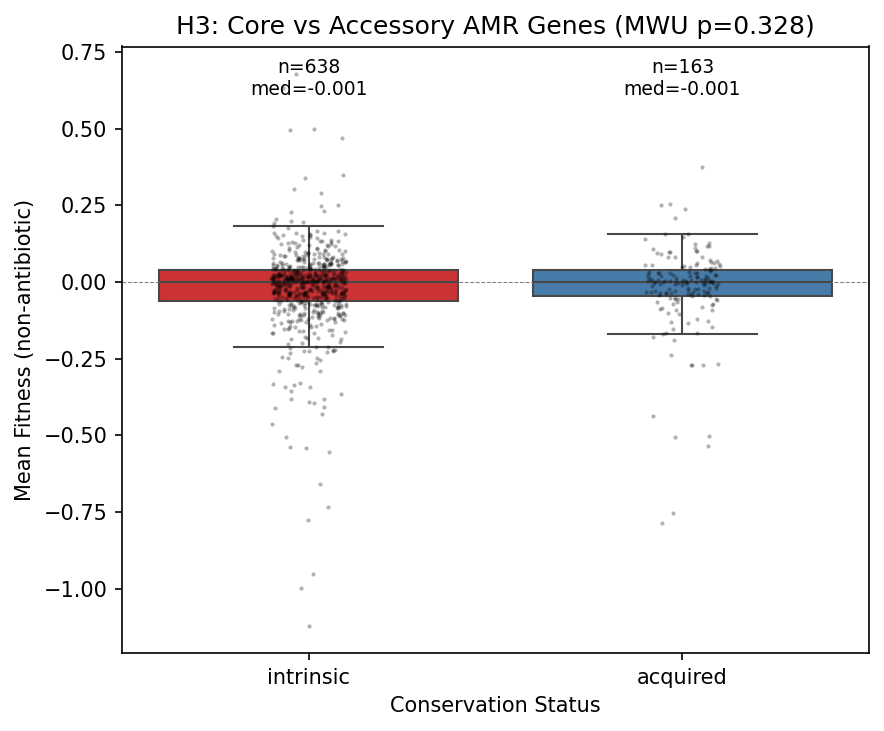 Box plot comparing core vs accessory AMR gene fitness. From amr_fitness_cost.
Possible Reconciliations
- Hypothesis 1: scope mismatch. The two results address different scopes and observables 1 2. Side A asks how often genes are core within fitness categories. Side B asks how fitness differs between conservation classes within one functional class. Both could hold without contradiction.
- Hypothesis 2: insufficient AMR subset. The AMR comparison may lack the size, condition matching, or singleton coverage needed to detect a gradient. Singletons are genes found in only one genome. Under this hypothesis, AMR genes are not truly an exception.
- Hypothesis 3: genuine exception. AMR genes may be retained or lost for reasons decoupled from baseline fitness, such as conditional benefit under drug exposure. If so, they would depart from the all-gene pattern.
- Hypothesis 4: relative-fitness readout. RB-TnSeq fitness is relative to the pool, not an absolute selection coefficient 2. Conservation-linked effects visible across all genes might therefore be diluted within a small, functionally narrow class.
Resolving Work
- Assemble a larger, condition-matched AMR subset with comparable coverage of core, accessory, and singleton genes. Re-run the core-versus-accessory fitness comparison to test whether the null persists with more genes. This is the resolution the source text itself names.
- Apply the all-gene binning (essential, broadly fitness-active, neutral) to AMR genes only, using the same fitness tables. Ask whether the core-representation gradient appears, flattens, or reverses.
- Compare positive and negative fitness tails between core and accessory AMR genes, not only central distributions. Ask whether the stronger tails reported for core genes genome-wide also appear among core AMR genes.
- Stratify AMR fitness by antibiotic-exposure versus baseline experiments. Ask whether conservation-linked differences emerge only where AMR genes are expected to be beneficial.
- Run an equivalence test with a pre-specified effect-size bound on the AMR comparison. Ask whether the null is a demonstrated absence of difference or merely a failure to detect one.