The environmental-resistome page records a positive relationship between antimicrobial resistance (AMR) and phylogenetic distance (evolutionary divergence between strains) in 701/1,261 species 1,2. That relationship may reflect lineage-associated acquisition or uneven sampling of lineages across environments, and the available analyses do not separate these explanations 1,2. A related limit applies to environmental signal. Where that signal is weak, it cannot distinguish absent adaptation from inadequate environmental representation 1,2. The distinction matters because it decides how far the resistome (the collection of AMR genes in a population) can be read as environmentally structured.
Evidence Sides
Side 1 (hypothesis): lineage-associated acquisition
The positive relationship between AMR and phylogenetic distance in 701/1,261 species may reflect lineage-associated acquisition 1,2. This reading explains the phylogenetic pattern. It does not by itself establish that environmental adaptation is absent, because weak environmental signal cannot distinguish absent adaptation from inadequate environmental representation 1,2.
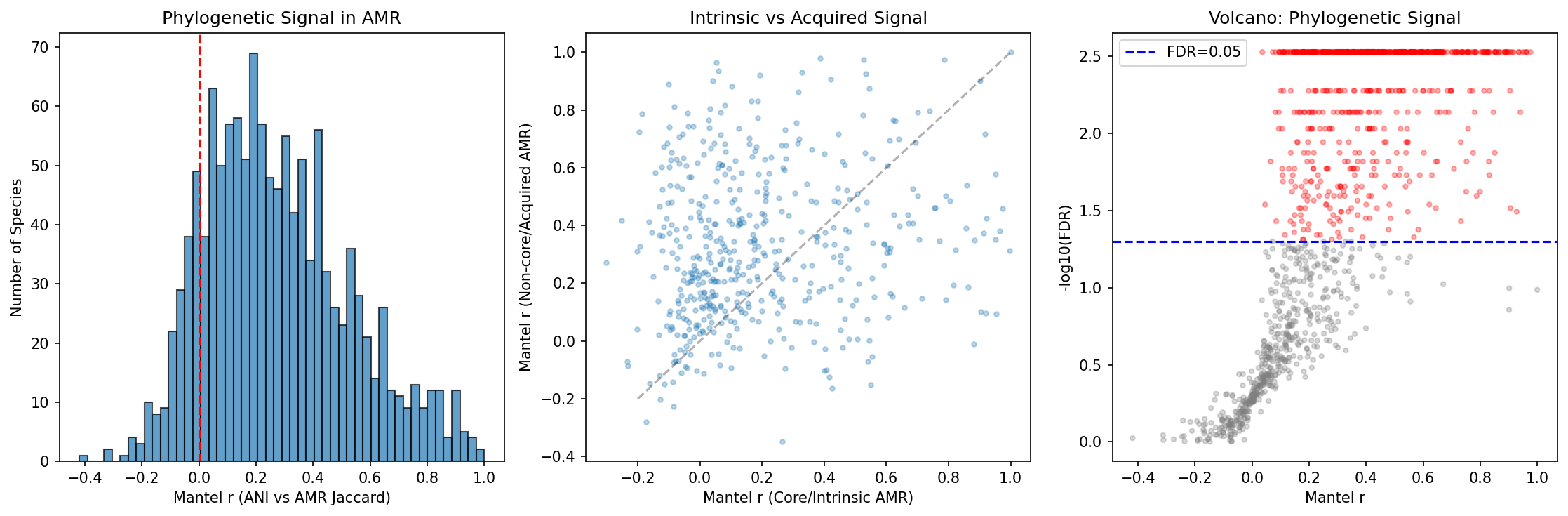 Phylogenetic signal showing Mantel r distribution, core vs non-core, and signal vs diversity. From amr_strain_variation.
Side 2: uneven lineage sampling and inadequate environmental representation
The same relationship may instead reflect uneven sampling of lineages across environments 1,2. Geographic coordinates were often missing or imprecise 1,2. Partial correlations (correlations between two distance matrices while controlling for a third) assume linear relationships between distance matrices 1,2. As a result, weak environmental signal cannot distinguish absent adaptation from inadequate environmental representation 1,2.
Possible Reconciliations
- Hypothesis: Both processes may operate together. Lineage-associated acquisition and uneven sampling of lineages across environments are both offered as explanations of the relationship, and the available analyses do not separate them 1,2.
- Hypothesis: Environmental effects may be non-linear. Partial correlations assume linear relationships between distance matrices 1,2, so such effects could be underestimated. In that case the weak signal would partly reflect the method.
- Hypothesis: Weak environmental signal may partly reflect metadata quality. Geographic coordinates were often missing or imprecise 1,2, so genomes with precise coordinates might show stronger structure.
Resolving Work
- Data: genomes per species with environment labels. Method: subsample to balance lineages across environments, then re-test the AMR–phylogeny relationship. Question: does the positive relationship persist once lineage sampling is even across environments?
- Data: the subset of genomes with precise geographic coordinates. Method: repeat the environment-versus-phylogeny partial correlations on that subset only. Question: does environmental signal strengthen when location is well specified?
- Data: the existing AMR and phylogenetic distance matrices. Method: rank-based partial correlations, which use ranks rather than raw distances, and multiple regression on distance matrices (MRM, which regresses one distance matrix on others) with non-linear terms. Question: is environmental signal hidden by the linearity assumption?
- Data: AMR genes split into mobile or acquired versus intrinsic ones. Method: compare their phylogenetic signal within the same species. Question: is the phylogenetic relationship driven by lineage-associated acquisition rather than by shared ancestry alone?
- Data: species with repeated sampling of the same lineage across contrasting environments. Method: compare AMR profiles within lineages and between environments. Question: do AMR profiles within a lineage differ between environments, which would show an environmental association independent of lineage?