Projects in this corpus disagree on whether genome-derived metal-tolerance scores line up with where bacteria are actually isolated. An isolate-level comparison against BacDive (a curated database of strain isolation and phenotype metadata) reports higher scores among contamination-associated isolates, while a species-scale cross-resistance analysis finds no correlation. 1,2 Global metagenome and amplicon analyses offer related but non-equivalent biogeographic signals. 3,4 The outcome matters for environmental-resistome, because it bears on how far these scores can be treated as validated against real isolation ecology.
Evidence Sides
Side A: contamination-associated isolates score higher
BacDive reports higher metal-tolerance scores among contamination-associated isolates. This includes a Cohen’s d (standardized mean difference between groups) of +1.00 for heavy-metal contamination, based on n = 10 isolates. 1,2 This side reports a positive direction at the isolate level, but the heavy-metal group is small.
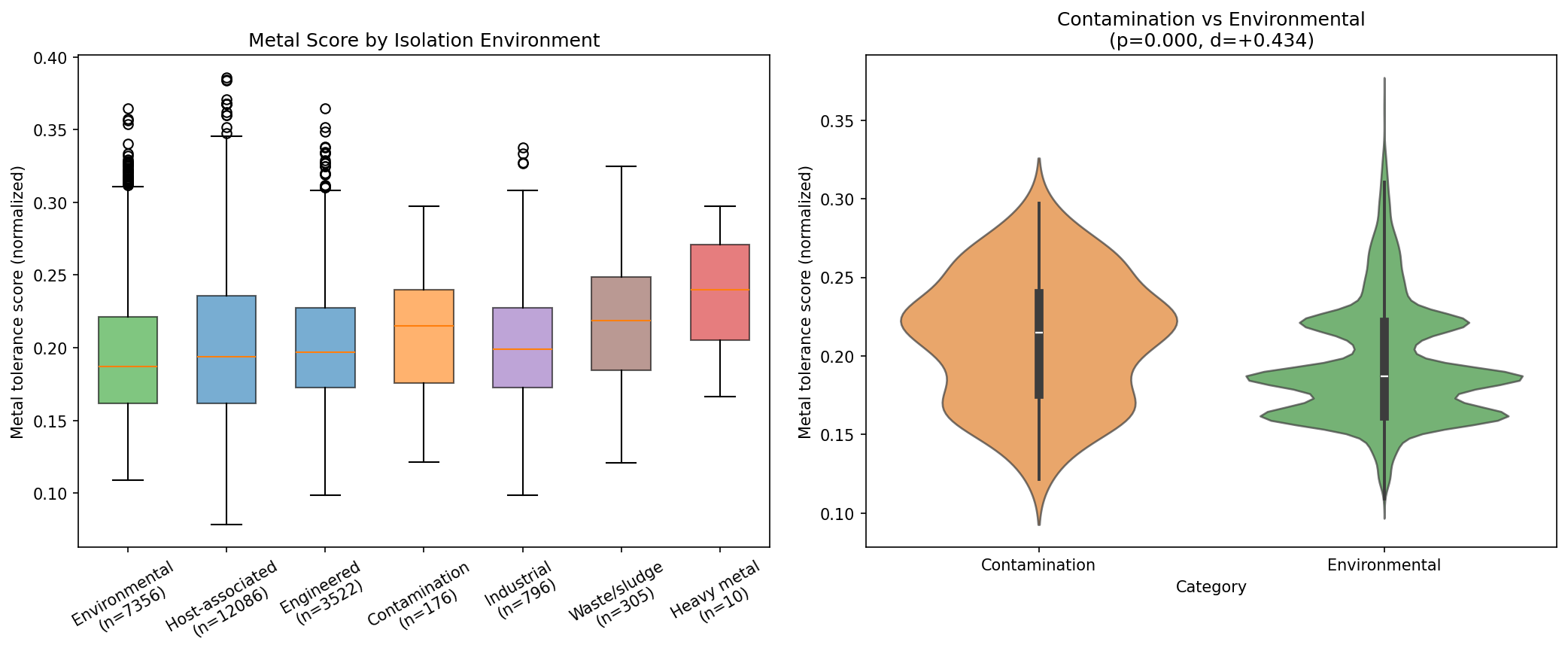 Metal score by environment. From bacdive_metal_validation.
Side B: no species-scale correlation
The cross-resistance analysis found no species-scale correlation between multi-metal tolerance and metal-associated isolation. Spearman rho, a rank correlation coefficient, was approximately −0.02, with a p-value (the probability of a result at least this extreme if no association existed) of p > 0.8. After matching, only 20 independent species remained. 1,2 This null result rests on a small species sample, so it does not establish that no association exists.
Context: related but non-equivalent global signals
A global analysis of MAGs (metagenome-assembled genomes) found that soil had 5.8% prevalence of metal resistance with an OR (odds ratio) of 5.05. Marine samples had 1.2% prevalence with an OR of 0.20. 3,4 MicrobeAtlas, a global amplicon-survey collection, found that metal-type diversity was associated with groundwater prevalence (ρ = +0.112, p = 0.0019) but not with groundwater-specific fold enrichment (ρ = +0.042, p = 0.242). 3,4 These results concern biome prevalence and genus-level metal-type diversity rather than isolate tolerance scores, so they are related to, but do not directly test, either side.
Possible Reconciliations
- Hypothesis 1: unit of analysis. Side A compares contamination-associated isolates, while Side B collapses data to independent species. 1,2 A signal carried by particular contaminated isolates may vanish once strains are pooled to species.
- Hypothesis 2: sample size. Both sides rest on small groups, so either result could reflect limited power rather than true presence or absence of an association.
- Hypothesis 3: score definition. Side B used a multi-metal tolerance score; if it differs from the score Side A tested, the analyses may measure different traits.
- Hypothesis 4: prevalence versus enrichment. The MicrobeAtlas contrast between prevalence and fold enrichment suggests that habitat breadth, rather than specialization, might drive any apparent metal–environment link.
Resolving Work
- Same score, different units. Use BacDive isolation records and pangenome (all genes across a species’ genomes) metal-tolerance scores, applying one score at isolate and species level. Does the positive effect persist after strains are collapsed to species?
- Mixed-effects modelling. Fit BacDive contamination categories in a mixed-effects model (regression with fixed and random terms), with species as a random effect (a per-species offset). Is the isolate-level association explained by species identity?
- Stricter taxonomic matching. Re-match the cross-resistance validation set with stricter taxonomic bridging and add species. Does a species-scale correlation emerge with a larger sample?
- Biome stratification of isolates. Combine MAG biome labels with isolate scores. Do high-scoring species concentrate in soil and avoid marine samples?
- Breadth controls. Use MicrobeAtlas groundwater samples in a regression that explicitly includes habitat breadth and sampling intensity as covariates. Does metal-type diversity predict groundwater fold enrichment once breadth is controlled?