Raw report: costly_dispensable_genes Feeds into: chromosomal-and-integrative-gene-transfer, community-metabolic-interdependence, condition-dependent-gene-tradeoffs, condition-specific-fitness, core-genome-burden-paradox, costly-dispensable-gene-loss, fitness-condition-coverage-prioritization-bias, gene-essentiality, genetic-perturbation-coverage-bias, homology-search-negative-evidence, horizontal-gene-transfer-driven-innovation, laboratory-fitness-versus-natural-selection, pangenome-core-boundary-and-clade-size-bias, research-attention-inequality, transposon-callability-bias
Overview
This analysis characterizes 5,526 bacterial genes that are both costly in laboratory fitness measurements and dispensable in the pangenome. The report describes it as the first systematic characterization of genes that are simultaneously burdensome (fitness improves when deleted) and not conserved in the pangenome. Across 142,190 genes from 43 bacteria, the costly+dispensable quadrant is dominated by mobile genetic elements and by poorly annotated, taxonomically restricted DNA rather than by core metabolic functions. The report reads these as hallmarks consistent with recent acquisition, but provenance was not measured directly. 1
Per-gene fitness values, gene metadata and experiment descriptions come from the kescience_fitnessbrowser collection (tables genefitness, gene, exps; see kescience-fitnessbrowser and kescience-fitnessbrowser). This is the Fitness Browser mutant-fitness data generated by Price et al. (2018). Pangenome gene clusters, gene-to-cluster mappings and functional annotations come from kbase_ke_pangenome (tables gene_cluster, gene_genecluster_junction, eggnog_mapper_annotations; see kbase-ke-pangenome). 1
The project’s generated table data/gene_quadrants.tsv holds 142,190 genes with fitness statistics, conservation status and selection-quadrant assignment. 1
Key Findings
Mobile genetic elements dominate
Costly+dispensable genes are 7.45x more likely than costly+conserved genes to contain mobile-element keywords such as transposase, integrase, phage, IS element, recombinase, or prophage (OR=7.45, p=4.6e-71). 1
The report compared SEED functional categories using FDR (false discovery rate, the expected proportion of false positives among the results called significant, here used as a multiple-testing-adjusted value). The SEED category “Phages, Prophages, Transposable elements, Plasmids” is 11.7x enriched in costly+dispensable versus costly+conserved genes (FDR=1.3e-17). “Virulence” is 26.7x enriched (FDR=5.6e-14), but this rests on small counts of 21 versus 4 genes. 1
The report’s figure fig_seed_enrichment.png shows SEED top-level category enrichment in costly+dispensable versus costly+conserved genes. 1
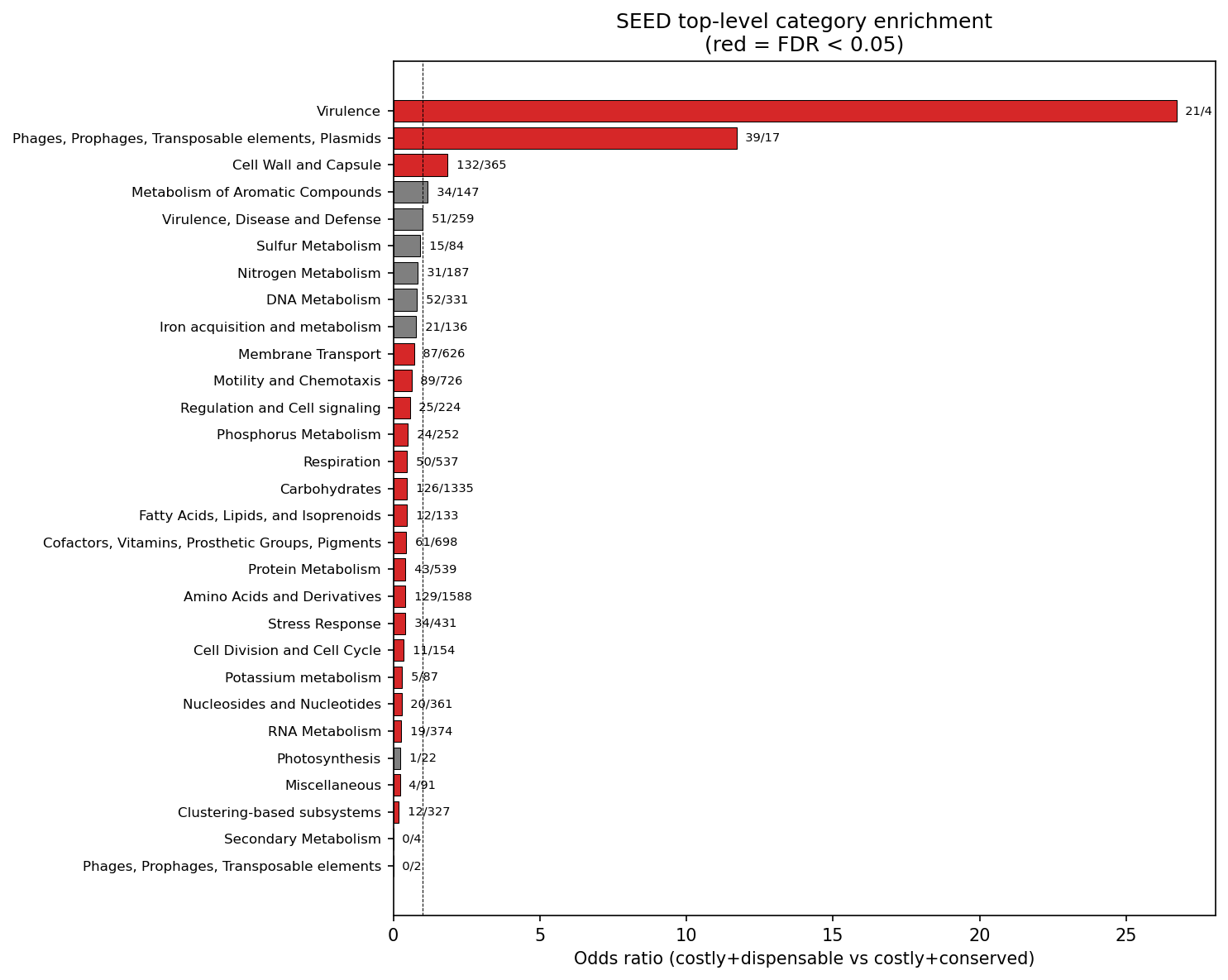 SEED top-level category enrichment in costly+dispensable vs costly+conserved. From costly_dispensable_genes.
Costly+dispensable genes show signatures of recent acquisition
Only 50.8% of costly+dispensable genes have SEED annotations, compared with 74.9% of costly+conserved genes. KEGG annotation rates are 20.0% and 42.7%, respectively. 1
The costly+dispensable group contains 44.5% orphan genes, meaning genes with no ortholog group (OG), compared with 13.1% among costly+conserved genes. Its median ortholog breadth is 15 organisms sharing the OG, compared with 31 for costly+conserved genes (Mann–Whitney p=4.0e-99, rank-biserial r=0.233). 1
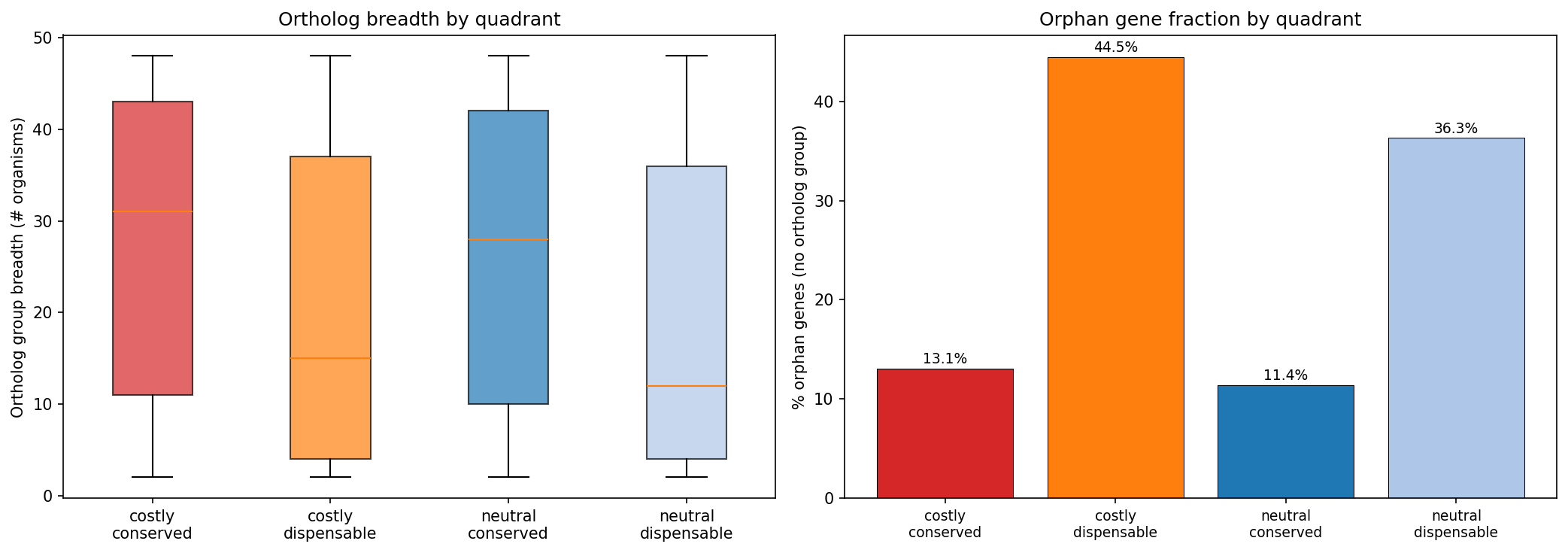 Ortholog group breadth and orphan gene fraction by quadrant. From costly_dispensable_genes.
The costly+dispensable group has a 24.2% singleton fraction, where a singleton is a gene found in only 1 genome. No costly+conserved genes are singletons. This contrast is partly structural, because core genes cannot be singletons by definition. Within the dispensable category, costly genes are only slightly more likely than neutral genes to be singletons (OR=1.09, p=0.02). 1
Costly+dispensable genes are shorter, with a median length of 615 bp versus 765 bp for costly+conserved genes (p=4.2e-75, rank-biserial r=0.170). This is consistent with IS elements and gene fragments. 1
Three of the report’s figures show these patterns by selection quadrant: fig_annotation_rate.png shows SEED and KEGG annotation rates, fig_ortholog_breadth.png shows ortholog-group breadth and orphan-gene fraction, and fig_gene_length.png shows gene-length distributions. 1
Core metabolism is depleted
Fourteen SEED top-level categories are significantly depleted in costly+dispensable genes at FDR < 0.05. They include Protein Metabolism, Respiration, Carbohydrates, Amino Acids, Cofactors/Vitamins, Motility, Stress Response, and RNA Metabolism. These core cellular functions are maintained in the 28,017 costly+conserved genes. The report interprets their lab-measured burden as offset by natural selection in environments not captured by laboratory experiments; this is an interpretation, not a measurement. 1
Pseudomonas stutzeri RCH2 is an outlier
pseudomonas-stutzeri-rch2 (psRCH2) contributes 21.5% of its genes as costly+dispensable. The next organism, bacteroides-thetaiotaomicron, is at 14.0%. The report suggests this may reflect a recent mobile-element invasion or a genomic expansion specific to this strain, but the cause is not established. 1
The report’s figure fig_organism_distribution.png shows costly+dispensable gene counts by organism, and fig_per_organism.png shows a stacked bar of selection-quadrant proportions per organism. 1
Some costly+dispensable genes have condition-specific effects
Despite being burdensome and non-conserved, 14.1% of costly+dispensable genes have condition-specific phenotypes. The rate is 16.7% for costly+conserved genes and 2.7% for neutral+dispensable genes. This pattern suggests that costly+dispensable genes are not inert and that their condition-specific effects may slow their loss from genomes. 1
Interpretation and biological significance
The report interprets costly+dispensable genes as the genomic debris of horizontal gene transfer (HGT). On this reading they are insertion sequences, prophage remnants, transposases, and defense systems that impose costs on their host and are not conserved across the species pangenome. Their mobile-element enrichment, narrow taxonomic distribution, short length, poor annotation, and depletion from core metabolism support this interpretation. Their provenance was not measured directly. 1
The report hypothesizes that these genes are candidates for ongoing gene loss. They may have been acquired by HGT, but their cost would likely see them purged over evolutionary time unless they provide a selective advantage in particular environments. The 14.1% with condition-specific phenotypes may persist when the relevant conditions occur frequently enough. 1
The 28,017 costly+conserved genes provide the contrast. They are enriched in core metabolism, including Protein Metabolism, Respiration, and Motility. The report interprets these functions as energetically expensive but maintained by purifying selection, because they are essential in natural environments not captured by lab experiments. In the pangenome, by contrast, costly+dispensable genes appear evolutionarily unstable. The report frames this as a distinction between laboratory-measured cost and environmental maintenance by selection. 1
The report places these findings alongside four lines of prior work. Morris et al. (2012) proposed the Black Queen Hypothesis, in which costly genes can be lost when community members provide their functions as public goods. Price et al. (2018) generated the Fitness Browser data used here and showed that mutant fitness data can assign phenotypes to genes of unknown function. Rosconi et al. (2022) showed that gene essentiality is strain-dependent in streptococcus-pneumoniae, with the accessory genome modulating which genes are required; this is literature context, not part of this project’s analysis. Further work links genome degradation to relaxed selection in symbiotic cyanobacteria. 1
According to the report, the cross-organism scale and the pangenome dimension are new, although mobile-element burden has been studied in individual organisms. The report concludes that costly+dispensable genes are almost exclusively mobile-element debris rather than degrading metabolic pathways. That conclusion supports the hypothesis that HGT-mediated genome expansion, rather than pathway degradation, is the primary source of costly non-conserved genes in bacteria. It is an interpretive inference from functional composition, not a direct test of provenance. 1
Caveats
- “Burden” is defined as max_fit > 1 in any experiment, so a single experiment can classify a gene as burdensome and the result is sensitive to noise in the fitness data. 1
- SEED and KEGG annotations cover only 56-79% of genes, and the unannotated fraction may have different functional profiles. 1
- The pangenome core/accessory (auxiliary) classification is binary; using the fraction of genomes carrying each gene would provide more resolution. 1
- The 90% identity DIAMOND threshold used for Fitness Browser–pangenome linking may miss recently acquired genes with low sequence similarity. 1
- The extreme 21.5% costly+dispensable proportion in psRCH2 may reflect strain-specific genomic features rather than a general pattern. 1
- Ortholog groups are assigned using bidirectional best hits (BBH) across 48 organisms, so genes with orthologs outside this set may be misclassified as orphans. 1
- Condition-specific phenotype data is biased toward conditions that can be tested in the laboratory. 1
Proposed Follow-up
The report proposes a Black Queen Hypothesis test using enigma-coral community composition data. The test would ask whether organisms with more costly+dispensable genes tend to co-occur with organisms that could provide the lost functions. 1
Slots Into
- costly-dispensable-gene-loss — This project is the core evidence for the costly+dispensable quadrant: 5,526 genes enriched for mobile elements (OR=7.45), orphan and singleton genes, short length, poor annotation and core-metabolism depletion, plus the hypothesis of ongoing loss and the psRCH2 outlier. 1
- horizontal-gene-transfer-driven-innovation — The report’s interpretation of costly+dispensable genes as HGT debris adds a counterpoint: much horizontally acquired DNA appears to be a burden rather than an innovation. 1
- core-genome-burden-paradox — The 28,017 costly+conserved genes are enriched in core metabolism, and the report interprets them as costly in the lab but maintained by selection. 1
- laboratory-fitness-versus-natural-selection — The report frames lab-measured cost as offset by environmental selection not captured in laboratory experiments. 1
- condition-dependent-gene-tradeoffs — 14.1% of costly+dispensable genes have condition-specific phenotypes, versus 2.7% of neutral+dispensable genes. 1
- community-metabolic-interdependence — The report invokes the Black Queen Hypothesis and proposes a co-occurrence test with ENIGMA CORAL data. 1
- pangenome-core-boundary-and-clade-size-bias — The singleton contrast is partly structural, and the binary core/auxiliary classification limits resolution. 1
- homology-search-negative-evidence — The 90% identity DIAMOND linking and BBH orthology across 48 organisms may inflate orphan calls and miss low-similarity acquired genes. 1
- fitness-condition-coverage-prioritization-bias — Condition-specific phenotype evidence is biased toward lab-testable conditions. 1
- gene-essentiality — The project adds a cross-organism selection-quadrant analysis showing that costly, non-conserved genes are enriched for mobile elements rather than core cellular functions. 1
- condition-specific-fitness — It shows that 14.1% of costly+dispensable genes nevertheless have condition-specific phenotypes, linking genomic dispensability to context-dependent fitness effects. 1
- pangenome-integration — It connects laboratory fitness burden with pangenome conservation, ortholog breadth, orphan status, singleton frequency, and gene length. 1