Projects disagree on how to read Complex I dispensability on non-aromatic carbon sources. Complex I is a respiratory NADH dehydrogenase, where NADH is reduced nicotinamide adenine dinucleotide. One reading treats its dispensability on glucose and lactate as consistent with compensation by NDH-2, an alternative NADH dehydrogenase. 1 An ADP1-specific analysis finds no significant cross-species compensation pattern. 2 The question matters for respiratory-capacity-and-nadh-load. If NDH-2 compensation explains substrate-dependent Complex I requirements, respiratory dependence could reflect dehydrogenase redundancy rather than NADH load alone.
Evidence Sides
Side 1: Complex I is dispensable, consistent with NDH-2 compensation
The earlier interpretation used transferred fitness, meaning fitness scores carried over from ortholog genes in other organisms. On that basis it reports Complex I as dispensable on glucose and lactate. It treats this as consistent with NDH-2 compensating for Complex I loss. 1
Side 2: ADP1-specific and cross-species evidence does not support compensation
The ADP1-specific analysis makes three findings. 2
- It reports a Complex I growth ratio of 1.44 on glucose. 2
- Under standard flux balance analysis (FBA) conditions, it predicts zero NDH-2 flux. FBA is a constraint-based model that predicts steady-state reaction fluxes. 2
- It finds no significant cross-species compensation pattern (p = 0.52; the p-value is the probability of a result at least this extreme if the null hypothesis of no pattern were true). 2
The central digest adds that an earlier cross-species result seemed to support compensation. That result was an annotation artifact: the NDH-2 candidates had been identified by text matching. 3
On lactate, the ADP1 wiring analysis reports a mild Complex I effect (0.77) rather than outright dispensability. 2
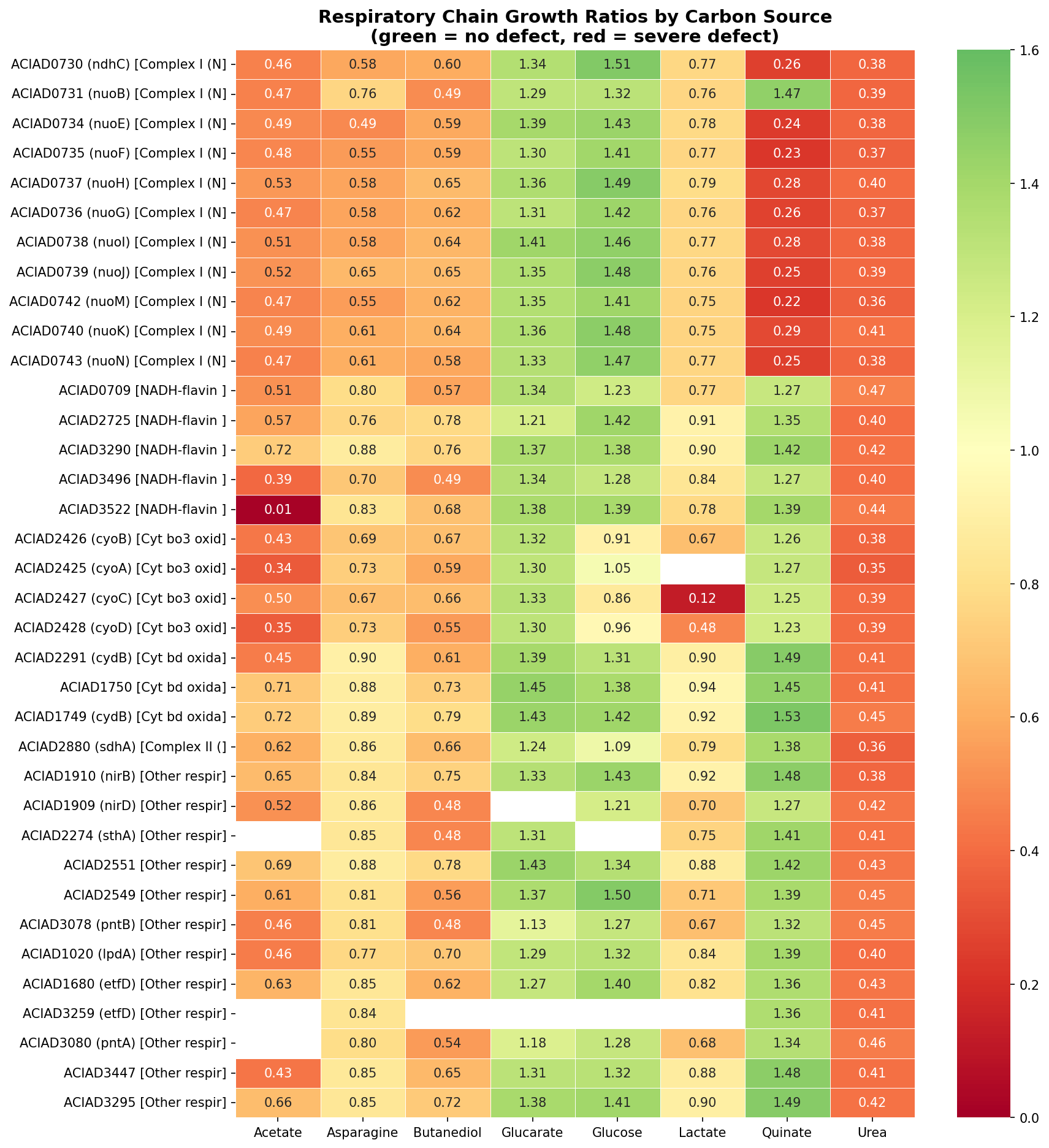 Respiratory chain growth ratios by carbon source. From respiratory_chain_wiring.
These results do not establish that the earlier interpretation is false. 2
Possible Reconciliations
- Hypothesis: different fitness metrics. Ortholog-transferred fitness scores and ADP1 growth ratios may measure different quantities. If so, “dispensable” and “mild effect” could describe the same underlying phenotype at different resolutions. 2
- Hypothesis: model assumptions. The zero NDH-2 flux prediction may depend on the standard FBA objective and constraints. If so, it may say little about NDH-2 activity in vivo. 2
- Hypothesis: species-level respiratory architectures. Compensation by NDH-2 may operate in some species and not others. If so, a strain-specific ADP1 result and a cross-species transferred result need not conflict. 2
Resolving Work
- Matched deletion assays. Build matched ADP1 deletion assays: Complex I, NDH-2, and the double deletion, each grown on glucose and lactate. This asks whether NDH-2 loss unmasks a Complex I requirement in ADP1. 2
- Direct redox measurements. Measure the NADH/NAD⁺ ratio (NAD⁺ is the oxidized form) across carbon sources in wild-type and Complex I mutants. This tests whether Complex I loss perturbs redox balance on substrates where growth looks unaffected. 2
- Validated cross-species annotations. Repeat the cross-species compensation test using NDH-2 calls validated by domain or homology evidence rather than text matching. This would show whether any compensation signal survives once annotation artifacts are removed. 3
- Altered FBA constraints. Rerun FBA with NDH-2 flux allowed under alternative objectives and capacity constraints, asking whether the zero-flux prediction is robust or depends on model assumptions. 2
- Same-metric comparison. Recompute transferred fitness and ADP1 growth ratios for the same genes and conditions on a common scale, asking whether the disagreement reflects the fitness metric rather than the biology. 2