This topic asks whether a gene’s measured effect on growth in the laboratory tells us why it is kept or lost across a species’ genomes in nature. The corpus can address this because several projects link genome-wide mutant fitness data from the Fitness Browser to pangenome conservation. The Fitness Browser data come from random barcode transposon sequencing (RB-TnSeq), which estimates each gene’s fitness from barcode abundance after pooled growth. Pangenome conservation is the split of a species’ full gene set into core genes, carried by nearly all strains, and accessory (auxiliary) genes, carried by only some. 1 The overall answer is that laboratory fitness and conservation are linked in a consistent direction, but the link is weak, depends on gene function, and is confounded by measurement artifacts. Laboratory fitness is therefore an imperfect proxy for natural selection rather than a readout of it. 1,2,3
Literature Context
Pangenome theory treats a species’ gene set as core genes present in all individuals plus accessory genes of variable presence. That variation is attributed to random drift, selection, the balance of gene gain and loss, and ecological and epistatic interactions, in which one gene’s effect depends on other genes. Separating these contributions will require new theory and empirical data (PMID 33423895).
Transposon-sequencing (Tn-seq) studies show that essentiality is conditional and strain-dependent. A reanalysis of public Tn-seq data from four Streptococcus pyogenes genetic backgrounds and nine conditions, using a 249-genome pangenome database, found 355 essential genes, about 24% of the core genome. It detected more essential operons under in vivo conditions (PMID 39012116). In Burkholderia cenocepacia K56-2, 508 genes were not significantly disrupted, which suggests they are essential for survival in rich, undefined medium. This set overlapped only partly with the essential genome of strain J2315, suggesting that some essential genes are strain-specific (PMID 29208119). In a murine surgical-wound model, co-infection with Pseudomonas aeruginosa converted about 25% of Staphylococcus aureus mono-culture essential genes to non-essential, and 182 genes became uniquely essential (PMID 28555625). In Mycobacterium intracellulare, 175 genes were conditionally essential under hypoxia (PMID 32214196). Single-gene disruption can also hide function. When nitrogen-fixing-dependent growth was compared with growth on supplied urea, many Azotobacter vinelandii genes previously believed important were disrupted without affecting fitness (PMID 34570624). Dual Tn-seq, which sampled 73% of the 1.3 million possible double deletions in Streptococcus pneumoniae, was built because gene redundancy masks single-mutant phenotypes (PMID 40997176). Tn-seq essentiality calls can also be false positives when the gene is actually deleted from the strain’s genome (PMID 34889987).
Against this background, the corpus’s modest essential-to-core gradient is consistent with a literature that treats essentiality as condition- and strain-bound rather than fixed. The corpus extends single-species work by measuring the gradient across many Fitness Browser organisms. Its observation that laboratory-neutral genes are often still core fits the redundancy and condition-dependence findings above. Those findings suggest the hypothesis that neutrality in a few lab conditions need not imply dispensability. The deletion false-positive result (PMID 34889987) supports the hub’s concern about measurement artifacts. It is a separate problem from the corpus’s unadjusted gene-length confound.
The corpus is in tension with a simple streamlining expectation. In marine bacterioplankton, free-living lineages carry streamlined genomes, and natural selection is thought to maintain these strategies, although genetic drift is not ruled out for ancient ecological switches (PMID 26051014). The corpus instead finds that core genes are more often burdensome in the lab than accessory genes. That result is reported only for laboratory conditions, and its selective interpretation remains a hypothesis. The costly-and-dispensable genes enriched in mobile-element annotations fit the gain/loss and drift processes in the pangenome framework (PMID 33423895). However, the corpus infers their horizontal-transfer origin from annotations rather than measuring it (costly-dispensable-gene-loss).
What the Corpus Shows
A real but modest gradient. Across 194,216 protein-coding genes from 43 bacteria, essential genes were 82% core and always-neutral genes were 66% core. The synthesis describes this gradient as clear but modest. 1 An independent analysis supports this result. However, fitness breadth, the number of tested experiments in which a gene affects fitness, was only weakly associated with core status (Spearman rho=0.086, p=8.1e-230). 2 A separate 33-organism linkage found that essential genes were 86.1% core versus 81.2% of non-essential genes, with a median odds ratio of 1.56. An odds ratio here compares the odds of being core between the two groups. In that linkage, 18 of 33 organisms showed significant enrichment after Benjamini–Hochberg false discovery rate (FDR, a multiple-testing correction) control. 4 These cohorts and essentiality definitions differ, so the figures must not be averaged. 4,1 Laboratory neutrality therefore does not imply evolutionary dispensability, as laboratory-fitness-versus-natural-selection argues. 2
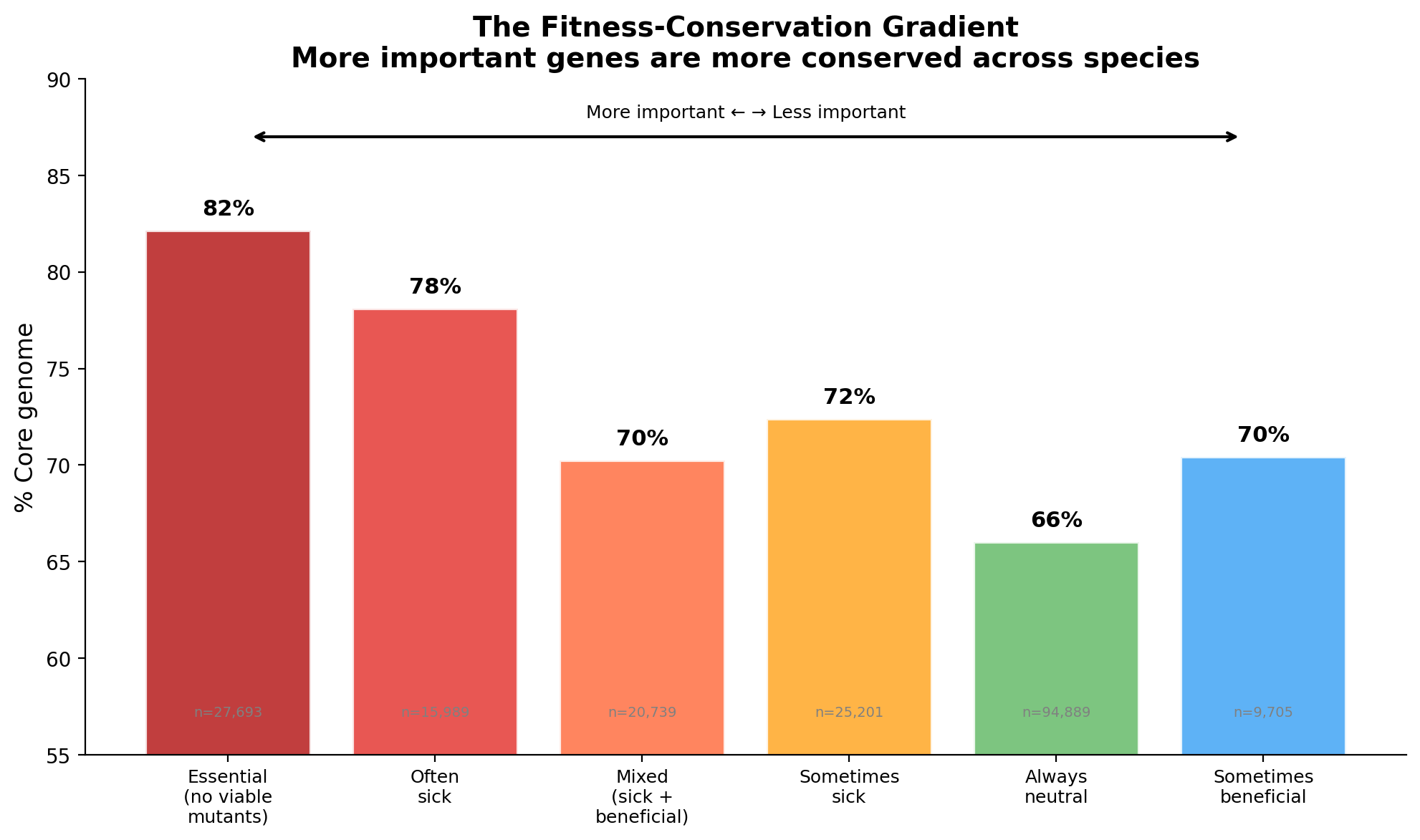 Fitness-Conservation Gradient. From conservation_fitness_synthesis.
Conserved genes are often costly in the lab. Deleting a gene improved growth for 24.4% of core genes but only 19.9% of accessory genes. 1 The cross-project digest frames this as a challenge to a “streamlining” model in which accessory genes are the metabolic burdens. 5 The core-genome-burden-paradox page shows that the effect depends on function. Core genes carried more burden than non-core genes in RNA Metabolism (+12.9 percentage points), Motility (+7.8) and Protein Metabolism (+6.2). Cell Wall genes reversed the pattern at -14.1 percentage points. 6 The analysis identified 25,271 true trade-off genes, 17.8% of genes examined, which were important in some conditions and burdensome in others. These genes were more likely to be core (OR=1.29, p=1.2e-44). 6 The 28,017 genes that are both costly in the lab and conserved are treated as evidence for purifying selection in environments the assays do not represent. They are not a direct measurement of that selection. 1 The proposed explanations, flagella as costly but useful for chemotaxis and ribosomal components as costly but needed for rapid growth, are interpretations rather than measurements. 1
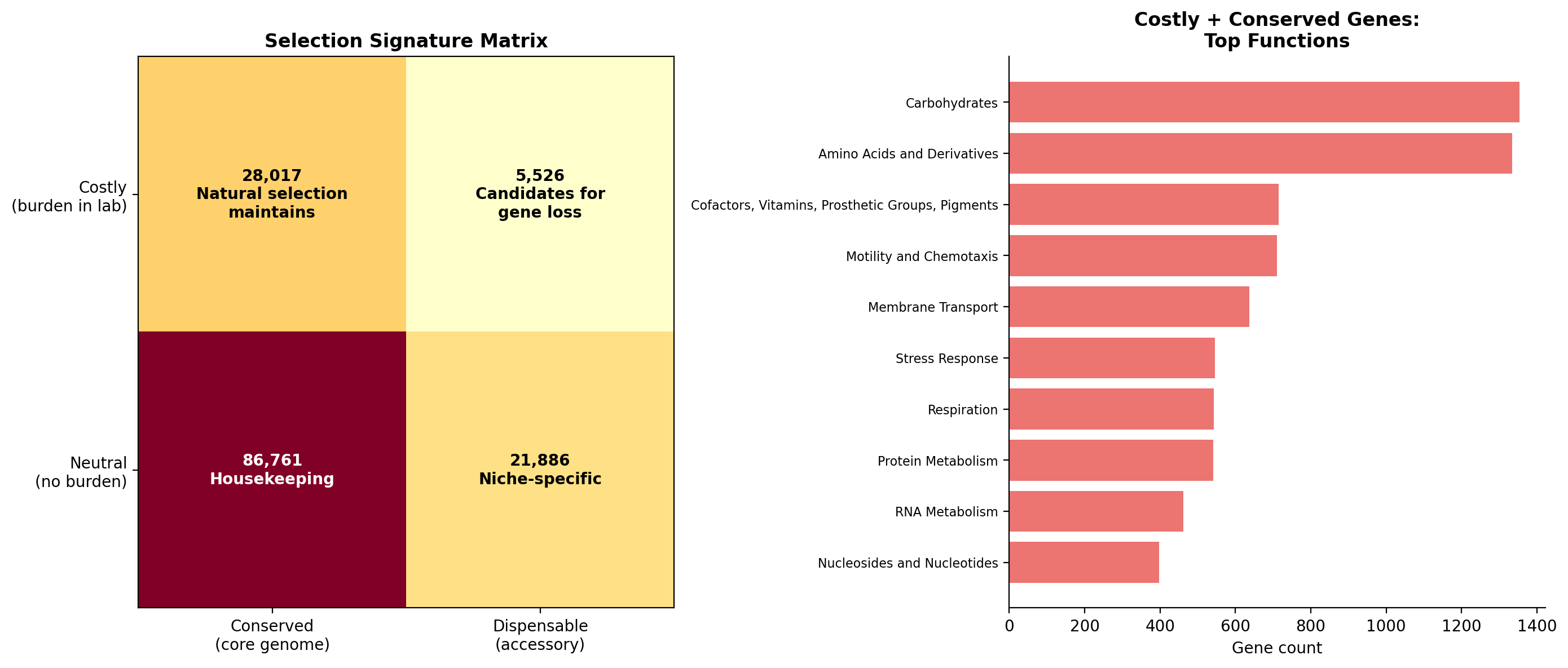 Selection Signature. From conservation_fitness_synthesis.
Costly and dispensable genes look like mobile debris. The opposite quadrant contains 5,526 genes that are costly in the lab and not conserved, identified among 142,190 genes from 43 bacteria. 7 These genes were 7.45 times more likely than costly-and-conserved genes to carry mobile-element keywords (OR=7.45, p=4.6e-71). Of them, 44.5% were orphans with no ortholog group, compared with 13.1% of costly-and-conserved genes. 7 The report reads them as debris from horizontal gene transfer that is subject to loss. That origin is inferred from annotation and distribution patterns, not measured directly, as costly-dispensable-gene-loss notes. 7
Some gene sets show decoupling. For antimicrobial-resistance (AMR) genes, core genes (N=638) and accessory genes (N=163) had virtually identical mean fitness of −0.024. The standardized difference between the group means was Cohen’s d = 0.002, with Mann-Whitney U p = 0.33. This null result stays null. 8 A separate cross-reference found singleton AMR genes to be the costliest class (median -0.019). 9 The neutral-and-conserved class contained 86,761 genes, conserved without any measured burden. 6 These results and their limits are developed in pangenome-conservation-fitness-decoupling.
Lab–field concordance is partial and conditional. A pre-registered mapping found 29 of 47 testable dark-gene clusters concordant with their carriers’ environments (61.7%). The one-sided binomial test gave p = 0.072 and Fisher’s combined test gave p = 0.031. 10 At Oak Ridge, a laboratory metal-tolerance score showed a positive but non-significant association with uranium-linked field abundance (Spearman rho = 0.503, p = 0.095, n = 12 genera). 11 In Desulfovibrio vulgaris Hildenborough (DvH), logistic-regression models predicted core status rather than environmental distribution. They covered 2,725 non-essential genes with fitness and pangenome links, and essential genes were excluded. The models were scored by cross-validated area under the receiver operating characteristic curve (CV-AUC), a measure of classification discrimination in which values near 0.5 indicate an uninformative predictor. CV-AUC was 0.517 (standard deviation 0.052) for field fitness, 0.531 (0.052) for lab fitness and 0.548 (0.053) for both combined. Adding gene length raised it to 0.645 (0.068). 3 The details are in lab-field-fitness-concordance.
“Conserved” depends on the metric. eggNOG is the ortholog-group annotation resource used here. Its broad ortholog-group classification placed 30,721 of 30,756 dark-gene clusters (99.9%) in the “universal” category, which made it non-discriminative. 10 A continuous species-count variant correlated with the original ranking at Spearman ρ = 0.982, yet the two shared only 62% of their top-50 candidates. 10 Querying the full 27,690-species Genome Taxonomy Database (GTDB) r214 pangenome produced graded taxonomic tiers instead. 10 comparative-conservation-metric-calibration explains how these choices change which unknown genes get prioritized.
Tensions and Caveats
- Effect size across cohorts. The 82%-versus-66% comparison and the 86.1%-versus-81.2% comparison agree in direction but differ in cohort and category definitions. Neither can stand alone as the magnitude of the essentiality–conservation link. 2,4 See conflicts/conflict—core-genome-burden-paradox—39aa8e5b.
- Gene length confound. Short genes receive fewer transposon insertions, and core genes tend to be longer. The broad analyses did not adjust for gene length. 3,2,1 How much of the gradient survives adjustment is unresolved. See conflicts/conflict—laboratory-fitness-versus-natural-selection—239d08e3.
- Validation versus suggestion. The digest calls lab–field concordance a validation of Fitness Browser data as a proxy for in situ importance. 5 The project’s own binomial p = 0.072 supports only suggestive concordance. 10 See conflicts/conflict—lab-field-fitness-concordance—1e5ceb53.
- Oak Ridge denominators and BacDive power. Projects report different genus counts for the Oak Ridge test 11,12 and describe the statistical power of the BacDive metal validation in incompatible ways. 13,12 See conflicts/conflict—lab-field-fitness-concordance—59292395 and conflicts/conflict—lab-field-fitness-concordance—85017f97.
- Metal genes: core or accessory? In DvH, heavy-metal-important genes were less core than field-stress genes. 3 The Metal Fitness Atlas, as cited in counter_ion_effects, reported that metal-important genes are enriched in the core. 14 Per-metal deltas and gene-set definitions also disagree across reports. 15,14,16 See conflicts/conflict—laboratory-fitness-versus-natural-selection—a172813c, conflicts/conflict—pangenome-conservation-fitness-decoupling—3d49a2ee and conflicts/conflict—pangenome-conservation-fitness-decoupling—ae3d6d63.
- Decoupling versus gradient. The AMR null result and the genome-wide gradient may differ because of scope, and singleton AMR results complicate coarse prevalence classes. 8,2,9 See conflicts/conflict—pangenome-conservation-fitness-decoupling—e470a03a and conflicts/conflict—pangenome-conservation-fitness-decoupling—8173d997.
- Pathway-level extension. Pathway analyses disagree on whether metabolic dependencies an organism actively uses sit higher in the core than capabilities it carries but does not use. 17 See conflicts/conflict—condition-specific-fitness—74a89753.
- What counts as “conserved”. Clade-core membership and taxonomic breadth are different measurements, and they rank genes differently. 4,10 See conflicts/conflict—comparative-conservation-metric-calibration—84eb9535.
- Proxy limits. Laboratory conditions are an impoverished stand-in for soil, biofilms and host tissue. 1 For the costly-and-conserved genes, neither selection nor essentiality in natural environments was directly measured. 6
Where to Go Deeper
- laboratory-fitness-versus-natural-selection — the central proxy argument, including the DvH field-versus-lab models and the gene-length confound.
- core-genome-burden-paradox — the function-by-function burden structure and the costly-and-conserved quadrant.
- costly-dispensable-gene-loss — the mobile-element evidence for costly-and-dispensable genes as candidates for ongoing gene loss.
- pangenome-conservation-fitness-decoupling — the AMR null result, graded essentiality, and where conservation stops tracking fitness.
- lab-field-fitness-concordance — the carrier-environment tests, the Oak Ridge field data, and their statistics.
- comparative-conservation-metric-calibration — why the choice of conservation metric changes gene priorities.
Key entities: kescience-fitnessbrowser, tnseq, kbase-ke-pangenome, gtdb, independent-component-analysis, desulfovibrio-vulgaris-hildenborough, metal-fitness-atlas.
Reports: Gene Conservation, Fitness, and the Architecture of Bacterial Genomes, Fitness Effects vs Conservation — Quantitative Analysis, Conservation vs Fitness — Linking FB Genes to Pangenome Clusters, Core Gene Paradox — Why Are Core Genes More Burdensome?, The 5,526 Costly + Dispensable Genes, Field vs Lab Gene Importance in *Desulfovibrio vulgaris* Hildenborough, Functional Dark Matter — Experimentally Prioritized Novel Genetic Systems, Fitness Cost of Antimicrobial Resistance Genes.