Projects linking laboratory fitness to pangenome conservation (whether a gene belongs to the core genome shared across a species’ genomes) report effects that cannot be compared directly. Two cross-organism estimates of how often essential genes are core come from different cohorts and definitions. 1 2 A single-organism model improves when gene length is added to fitness. 3 The broad analyses report a weak gradient without adjusting for length. 4,1 The laboratory-fitness-versus-natural-selection argument depends on this point: if much of the gradient reflects gene length or other confounders, laboratory fitness is an even weaker proxy for natural selection than the broad analyses imply.
Evidence Sides
Broad cross-organism analyses: a real but weak gradient, without length adjustment
The broad synthesis estimates that 82% of essential genes are core. 1 A separate 33-organism linkage of Fitness Browser essentiality calls to pangenome conservation estimates 86.1%. 2 These are an unresolved scope tension, not competing measurements, because their cohorts and definitions differ. 1 2 Broader analyses report a real but weak gradient between fitness importance and conservation, with no adjustment for gene length. 4,1
Within-organism DvH model: adding gene length improves prediction
In Desulfovibrio vulgaris Hildenborough (DvH), models predicting conservation from fitness alone reached a cross-validated area under the receiver operating characteristic curve (CV-AUC, a measure of how well a model separates classes on held-out data) of 0.517–0.548. Adding gene length raised CV-AUC to 0.645. 3 This result comes from a single organism and should be treated as such.
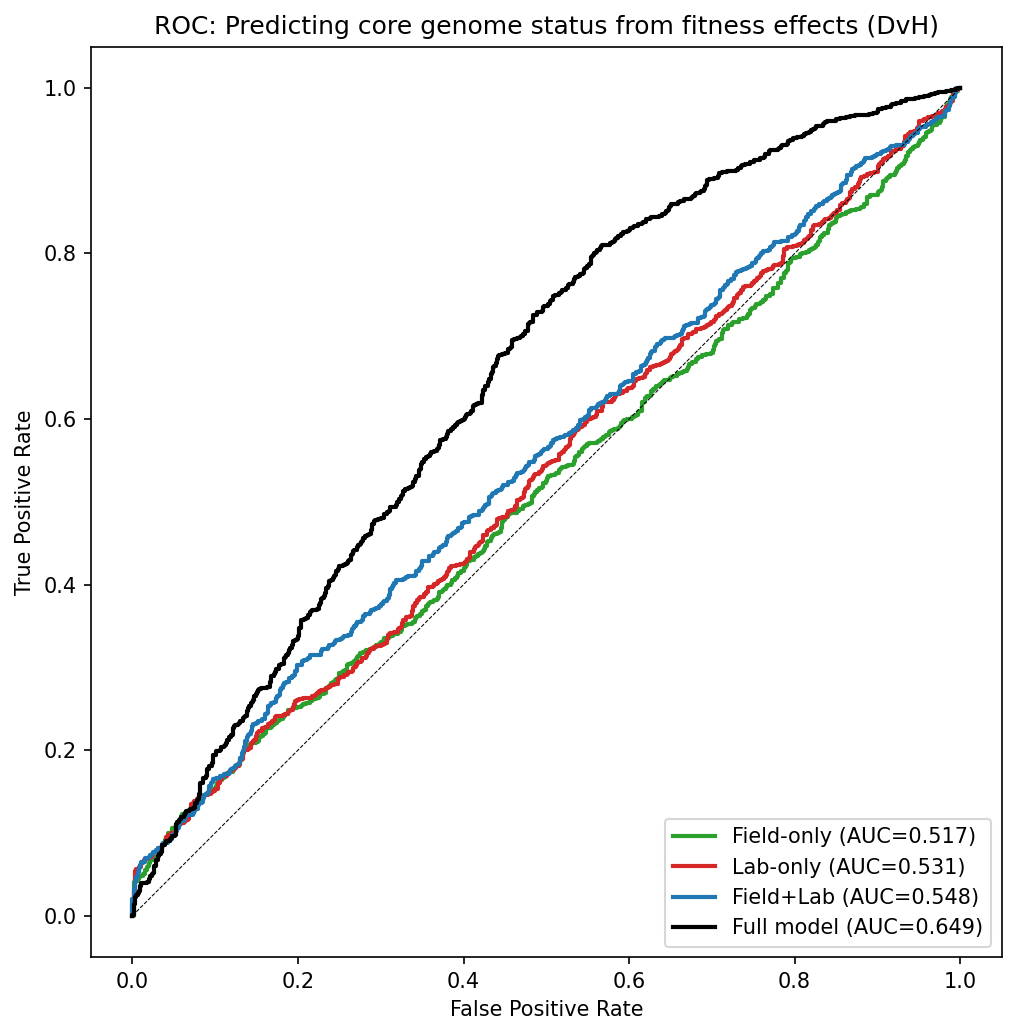 ROC curves comparing field-only, lab-only, combined, and full models for predicting core genome status. From field_vs_lab_fitness.
These results do not estimate a shared model. The open question is how much of the broad gradient survives explicit adjustment for length, insertion callability (whether transposon insertions can be detected in a gene), phylogeny and pangenome coverage. 3 4,1
Possible Reconciliations
- Hypothesis: Gene length confounds both essentiality calls and core status across organisms, so part of the broad gradient is a length effect.
- Hypothesis: The gap between the 82% and 86.1% estimates reflects differences in cohort membership and essentiality definitions, not a disagreement about biology. 1 2
- Hypothesis: DvH is atypical, and adjusting for length in other organisms would leave more of the fitness–conservation gradient intact.
Resolving Work
- Data: the 33-organism Fitness Browser cohort, restricted to genes shared with the broad synthesis cohort. Method: recompute core fraction under one shared essentiality definition. Question: does the scope gap between the two estimates close under matched cohorts and definitions?
- Data: per-gene fitness, length and core status for every organism in the broad synthesis. Method: per-organism logistic models (models estimating the probability of a binary outcome) with and without length, compared by CV-AUC. Question: is the DvH length effect general?
- Data: transposon insertion density per gene. Method: add an insertion-callability covariate (an explanatory variable included in a model) to the models. Question: does part of the “essential” signal reflect genes that cannot receive detectable insertions?
- Data: a species phylogeny alongside the gene-level tables. Method: phylogenetic mixed models of core status (models that account for relatedness through shared ancestry). Question: does the gradient persist once shared ancestry is controlled for?
- Data: genome counts per species pangenome. Method: stratify the gradient by pangenome coverage. Question: is the gradient weaker or stronger in well-sampled pangenomes?