A gene fitness landscape is the set of growth effects that disrupting each gene produces across many experimental conditions. Cofitness measures similarity in genes’ fitness profiles across conditions 1. A fitness module is a group of genes with coordinated fitness patterns across experiments 2. This corpus addresses the topic at scale. One synthesis integrates RB-TnSeq (random barcode transposon sequencing, a pooled transposon-mutant fitness assay) data for 194,216 protein-coding genes across 43 bacteria with pangenome conservation 3. Another evaluates module discovery across 32 organisms 2. Studies in Acinetobacter baylyi ADP1 test how condition dependence is wired 4,5. The evidence supports structured, condition-dependent fitness organization but does not settle whether that structure reflects direct co-regulation or shared dispensability 1. Module calls also depend on thresholds and decomposition choices 2.
Literature Context
Genome-wide transposon fitness profiling is well established. The original Tn-seq method sequenced the flanking regions of a saturated Mariner insertion library to calculate a fitness value for each gene of Streptococcus pneumoniae. A screen of five query genes in that study found alleviating and aggravating genetic interactions in seven distinct categories (PMID 19767758). RB-TnSeq (random barcode transposon-site sequencing) added DNA barcodes so that TnSeq is performed once per organism rather than once per sample. Its developers reported 387 successful genome-wide fitness assays covering 130 bacterium–carbon source combinations and found 5,196 genes with significant phenotypes across five bacteria (PMID 25968644). Published protocols separate genes essential in a single condition from those that are conditionally important across growth environments, illustrated in Rhodobacter sphaeroides and Zymomonas mobilis (PMID 34709619).
Gene requirements are strongly condition-dependent. In Mycobacterium intracellulare ATCC13950, 506 of 5126 genes were essential and 175 genes showed decreased fitness as conditionally essential under hypoxia (PMID 32214196). Across eight clinical isolates and the type strain, 131 essential or growth-defect-associated genes were shared. Under standard growth conditions the clinical strains had increased requirements for gluconeogenesis and type VII secretion genes, and increased requirements of hypoxic fitness genes were confirmed in a mouse lung infection model (PMID 41432055). In Staphylococcus aureus osteomyelitis, 65 genes were essential for survival in infected bone and a further 148 mutants had compromised fitness in vivo (PMID 26684646). In vitro, clpP loss reduced S. aureus fitness under calprotectin-imposed metal limitation; separately, ClpP contributed to pathogenesis in vivo in a calprotectin-dependent manner (PMID 38920392). In Azotobacter vinelandii, a Tn-seq comparison of nitrogen-fixing growth with urea-supplied growth probed more than 3,800 genes and found that many genes previously believed important could be disrupted without impacting fitness under these conditions, which the authors read as functional redundancy (PMID 34570624). These are abstract-level findings from one organism or a small strain panel.
The corpus is consistent with this condition dependence. In A. baylyi ADP1, 5 principal components captured 82% of variance across 8 carbon sources. Across 48 organisms, 267 of 1,695 complete pathway–organism pairs (15.8%) were fitness-neutral “latent” capabilities. That these reflect redundancy like that proposed for A. vinelandii (PMID 34570624) is a hypothesis. The corpus extends RB-TnSeq beyond five bacteria (PMID 25968644) to 194,216 genes across 43 bacteria. It calls 1,116 modules across 32 organisms by independent component analysis (ICA), which decomposes correlated profiles into components. Its modest essential-gene core bias is novel relative to this set, since no candidate tests conservation. Strain-specific requirements in M. intracellulare (PMID 41432055) suggest the hypothesis that phenotypes transfer imperfectly between orthologs, as the corpus cautions, though strains are not species.
The measurements also differ in kind. The original Tn-seq study reported genetic interactions from a screen of five query genes (PMID 19767758), whereas the corpus’s cofitness edges are correlations across conditions that it reads as a shared phenotype rather than co-regulation. No candidate paper offers a fitness-matched null that would separate co-regulation from shared dispensability. The calprotectin study concerns metal sequestration rather than metal excess (PMID 38920392), so it does not directly bear on the corpus’s split between metal-specific and general-stress fitness.
What the Corpus Shows
Modules are real, but their boundaries are set by the calling procedure. Independent component analysis (ICA) is a statistical method that decomposes correlated measurements into components 2. With membership set at |weight| >= 0.3 and at most 50 genes, it yielded 1,116 stable modules across 32 organisms. Of these, 94.2% showed significantly elevated within-module cofitness (Mann-Whitney U, p < 0.05). Mean |r| was 0.34 against a background of 0.12, and genomic-adjacency enrichment was 22.7× 2. Replacing a permissive normality-test rule with this cutoff raised cofitness enrichment from 59% to 94.2% and within-module |r| from 0.047 to 0.34 6. The digests phrase the cutoff as |Pearson r| ≥ 0.3 with the module profile, and that difference is unreconciled 2,6. The pitfalls digest calls this cutoff the single most impactful parameter in the pipeline 7. fitness-module-detection-sensitivity therefore treats ICA as a process-level tool: a module places a gene in a coordinated process without establishing its precise molecular function 2.
A cofitness edge records a shared phenotype, not shared regulation. In the antimicrobial-resistance (AMR) analysis, 769/801 AMR genes (96%) had at least one extra-operon partner at |r| > 0.3. Mean support networks contained 233, 110 and 71 genes at |r| > 0.3, 0.4 and 0.5. The report cautions that the 233-gene mean includes many weak associations and needs confirmation at |r| > 0.4 1. AMR-containing modules had a median of 46 versus 27 genes (p = 1.7×10⁻⁸) 1. cofitness-network-architecture reads this as large, conserved, condition-associated structure 1. It also notes that genes can correlate simply because both are dispensable in the same conditions 1. Flagellar and biosynthesis terms were enriched, for example flagellum assembly at a mean odds ratio (OR) of 5.3 in 5 organisms. This could reflect useless flagella in shaken liquid culture rather than co-regulation 1. fitness-matched-null-models specifies the test that would separate these explanations: a permutation matching mean fitness as well as conservation class 1.
Fitness importance predicts conservation, but only modestly. Essential genes were 82% core (present in nearly all genomes of a species), compared with 66% of always-neutral genes 3. Fitness breadth, however, was only weakly associated with core status (Spearman rho=0.086, p=8.1e-230) 8. In a narrower linked dataset, essential genes were 86.1% core versus 81.2% of non-essential genes (median OR 1.56). Only 18 of 33 organisms were significant after Benjamini-Hochberg false discovery rate (FDR) correction 9. condition-dependent-gene-tradeoffs refines this picture. It finds 25,271 genes (17.8% of those examined) with fitness below -1 in some conditions and above 1 in others, and these were 1.29 times more likely to be core (p=1.2e-44) 10. module-level-coinheritance finds that pairwise cofitness barely predicts co-occurrence across genomes. Delta phi is cofit-pair co-occurrence minus prevalence-matched random-pair co-occurrence. It averaged +0.011 across 9 organisms, with an aggregate effect of +0.003. The organism-level Wilcoxon test was null (W=9, p=0.13), and multi-gene modules gave a stronger signal 11.
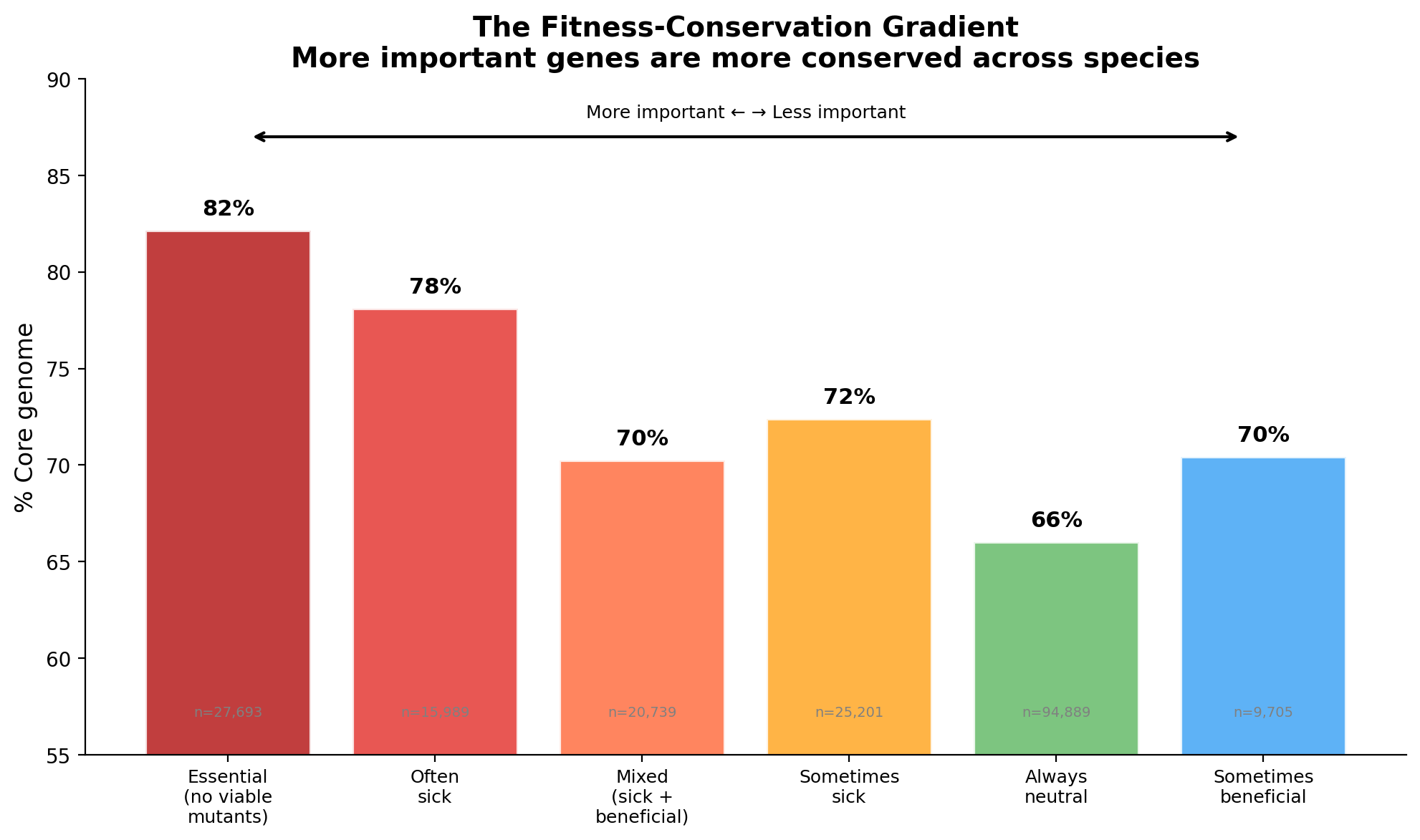 Fitness-Conservation Gradient. From conservation_fitness_synthesis.
Condition space is multidimensional, and dependence is conditional. In ADP1, principal component analysis (PCA), which summarizes correlated variation into orthogonal components, found that 5 components captured 82% of variance across 8 carbon sources, none more than 37% 4. condition-space-dimensionality also reports latent capabilities, which are complete pathways that were fitness-neutral under the study’s thresholds. Of 1,695 complete pathway–organism pairs from 48 organisms, 267 (15.8%) were latent, and the latent fraction ranged from 4.7% to 21.1% across tested thresholds 12. condition-specific-fitness shows substrate-specific respiratory wiring. Complex I, also called NDH-1, is the proton-pumping dehydrogenase that oxidizes NADH, the reduced electron carrier 5. Quinate specifically required Complex I, whereas glucose required no specific respiratory component 13. genomic-dispersal-functional-coupling shows coupling without physical clustering: a 51-gene quinate support network places 44/51 genes (86%) in four subsystems in distinct chromosomal regions 5. outer-membrane-lipid-homeostasis adds a multi-component case: Caulobacter crescentus Δlpxc (lipid A loss) in a Δfur ΔsspB background, whose viability prior work ties to Δfur and anionic sphingolipid. The evidence supports a phased, component-specific rescue rather than a single-gene phenotype, and causal order remains unresolved 14.
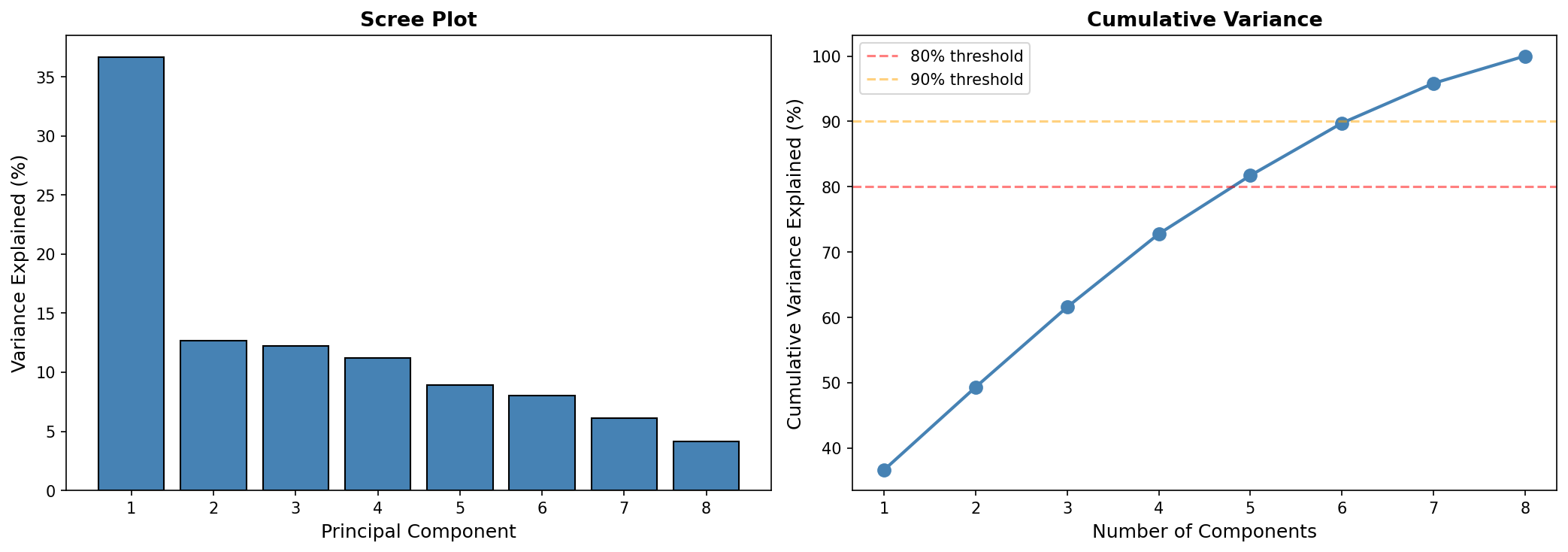 PCA variance explained and cumulative variance. From adp1_deletion_phenotypes.
Fitness profiles mix shared stress with stressor-specific requirements. Of 10,821 metal-important gene records, 4,304 (39.8%) were also NaCl-important, falling to 36.7% without the Synechococcus elongatus outlier 15. A separate set of 7,609 records from 24 organisms was classified against 5,945 non-metal experiments. A metal-specific record required a significant metal defect and a non-metal sick rate below 5%, while general-sick records were those whose genes were also sick across the non-metal experiments. By these rules 54.9% were metal-specific and 38.0% general sick, and the specific fraction was approximately 41% at a 2% threshold and approximately 67% at 10% 16. Metal–metal fitness correlations were 98.1% positive (311/317), but a metal-label permutation was non-significant (p = 0.42) and that study had no non-metal stress controls 17. shared-stress-versus-stressor-specific-fitness therefore requires decomposing these profiles before any mechanistic reading 15. cross-species-fitness-transferability applies similar caution to ortholog transfer, which carries phenotype evidence between corresponding genes in different species. Complex I orthologs had mean fitness of -1.35 on aromatic conditions versus -0.77 on comparison conditions, but the largest defects relative to background were on acetate (-1.55) and succinate (-1.39) 5. This supports the hypothesis of a dependence on NADH-generating substrates rather than a demonstrated mechanism, and the dataset mixes organisms with different respiratory chains 5.
Tensions and Caveats
- AMR cost. One line finds AMR fitness cost independent of neighbourhood size and mechanism. Another finds a stronger antibiotic-dependent flip for efflux genes 1,6. See conflicts/conflict—cofitness-network-architecture—268ee500.
- Pairs versus modules. The module-level co-inheritance advantage may hold only for a small, uneven subset of modules 11. See conflicts/conflict—cofitness-network-architecture—52cc7c49. Shared ancestry has not been ruled out as a cause of cross-organism signals in the co-inheritance and metal studies 11,17. See conflicts/conflict—cofitness-network-architecture—f152c7da.
- Gradient or modules. The ADP1 deletion screen describes a near-continuous gradient, whereas transposon ICA recovers many discrete modules. The reports say the difference is not a direct contradiction and that its cause is unresolved 4,2. See conflicts/conflict—fitness-module-detection-sensitivity—ab525b1a. The ADP1 correlation summaries also differ: one report gives median r = 0.25 and another mean r = 0.44 4,18. See conflicts/conflict—condition-space-dimensionality—46629866.
- Essential genes and modules. One project found zero essential genes in ICA modules. Whether this absence is biological or a consequence of how modules and essentiality are measured is open 19,20. See conflicts/conflict—cofitness-network-architecture—7a75ec8a.
- Gene identity. KEGG Orthology assignment gives each gene a curated orthologous-gene function identifier. Module methods fall short when scored against strict assignment of this kind 2. See conflicts/conflict—cofitness-network-architecture—80bc8754.
- Metal conservation. The metal atlas reports broad metal-important genes at 87.4% core against a 76.9% baseline, whereas a D. vulgaris heavy-metal set was 71.2% core. Definitions differ, so these values cannot be averaged 21,22. See conflicts/conflict—condition-specific-fitness—369569e8.
- General-stress share. The metal atlas describes most metal-important genes as general stress genes. The counter-ion analysis and the discoveries digest classify a majority as metal-specific 21,15,6. See conflicts/conflict—shared-stress-versus-stressor-specific-fitness—2a0ca793.
- NDH-2 compensation. NDH-2 is an alternative NADH dehydrogenase proposed to compensate for Complex I. A corrected cross-species comparison found no supporting compensation pattern 13. See conflicts/conflict—cofitness-network-architecture—c23a4ccc.
- Load-bearing limitations. The AMR operon exclusion used matrix row index as a proxy for genomic position and excluded only 0.6% of pairs 1. The NaCl-importance rule
n_sick >= 1is biased by the number of experiments each organism has 7.
Where to Go Deeper
- cofitness-network-architecture — the central page, which collects network, module and co-regulation evidence.
- fitness-module-detection-sensitivity — read before trusting any module count.
- fitness-matched-null-models — the analysis that would separate co-regulation from shared dispensability.
- condition-dependent-gene-tradeoffs — how fitness relates to pangenome conservation.
- shared-stress-versus-stressor-specific-fitness — decomposing metal and salt profiles.
- condition-space-dimensionality — how many independent condition axes exist.
- module-level-coinheritance — fitness modules as evolutionary units.
Key entities: kescience-fitnessbrowser, independent-component-analysis, tnseq, acinetobacter-baylyi-adp1, kbase-ke-pangenome.
Reports: Pan-bacterial Fitness Modules via Independent Component Analysis, AMR Co-Fitness Support Networks, Gene Conservation, Fitness, and the Architecture of Bacterial Genomes, Co-fitness and Co-inheritance in Bacterial Pangenomes, Counter Ion Effects on Metal Fitness Measurements, Aromatic Catabolism Support Network in ADP1.