Projects in the corpus that infer gene function from fitness data report outputs at different levels. Gene-level identity means assigning a specific KEGG Orthology (KO) term, a curated orthologous-gene function identifier, to a gene. Process-level inference places a gene within a biological process or yields a candidate role. One project scores fitness-based module methods against strict KO assignment and finds they fall short, while ortholog transfer scores highly 1. Other projects present dark-gene inferences as hypotheses rather than direct assignments 2,3, and donor inference as exploratory 4. This matters for how the cofitness architecture in cofitness-network-architecture can be used. The open question is whether cofitness-derived signals should be read as weak gene-identity predictors or as a separate class of process-level evidence that no single benchmark captures.
Evidence Sides
Gene-level identity benchmark: process methods score near zero on strict KO precision
Module-ICA (independent component analysis, which groups genes into co-varying fitness modules) and cofitness voting (assigning function from genes with correlated fitness profiles) each had <1% strict KEGG KO precision 1. Ortholog transfer, which carries annotations across sequence-homologous genes, achieved 95.8% precision, 91.2% coverage, and 0.934 F1 (a summary score combining prediction accuracy measures) 1.
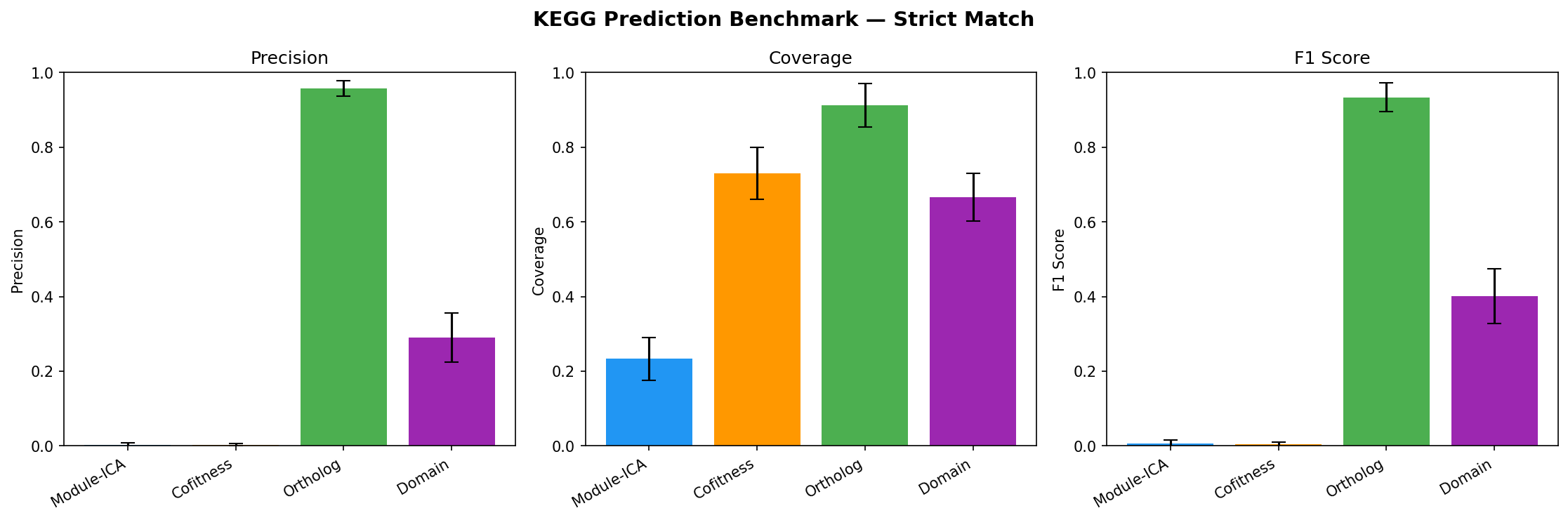 Strict benchmarking: precision and coverage by method. From fitness_modules.
Process and hypothesis-level outputs: inferences are framed as candidates, not assignments
Functional-dark-matter results from GapMind (a pathway-gap annotation tool) and protein-domain analysis do not give direct gene-to-step assignments 2,3. Neither do truly-dark-gene clues from eggNOG (an orthology-based annotation resource) or from phenotypes 2,3. Both identify hypotheses 2,3. The Agora’s M26 tree-based donor inference, which infers the source lineage of acquired genes from phylogenetic trees, is described as exploratory rather than donor identification 4.
Possible Reconciliations
- Hypothesis: The two sides measure different targets. Strict KO precision tests molecular-function identity. Process-level methods may carry valid information that this metric cannot score.
- Hypothesis: Process-level signals become gene-level evidence only when combined with independent sequence evidence, such as orthology or domains. Each alone stays at hypothesis level.
- Hypothesis: The low KO precision of Module-ICA and cofitness voting reflects real limits of fitness-based inference. If so, process framings in dark-gene and Agora work describe how far these methods actually reach, not a separate valid layer.
Resolving Work
- Data: Fitness Browser genes with curated pathway membership but no strict KO. Method: score Module-ICA and cofitness voting with a process-level metric, such as pathway or module membership, instead of strict KO match. Question: do these methods perform better at the process level than at the KO level?
- Data: dark genes with GapMind or domain hypotheses. Method: targeted mutant phenotyping on predicted substrates or conditions. Question: what fraction of hypothesis-level calls resolve into direct gene-to-step assignments?
- Data: genes with both ortholog-transfer annotations and module membership. Method: stratify ortholog-transfer accuracy by module agreement. Question: does process-level concordance add precision beyond orthology?
- Data: M26 tree-based donor inferences. Method: compare against independent synteny (conserved gene order across genomes) or mobile-element evidence (genetic elements that move between genomic locations or organisms) for the same acquisitions. Question: can exploratory donor inference reach donor identification?