Projects in this corpus disagree on how much of the “metal-important” gene set reflects general cellular stress rather than metal-specific requirements. The metal fitness atlas describes most of its metal-important genes as general stress genes. The counter-ion analysis and the discoveries digest each classify a majority as metal-specific 1,2,3. The counter-ion analysis examines the non-metal ion delivered alongside a metal in its salt. The disagreement matters for shared-stress-versus-stressor-specific-fitness, because reading metal fitness profiles as mechanistic metal-tolerance evidence depends on how the shared-stress component is estimated. The sides use different importance definitions, comparison conditions and record sets, so the disagreement should be kept open rather than settled by preferring one project 1,2,3.
Evidence Sides
Side A: most metal-important genes are general stress genes. The atlas’s limitations section says that most genes captured by its broad metal-important rule are general stress genes 1,2,3. This is a qualitative characterization of a broadly defined gene set. The TENSION text gives it no fraction.
Side B: most metal-important records are metal-specific relative to salt. The counter-ion analysis compares metal fitness with fitness under NaCl (sodium chloride, a salt stress condition). It classifies 60.2% of metal-important records as metal-specific relative to NaCl 1,2,3. Here the denominator is metal-important records, and the comparison condition is a single salt stress.
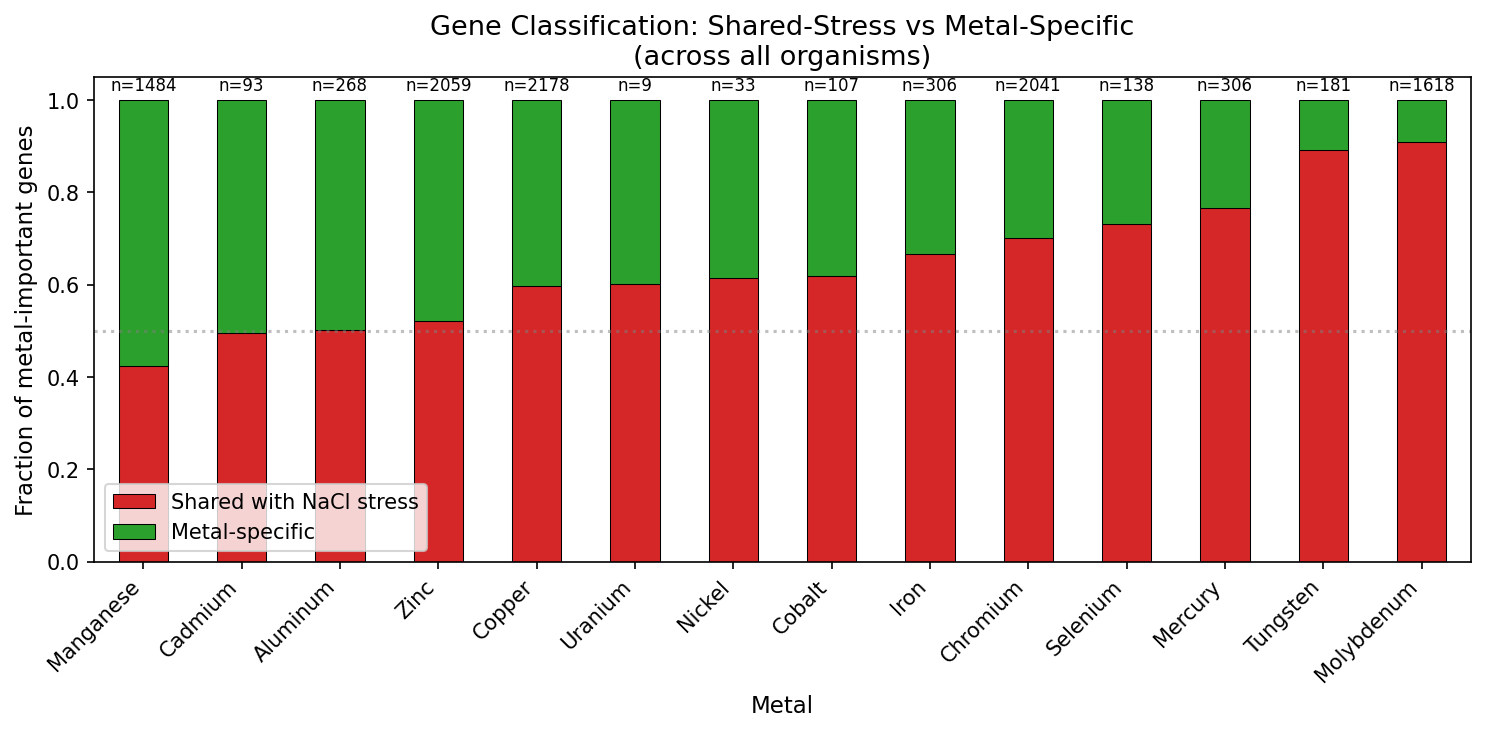 Per-metal gene classification: shared-stress vs metal-specific. From counter_ion_effects.
Side C: most metal-important records are genuine tolerance determinants. The discoveries digest applies a separate metal-specificity classification. From it, the digest concludes that the majority (55%) are genuine metal tolerance determinants 1,2,3. This is the digest’s interpretation of the classification. The TENSION text does not present it as a direct mechanistic test.
Possible Reconciliations
- Hypothesis: The atlas’s broad metal-important rule captures a larger, more stress-dominated set than the record sets classified by the counter-ion analysis and the digest. If so, the sides describe different populations rather than contradicting each other.
- Hypothesis: Being specific relative to one comparison condition (NaCl) is weaker than being specific relative to a wide panel of non-metal stresses. A record could be “metal-specific” in one scheme and “general stress” in another.
- Hypothesis: “Metal-specific” in a fitness classification is not the same as “genuine metal tolerance determinant.” Side C’s conclusion may go further than Side B’s classification supports, while Side A’s label may reflect an unquantified judgment.
Resolving Work
- Common record set: Apply all three classification rules to one shared set of metal-important records, using each project’s stated importance definition. This tests whether the disagreement comes from the choice of denominator.
- Comparison-condition sensitivity: Reclassify the same records against NaCl alone, then against progressively broader non-metal condition panels. This shows how the metal-specific fraction changes as the comparison widens.
- Quantify Side A: Recompute the atlas’s “most are general stress” statement as an explicit fraction under its broad rule. This would make it directly comparable to the fractions reported by the other two sides.
- Functional validation: Test whether genes classified as metal-specific are enriched for annotated metal-homeostasis functions, such as metal transporters, relative to shared-stress genes. This checks whether “metal-specific” tracks tolerance mechanisms or only condition breadth.