Raw report: lanthanide_methylotrophy_atlas Feeds into: community-metabolic-interdependence, confirmatory-exploratory-ecological-association-discordance, cultivation-collection-bias-in-ecological-genomics, environment-embedding-geography, environmental-distribution-of-lanthanide-methylotrophy, evidence-triangulation-for-functional-annotation, functional-marker-validation, gene-function-acquisition-depth, genomic-under-representation, homology-search-negative-evidence, lanmodulin-narrow-distribution, lanthanide-dependent-methanol-dehydrogenase-predominance, pangenome-integration, phenotype-database-coverage-bias, phylogenetic-confounding-of-pangenome-associations
Overview
This report, “Lanthanide Methylotrophy Atlas — Distribution and Environmental Context of REE-Dependent Methanol Oxidation Across 293K Genomes”, presents a 293,059-genome atlas of lanthanide-dependent methanol oxidation across the KBase Data Lakehouse pangenome, testing the distribution of xoxF (REE-dependent methanol dehydrogenase), mxaF (Ca-dependent methanol dehydrogenase), lanmodulin, PQQ-biosynthesis markers, and environmental associations using GTDB-r214 taxonomy, eggNOG, Bakta, and environmental metadata. The study finds strong global dominance of xoxF over mxaF, high xoxF rates in Acidobacteriota and Gemmatimonadota, strict clade restriction of Bakta-validated lanmodulin, strongest enrichment in soil/sediment, and substantial marker-source disagreement attributable partly to annotation gaps. 1
Key Findings
xoxF strongly outnumbers mxaF
eggNOG K00114 (xoxF; EC 1.1.2.8) occurs in 3,690 genomes, whereas K14028 (mxaF; EC 1.1.2.7) occurs in 195 genomes, giving a global xoxF:mxaF ratio of 18.92 : 1 with a Clopper-Pearson 95% CI of [13.07, 27.69]; elsewhere the report states this as the 19 : 1 global ratio with 95% CI [13.07, 27.69]. xoxF represents 0.9498 of joint xoxF + mxaF calls, with a 95% CI of [0.9425, 0.9558]. A one-sided binomial test against the pre-registered xoxF fraction threshold of 10/11 ≈ 0.909 gives p = 7.6 × 10⁻²², strongly supporting H1. 1
After Benjamini-Hochberg FDR (false discovery rate) correction across 29 testable phyla, the directional H1 verdict survives in every phylum with any MDH calls and adequate sample size, including Pseudomonadota, Acidobacteriota, Actinomycetota, Bacteroidota, Campylobacterota, Verrucomicrobiota, Chloroflexota, Gemmatimonadota, Methylomirabilota, Halobacteriota, and Thermoproteota. 1
A reviewer noted that the initial per-phylum binomial framework does not formally control for phylogenetic non-independence, so the report adds three orthogonal validation strategies, all of which support H1: naive genome-level pooling gives 3,885 MDH-informative genomes and an xoxF fraction of 0.950 [95% CI 0.942, 0.956]; equal weighting across 271 MDH-informative GTDB families gives 0.960 [95% CI 0.941, 0.976]; and a Bayesian binomial GLMM (generalized linear mixed model) with random intercepts for phylum and family gives 0.993 [95% CI 0.992, 0.994]. The GLMM was a variational-Bayes binomial GLMM fitted over 3,885 analysis units, the same count reported for naive pooling. It corresponds to a phylogeny-corrected ratio of ~143 : 1 with a 95% credible interval of [122, 169]. The report attributes this to the random effects absorbing phylum-level heterogeneity, so that within typical phyla xoxF dominance is more extreme than the global pooled estimate suggests. The family-equal-weight bootstrap counts each of the 271 MDH-informative GTDB families once regardless of genome count. The report says this confirms that H1 is not driven by the genome-count advantage of Pseudomonadota. All three validations have 95 % CI lower bounds above the 10 : 1 threshold, so the report concludes that H1 is robust to all three phylogenetic-correction frameworks. 1
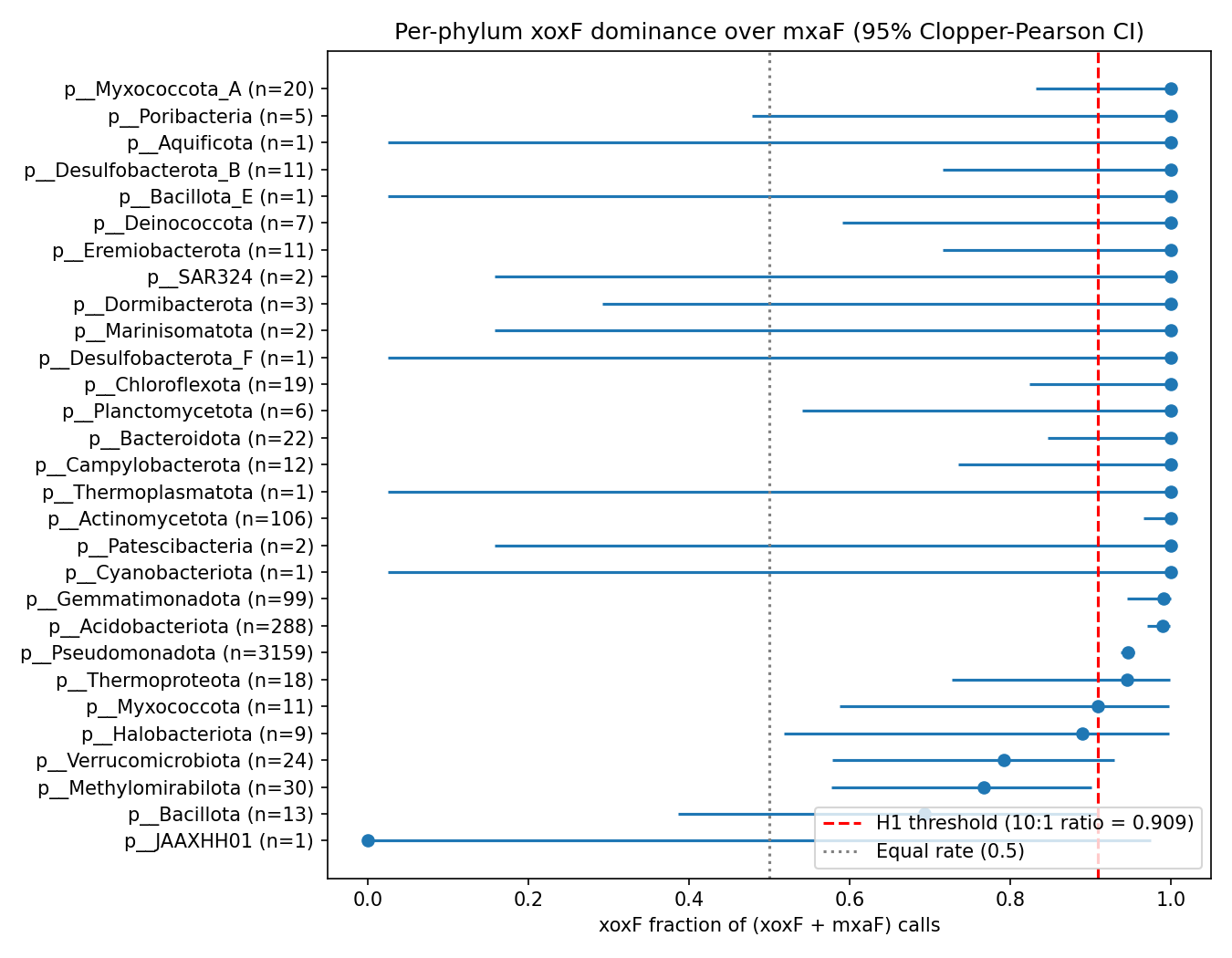 Per-phylum xoxF dominance forest plot. From lanthanide_methylotrophy_atlas.
High-rate carriers extend beyond canonical methylotrophs
Acidobacteriota contains 285 xoxF genomes and 3 mxaF genomes among 1,006 genomes, a 28.3 % xoxF rate and a 95 : 1 xoxF:mxaF ratio, with p_BH = 1.2 × 10⁻⁷⁹. Gemmatimonadota contains 98 xoxF and 1 mxaF among 386 genomes, a 25.4 % xoxF rate and a 98 : 1 ratio, with p_BH = 1.5 × 10⁻²⁷. Methylomirabilota contains 23 xoxF and 7 mxaF among 80 genomes, a 28.7 % xoxF rate and a 3.3 : 1 ratio, with p_BH = 0.011. 1
Pseudomonadota contains 2,988 xoxF and 171 mxaF genomes among 117,619 genomes, a 2.5 % xoxF rate and a 17.5 : 1 ratio; the table reports its p_BH as 0.0. Verrucomicrobiota contains 19 xoxF and 5 mxaF genomes among 2,440 genomes, a 0.78 % xoxF rate and a 3.8 : 1 ratio, with p_BH = 0.015. Within Pseudomonadota, Pseudomonadaceae alone contributes 566 xoxF genomes versus 1 mxaF genome, followed by Xanthobacteraceae (Bradyrhizobium) and Rhizobiaceae (Mesorhizobium); Beijerinckiaceae has 171 xoxF genomes among 508 genomes, a 33.7 % rate; and Hyphomicrobiaceae has 33 xoxF genomes among 56 genomes, a 58.9 % rate. Several phyla are xoxF-only with zero mxaF annotations: Bacteroidota, Cyanobacteriota, Chloroflexota, Planctomycetota, Campylobacterota, Actinomycetota, plus the archaeal lineages Halobacteriota and Thermoproteota. 1
These xoxF-dominated patterns, including the xoxF-only phyla, suggest that lanthanide-dependent methanol oxidation is distributed beyond the classical methylotroph lineages, but the report notes that annotation-based detection does not establish enzyme activity or methylotrophic physiology. 1
Lanmodulin is clade-restricted and only partly co-occurs with xoxF
Bakta-validated product = Lanmodulin occurs in 62 genomes spanning 10 species. All 62/62 = 100 % occur within Beijerinckiaceae, Acetobacteraceae, or Hyphomicrobiaceae, supporting H3a with a one-sided binomial p = 9.8 × 10⁻⁷ against the 80 % threshold. 1
xoxF co-occurs with lanmodulin in 49/62 = 79.0 % of these genomes, just below the pre-registered 80 % threshold; the one-sided binomial p = 0.65, so H3b is not formally supported. The 13/62 lanmodulin genomes without xoxF may reflect annotation incompleteness or alternative lanthanide-handling pathways, while xoxF genomes without lanmodulin may handle REEs through other mechanisms. 1
The dominant lanmodulin carrier is Methylobacterium extorquens, with 22 genomes and 1 lanmodulin copy each. Other contributors are an uncharacterised Acetobacteraceae genus, g__BOG-930, with 12 genomes; M. thiocyanatum with 6; M. rhodesianum with 6; M. aminovorans with 4; Hyphomicrobium_B with 2; and Methylocella with 2. 1
Soil/sediment is the strongest environmental enrichment
Environmental associations were tested with per-class Fisher’s exact tests of any-xoxF presence against the generic_environmental reference, with Benjamini-Hochberg FDR correction. Among environmental classes, soil_sediment contains 13,779 genomes, has a 6.84 % xoxF rate, and is enriched relative to generic_environmental with odds ratio (OR) = 1.92 and p_BH = 6.1 × 10⁻³⁹. Marine environments contain 15,554 genomes, have a 4.76 % xoxF rate, OR = 1.31, and p_BH = 7.8 × 10⁻⁷. The generic_environmental reference contains 21,538 genomes with a 3.69 % rate. 1
Volcanic_geothermal contains 3,450 genomes with a 3.19 % rate, OR = 0.86, and p_BH = 0.20. Mining contains 1,636 genomes with a 4.10 % rate, OR = 1.12, and p_BH = 0.38. REE-impacted samples contain 37 genomes with a 10.81 % rate, OR = 3.51, and p_BH = 0.082. Methylotrophic samples contain 5 genomes with a 20.0 % rate, OR = 8.70, and p_BH = 0.20. Host-associated samples contain 107,600 genomes with a 0.22 % rate, OR = 0.058, and p_BH = 0.0. 1
H2 is therefore partially supported: soil/sediment and marine environments show inferential enrichment and host-associated environments are dramatically depleted, whereas the REE-impacted signal (n=37) is descriptively elevated but, per the pre-registered caveat, is too small to clear the FDR threshold (p_BH = 0.082). Within Acidobacteriota, soil/sediment enrichment remains significant with OR = 2.16 and p_BH = 2.2 × 10⁻⁵, indicating that the broad soil signal is not entirely explained by phylogenetic composition. As background context rather than a measurement from the genome association test, the report notes that soil typically contains 100–300 mg/kg total REE and is the natural habitat of the methylotroph families that carry the cassette. 1
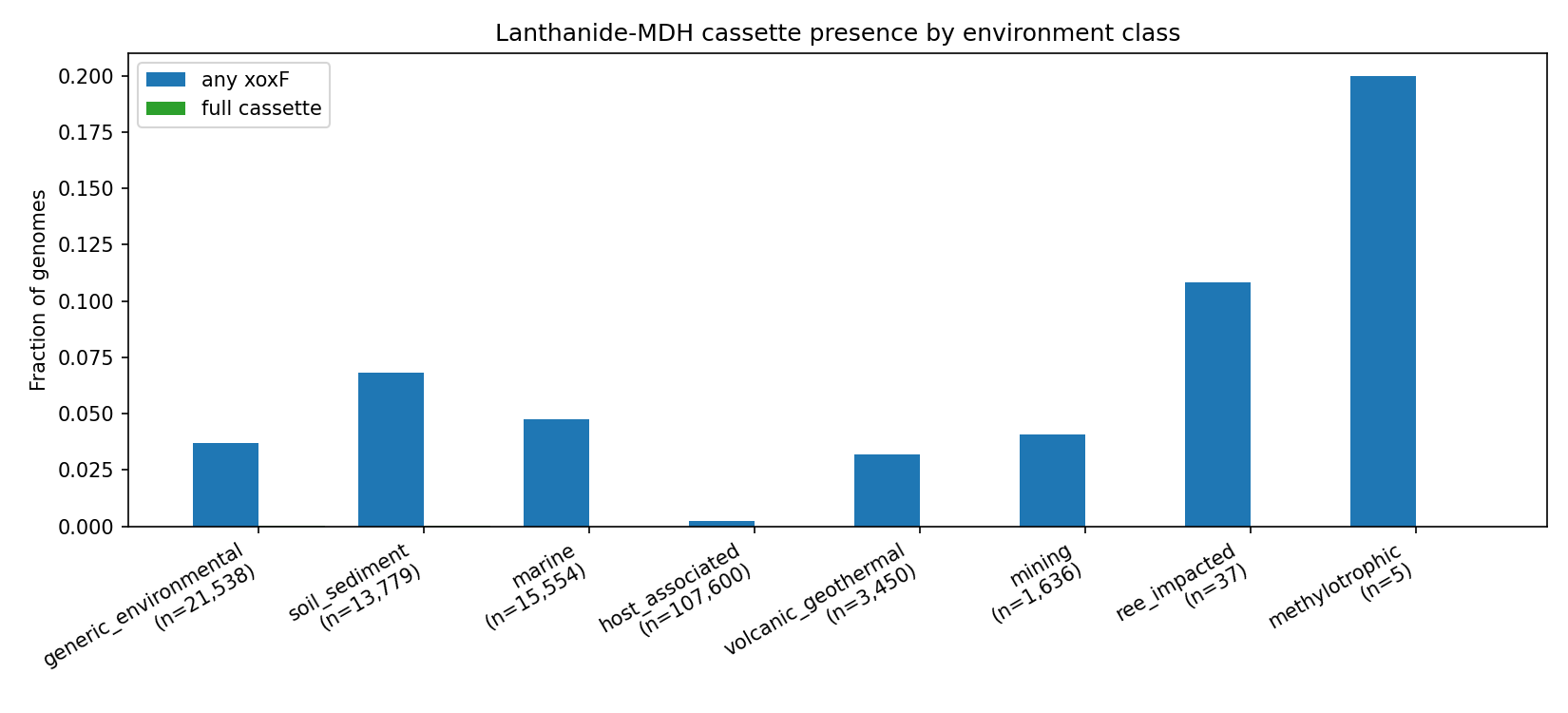 Cassette presence by environment class. From lanthanide_methylotrophy_atlas.
REE-acid-mine-drainage MAGs are dominated by stress biology
The 37 metagenome-assembled genomes (MAGs) from samples tagged “rare earth elements-acid mine drainage (REEs-AMD) contaminated river water” are taxonomically diverse, are not dominated by canonical methylotrophs, and are led by acidophilic and metal-tolerant lineages including Acidocella, Acidiphilium, Thiomonas, Metallibacterium, Burkholderiaceae_A/_B genera, Chitinophagaceae, Acidimicrobiia, Chloroflexota, Cyanobacteriota, and the previously uncharacterised f__REEB76 / g__REEB76 clade. 1
Only 4/37 REE-AMD MAGs carry any xoxF, and 0/37 carry Bakta-validated lanmodulin or xoxJ. Stress-associated products are more prevalent: RecN occurs in 33 MAGs, RadA in 32, RecO in 31, RecA in 28, RadC in 24, FtsH zinc metalloprotease in 31, proton-translocating NAD(P)+ transhydrogenase in 27, MerR-family heavy-metal-responsive regulators in 30, thioredoxin reductase in 25, and glutathione peroxidase in 24, with every count out of 37 MAGs; the report reads this as a textbook acid-mine-drainage stress profile. 1
PQQ asymmetry is largely an annotation gap
A pilot exploration noted 2,320 xoxF-bearing genomes lacking any eggNOG PQQ-biosynthesis annotation despite PQQ being an obligate XoxF cofactor; a follow-up cross-check against Bakta product-field PQQ matches categorises the xoxF set as: 33 (0.9 %) with complete eggNOG pqqA-E calls, 1,472 (39.9 %) with partial eggNOG pqq calls covering 1–4 of A-E, 899 (24.4 %) with Bakta-only strong evidence of at least 3 PQQ products, 389 (10.5 %) with Bakta-only partial evidence of 1–2 PQQ products, and 897 (24.3 %) with no PQQ detected by either source. The report does not reconcile the pilot’s 2,320 count with the 2,185 genomes with no eggNOG pqq used in the follow-up comparison. 1
Of 2,185 genomes with no eggNOG pqq annotation, 1,288 (59 %) have at least 1 Bakta PQQ product, indicating annotation gaps. The remaining 897 genomes, equal to 24 % of all xoxF carriers, lack PQQ evidence from either source and are candidates for assembly incompleteness, pseudogenization, or genuine reliance on community-acquired PQQ; disambiguating these three explanations requires sequence-level inspection, which is out of scope. 1
Marker-source calibration changes interpretation
In a 134,578-row hit-bearing matrix, lanmodulin has 0 calls in both sources, 505 eggNOG-only calls, and 62 Bakta-only calls; Bakta is therefore the trustworthy source for lanmodulin. xoxJ has 41 calls in both sources, 46,369 eggNOG-only calls, and 20 Bakta-only calls; Bakta is preferred because eggNOG KO K02030 is non-specific. xoxF has 418 calls in both sources, 3,272 eggNOG-only calls, and 1,402 Bakta-only calls; eggNOG K00114 is primary and Bakta is used as a union source. mxaF has 4 calls in both sources, 191 eggNOG-only calls, and 8 Bakta-only calls; eggNOG K14028 is primary. For pqqA-E, the calibration table reports varied shared and eggNOG-only counts and 50–90K Bakta-only calls, characterizes Bakta as over-calling, and treats eggNOG as primary; separately, the report’s PQQ-supply interpretation recommends that pangenome work on PQQ use the union of eggNOG and Bakta sources. These two recommendations arise in different contexts and are not reconciled in the report. The report’s summary states that for specialty markers such as Lanmodulin and XoxJ, Bakta’s curated product field outperforms eggNOG’s Preferred_name. 1
The 505 eggNOG Preferred_name = lanM false positives are concentrated in unrelated gut Bacillota, including Streptococcus pneumoniae (10), Blautia_A wexlerae (9), Enterococcus faecalis (8), Ruminococcus_B gnavus (8), and Streptococcus pyogenes (7). Bakta product = Lanmodulin identifies 62 genomes, all in canonical α-Proteobacterial methylotroph clades, so future KBase Data Lakehouse lanmodulin analyses should use Bakta product exclusively. 1
Literature context
The report places its results in prior literature. Its Literature Context section cites Pol et al. (2014, Nature) as the founding paper for lanthanide-dependent methanol dehydrogenase, which characterised XoxF in Methylacidiphilum fumariolicum SolV from a volcanic mudpot. The report’s References list gives that paper’s journal as Environmental Microbiology, with a note that it was originally described in Nature in 2014. The report does not reconcile the two attributions. The report cites Skovran & Martinez-Gomez (2015, Science) as establishing the “lanthanide switch” in Methylobacterium. Within the atlas, 102/209 Methylobacterium genomes carry xoxF and 46/209 carry lanmodulin, which the report calls consistent with that lanthanide-switch model and treats as broader population-genomic context. The report does not state which annotation source underlies the 46/209 lanmodulin count, and it does not reconcile that count with the Bakta-validated per-species counts listed above. The report credits Cotruvo et al. (2018, JACS) with discovering lanmodulin in Methylobacterium extorquens AM1 and characterising picomolar REE binding. It says its 100 % clade restriction (62/62 genomes) tightens that restriction compared with Cotruvo’s small-scale survey. The report notes that XoxF distribution beyond cultured methylotrophs had been an open question. The atlas places ~3,690 xoxF-bearing genomes across diverse phyla, including Acidobacteriota, Gemmatimonadota, Bacteroidota, and archaea. The report presents its 19 : 1 ratio at 293K genomes as confirming an earlier hypothesis of xoxF predominance at substantially larger scale. 1
Data and setup
GTDB r214 is the pangenome’s taxonomic backbone, and all H1/H2/H3 phylogenetic stratification uses GTDB phylum/class/family/genus assignments. The study used BacDive (kescience_bacdive) to validate lanthanide and methanol coverage. BacDive’s metabolite_utilization table contains no lanthanide or methanol entries, which is a null result. The project’s generated data include several products. One is a per-genome binary marker matrix of 134,578 genomes with at least one marker hit, covering xoxF, mxaF, xoxJ, pqqA-E and lanM, each called by eggNOG, by Bakta, or by either. Another is a per-genome environment classification with cassette flags covering 293,059 genomes. A third is a PQQ-supply categorisation of 2,185 xoxF-bearing genomes lacking eggNOG PQQ, which separates annotation gaps from cases with no PQQ detected. 1
Report figures
The report illustrates these results with the following figures:
- log-scale bars of xoxF versus mxaF counts for the top 15 phyla;
- a global xoxF:mxaF ratio bar with its CI and the H1 threshold marked;
- a per-phylum xoxF-dominance forest plot with 95% Clopper-Pearson CIs and the H1 threshold marked;
- the distribution of genomes by cassette-completeness category;
- a cross-method H1 comparison of phylogenetic-correction strategies and their 95% intervals (naive pooled, family-equal-weight bootstrap, and a binomial GLMM with random phylum and family intercepts), all above the 10:1 H1 threshold;
- lanmodulin clade restriction, shown as the family distribution of Bakta-validated lanmodulin inside versus outside the H3 clade;
- xoxF and full-cassette presence rates by environment class;
- the phylum and family taxonomy of the 37 REE-AMD MAGs;
- a heatmap of marker presence across the 37 MAGs;
- PQQ-supply asymmetry across xoxF genomes, by eggNOG, Bakta or neither;
- stacked bars of eggNOG-versus-Bakta agreement per marker (both, eggNOG-only, Bakta-only);
- the top 15 families by eggNOG-only lanM preferred-name false positives versus Bakta-validated calls. 1
Caveats and Future Work
The report addresses phylogenetic non-independence for H1 using pooled, family-equal-weight, and Bayesian GLMM analyses, all of which support H1; however, H2 still relies on within-phylum stratified analyses rather than a fully phylogeny-aware mixed model. 1
Marker calls vary substantially between eggNOG and Bakta, so headline statistics use a marker-specific source of truth and secondary union-of-sources analyses. Sequence-level evidence is out of scope: the study does not screen for pseudogenes, truncated ORFs, or assembly fragmentation. Genuinely novel REE-handling enzymes lacking KEGG or RefSeq homologs would also be missed. 1
The REE-AMD anchor contains only 37 MAGs from a single bioproject and is descriptive only; larger, independent collections from REE-mining tailings, leachate, and bioreactors are needed for inferential testing. The 897 xoxF genomes with no PQQ evidence require ORF-integrity and genome-completeness analysis, such as CheckM2, to distinguish fragmentation, pseudogenization, and community-PQQ acquisition. 1
AlphaEarth coverage is 1,457 / 3,690 = 39.5 % of xoxF genomes, compared with a 28 % pangenome baseline, leaving 60.5 % without environmental coordinates. Embedding-based niche analysis was scoped out of the report, but the report considers a coverage-restricted supplementary analysis feasible: coverage-restricted PCA (principal component analysis) / UMAP (uniform manifold approximation and projection) analysis could test whether xoxF carriers form distinct environmental or biogeographic clusters, stratified by phylum. 1
The ncbi_env environmental classification is text-mining-derived and uses hierarchical regex priorities, so broad classes such as host_associated may contain misclassifications. The host_associated class spans gut, skin, oral, infection and other samples. The report states that the strong signals, soil/sediment enrichment and host depletion, survive despite possible misclassification. The study also proposes characterizing f__REEB76, examining lanmodulin sequence diversity in 22 Methylobacterium extorquens genomes with 1 copy each, testing lanthanum and cerium chloride with targeted RB-TnSeq (random barcode transposon sequencing) on the FitnessBrowser organism panel, and reporting the 505 eggNOG lanM false-positive pattern upstream. 1
Slots Into
- pangenome-integration — The 293,059-genome atlas, GTDB-r214 stratification, and 18.92 : 1 xoxF:mxaF distribution provide cross-genome evidence for integrating functional markers with taxonomy. 1
- environment-embedding-geography — Soil/sediment enrichment, marine enrichment, host-associated depletion, limited AlphaEarth coverage, and proposed embedding analysis connect marker distribution to environmental geography. 1
- gene-function-acquisition-depth — Broad xoxF distribution, lanmodulin clade restriction, PQQ annotation gaps, and eggNOG-versus-Bakta calibration refine how marker annotations should be interpreted as evidence of function. 1
- lanthanide-dependent-methanol-dehydrogenase-predominance — The global 18.92 : 1 xoxF:mxaF ratio, its survival of FDR correction across 29 testable phyla, and the high-rate Acidobacteriota and Gemmatimonadota carriers are the core evidence for xoxF predominance. 1
- lanmodulin-narrow-distribution — Bakta-validated lanmodulin in 62 genomes, all within three α-Proteobacterial methylotroph families, with only 49/62 xoxF co-occurrence (H3b not formally supported). 1
- environmental-distribution-of-lanthanide-methylotrophy — Soil/sediment and marine enrichment, host-associated depletion, null mining and volcanic/geothermal results, and the 4/37 xoxF REE-AMD MAGs dominated by stress biology. 1
- confirmatory-exploratory-ecological-association-discordance — The descriptively elevated but non-significant REE-impacted (n=37) and methylotrophic (n=5) classes illustrate how small pre-registered classes fail FDR thresholds. 1
- phylogenetic-confounding-of-pangenome-associations — Pooled, family-equal-weight and GLMM corrections for H1, plus within-Acidobacteriota soil enrichment, test whether marker distributions are phylogenetic artefacts. 1
- homology-search-negative-evidence — The 897 xoxF genomes with no PQQ evidence in either source, after 1,288 eggNOG gaps were filled by Bakta, show the limits of absence calls from a single annotation source. 1
- evidence-triangulation-for-functional-annotation — Union-of-sources PQQ assessment and the eggNOG-primary, Bakta-union xoxF strategy show cross-source triangulation of marker calls. 1
- functional-marker-validation — Per-marker eggNOG-versus-Bakta calibration, including the 505 eggNOG lanM false positives and non-specific xoxJ KO K02030, sets marker-specific sources of truth. 1
- cultivation-collection-bias-in-ecological-genomics — AlphaEarth covers only 39.5 % of xoxF genomes, and the text-mined ncbi_env classes may be misclassified. Both limit how far environmental associations can be generalised. 1
- genomic-under-representation — Novel REE-handling enzymes that lack KEGG or RefSeq homologs would escape this annotation-based atlas. 1
- phenotype-database-coverage-bias — BacDive’s metabolite_utilization table has no lanthanide or methanol entries, a null result for phenotype validation. 1
- community-metabolic-interdependence — Among the ~897 xoxF genomes with no PQQ evidence, genuine community-PQQ acquisition is one candidate explanation. Separating it from fragmentation and pseudogenization requires ORF-integrity and CheckM2 analysis. 1