Lanthanide-dependent methylotrophy is the use of rare-earth elements (REEs, the lanthanides) as cofactors for methanol oxidation 1. The key enzyme is the lanthanide-dependent methanol dehydrogenase encoded by xoxF, which contrasts with the calcium-dependent mxaF form 1. This corpus addresses the topic through one genome-scale survey, the lanthanide methylotrophy atlas. The atlas counts xoxF, mxaF and the REE-binding protein lanmodulin across 293,059 genomes from GTDB-r214, release 214 of the Genome Taxonomy Database 1. It then tests which habitat categories are enriched for xoxF carriers 1. Its results are annotation counts from a single project. They are strong on gene carriage and silent on enzyme activity 1.
Literature Context
For decades lanthanides were considered not to be involved in biological processes. That changed with their discovery in the active site of the XoxF-type methanol dehydrogenase (MDH) of Methylacidiphilum fumariolicum SolV (PMID 30308436). This acidophilic methanotroph, isolated from an Italian volcanic mudpot, depends strictly on lanthanides for growth (PMID 24034209). That single-isolate study also noted that metagenome surveys show XoxF-type MDH to be much more prominent in nature than MxaF-type enzymes (PMID 24034209). The XoxF-MDHs described thus far are homodimers that carry a rare-earth element instead of calcium. Binding that element requires a specific aspartate near the catalytic site (PMID 24816778). Genes with this motif occur in methylotrophs and also in organisms not known for that lifestyle (PMID 24816778). Lanthanide incorporation into an enzyme was first demonstrated in 2011, and reviews now describe lanthanide use as widespread in environmentally important bacteria (PMID 32979423). In several methylotrophs, lanthanide availability reciprocally regulates the calcium- and lanthanide-dependent enzymes, a pattern called the “lanthanide switch” (PMID 40846390).
At the environmental level, amplicon sequencing found diverse xoxF genes in four coastal marine environments. These genes were related to both methylotrophs and non-methylotrophs (PMID 25943904). A second study sampled weathered granite and associated soil and reconstructed 136 genomes from 11 bacterial phyla. It found xoxF3 and xoxF5 clusters “surprisingly common” in moderately weathered granite. These included the first xoxF3 systems in Verrucomicrobia, along with clusters in Acidobacteria and Gemmatimonadetes (PMID 38369453). Lanthanides occur at picomolar to nanomolar levels in most natural waters but can reach micromolar concentrations in volcanic hot springs. The same review reports lanmodulin-encoding genes in soil metagenomes (PMID 33035309).
The atlas’s global xoxF:mxaF ratio of 18.92 : 1 is consistent with the metagenome-based claim of XoxF prominence (PMID 24034209). It extends that claim to a quantified, genome-scale estimate across 293,059 genomes. The atlas found high carrier rates in Acidobacteriota (28.3 %) and Gemmatimonadota (25.4 %), and it found xoxF in phyla with zero mxaF calls. These results agree with the granite-weathering genomes (PMID 38369453) and with the motif-based expectation of carriage beyond methylotrophs (PMID 24816778). The marine enrichment (odds ratio, OR, 1.31) fits the coastal amplicon survey (PMID 25943904).
The null volcanic/geothermal result (OR 0.86, adjusted p 0.20) does not directly conflict with the volcanic-mudpot origin of SolV or with micromolar hot-spring lanthanide levels (PMID 24034209, PMID 33035309). Neither finding establishes habitat-wide xoxF enrichment. The null result bears instead on the hypothesized availability-driven enrichment model, which the corpus already treats as weakened. Lanmodulin genes have been detected in soil metagenomes (PMID 33035309). This does not directly contradict the corpus’s family-restricted lanmodulin distribution (62 genomes, 10 species). The literature reinforces the corpus caveat that annotation is not activity. In several methylotrophs, xoxF expression depends on lanthanide presence (PMID 40846390), and lanthanide-dependent enzymes unrelated to XoxF may exist unrecognized (PMID 27357406).
What the Corpus Shows
The lanthanide-dependent dehydrogenase dominates at the gene level. Both enzymes are pyrroloquinoline-quinone (PQQ) methanol dehydrogenases (MDH). In the atlas, eggNOG annotations assigned KEGG (Kyoto Encyclopedia of Genes and Genomes) orthology (KO) groups K00114 (xoxF) in 3,690 genomes and K14028 (mxaF) in 195 genomes 1. That gives a global xoxF:mxaF ratio of 18.92 : 1, with a Clopper-Pearson 95% confidence interval (CI) of [13.07, 27.69] 1. xoxF accounts for 0.9498 of joint MDH calls. A one-sided binomial test against the pre-registered threshold of 10/11 ≈ 0.909 gave p = 7.6 × 10⁻²² 1. The report elsewhere rounds the ratio to “19 : 1”. This is the same result presented two ways, not two conflicting measurements 1. The details are in lanthanide-dependent-methanol-dehydrogenase-predominance.
Predominance holds across lineages, though lineages differ in how strongly. The atlas applied Benjamini-Hochberg false discovery rate (FDR) correction across 29 testable phyla. FDR correction limits the expected share of false positives among the tests called significant. After correction, xoxF predominance held in every phylum that had any MDH calls and adequate sample size 1. The report does not claim that all 29 phyla passed 1.
Carrier rates and ratios vary widely by phylum 1:
| Phylum | xoxF carrier rate | xoxF:mxaF ratio | Adjusted p | Source |
|---|---|---|---|---|
| Acidobacteriota | 28.3 % | 95 : 1 | 1.2 × 10⁻⁷⁹ | src: [[summaries/lanthanide_methylotrophy_atlas |
| Gemmatimonadota | 25.4 % | 98 : 1 | 1.5 × 10⁻²⁷ | src: [[summaries/lanthanide_methylotrophy_atlas |
| Pseudomonadota | 2.5 % | 17.5 : 1 | 0.0 (as reported) | src: [[summaries/lanthanide_methylotrophy_atlas |
| Methylomirabilota | 28.7 % | 3.3 : 1 | 0.011 | src: [[summaries/lanthanide_methylotrophy_atlas |
| Verrucomicrobiota | 0.78 % | 3.8 : 1 | 0.015 | src: [[summaries/lanthanide_methylotrophy_atlas |
Pseudomonadota hold the most xoxF genomes despite their low carrier rate. Methylomirabilota and Verrucomicrobiota show weaker ratios with marginal adjusted p values. The report does not formally test how carrier rate relates to dominance ratio 1.
Several phyla, including Bacteroidota, Actinomycetota and the archaeal Halobacteriota and Thermoproteota, carry xoxF with zero mxaF annotations 1. Pseudomonadaceae alone contributes 566 xoxF genomes against 1 mxaF 1. Together these results extend xoxF well beyond cultured methylotrophs 1.
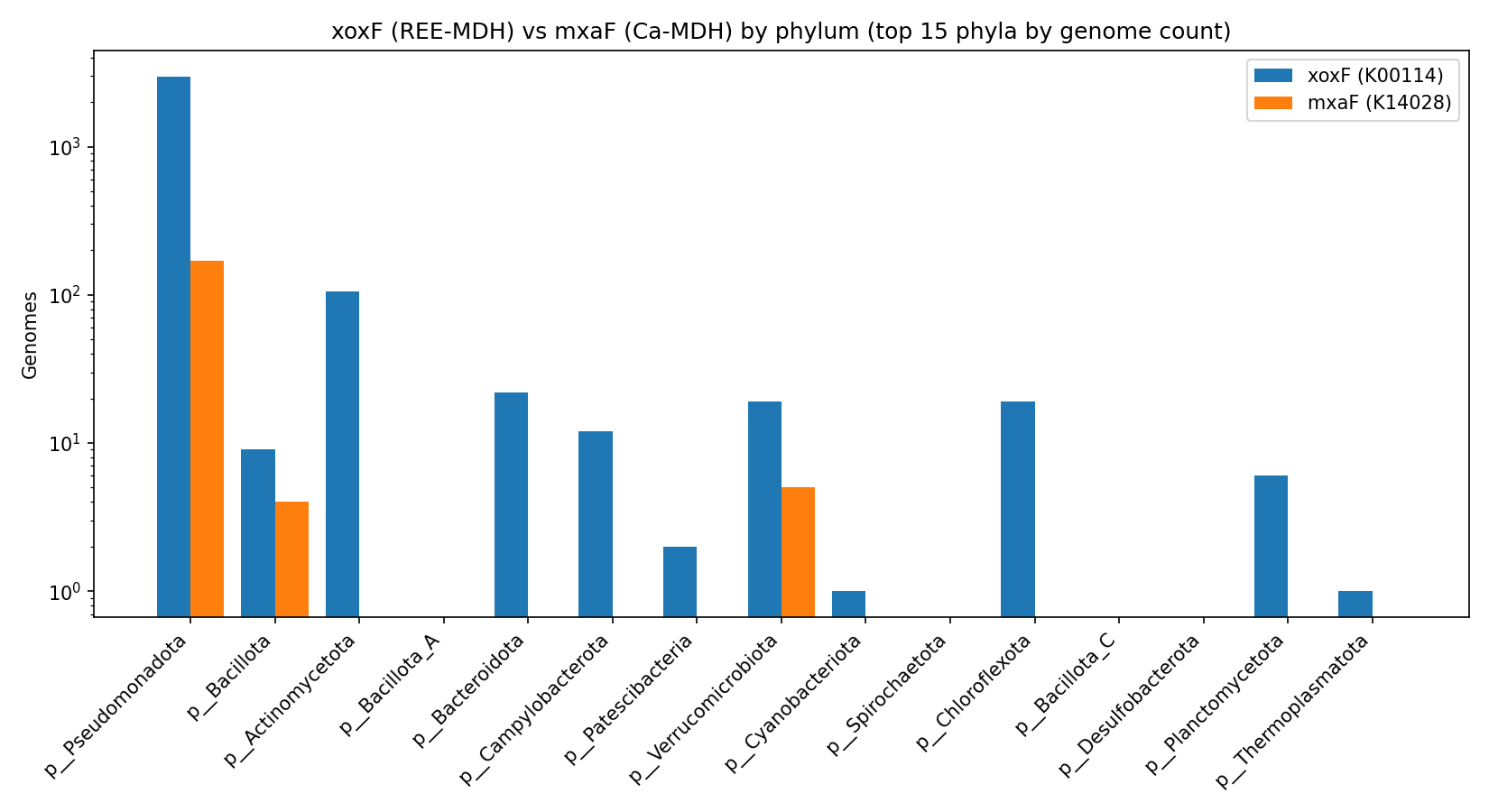 xoxF vs mxaF by phylum (log scale). From lanthanide_methylotrophy_atlas.
The REE chelator is far narrower than the dehydrogenase. Lanmodulin, as validated by bakta annotation, appears in 62 genomes from 10 species. All 62 / 62 = 100 % fall within Beijerinckiaceae, Acetobacteraceae or Hyphomicrobiaceae (p = 9.8 × 10⁻⁷ against an 80 % threshold) 1.
*Methylobacterium extorquens* dominates, with 22 genomes and 1 copy each, so paralogs do not explain the pattern 1. Within Methylobacterium, xoxF appears in 102/209 genomes and lanmodulin in 46/209 1. Set against the 3,690 xoxF genomes across many phyla, this contrast is the core of lanmodulin-narrow-distribution. The dehydrogenase is widespread, while the dedicated chelator is confined to a few α-Proteobacterial methylotroph families 1.
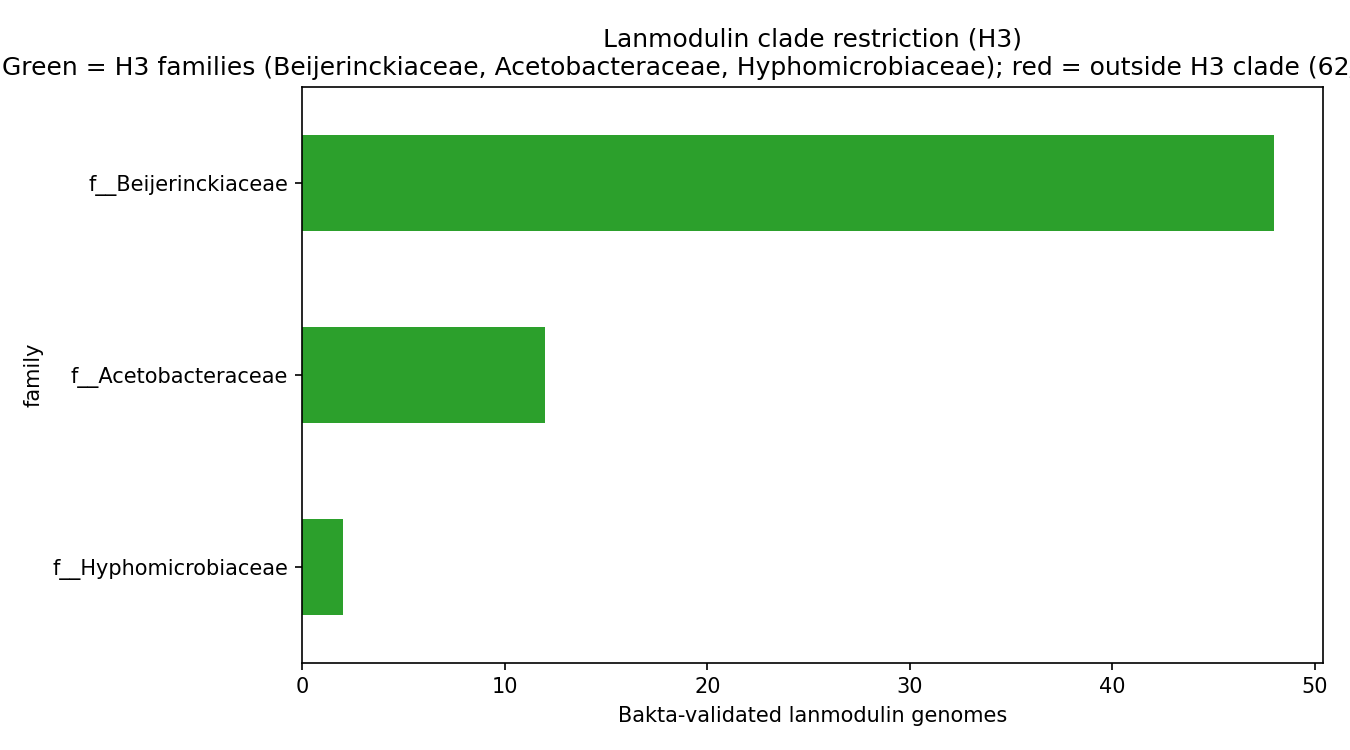 Lanmodulin clade restriction (H3). From lanthanide_methylotrophy_atlas.
Habitat enrichment does not simply follow REE abundance. The atlas used per-class Fisher’s exact tests against a generic environmental reference 1.
- Enriched: soil/sediment (6.84% xoxF rate, odds ratio 1.92, adjusted p 6.1 × 10⁻³⁹) and marine samples (4.76%, OR 1.31, adjusted p 7.8 × 10⁻⁷) 1.
- Null: mining (OR 1.12, adjusted p 0.38) and volcanic/geothermal samples (OR 0.86, adjusted p 0.20) 1.
- Strongly depleted: host-associated genomes (0.22% rate, OR 0.058) 1.
The soil/sediment signal persists within Acidobacteriota (within-phylum OR=2.16, p_BH=2.2 × 10⁻⁵). This suggests the signal is at least partly not phylogenetic confounding, although the check covers only one phylum 1. environmental-distribution-of-lanthanide-methylotrophy concludes that these results weaken, but do not refute, a model in which REE availability drives the trait 1.
REE-contaminated communities show a stress profile and few known lanthanide markers. A metagenome-assembled genome (MAG) is a genome reconstructed from community sequencing data. The atlas examined 37 MAGs from rare-earth acid-mine-drainage (REE-AMD) river water. They are not dominated by canonical methylotrophs; acidophiles such as Acidocella, Acidiphilium, Thiomonas and Metallibacterium lead, and the collection includes the newly named clade f__REEB76 1.
Only 4/37 carry any xoxF, and 0/37 carry bakta-validated lanmodulin or xoxJ, another known lanthanide marker 1. The atlas reads their functional signature as an acid-mine-drainage stress profile. Examples include DNA repair (RecN 33, RecA 28) and MerR-family metal-responsive regulators (30), with each count out of 37 1. This is a descriptive analysis of one sample collection, not a comparative test, so it does not show selection against methylotrophy 1.
Tensions and Caveats
- Habitat-scale and sample-scale views of REE genomes pull apart. The 37 explicitly REE-impacted genomes show a 10.81% xoxF rate and an odds ratio of 3.51 1. However, the adjusted p is 0.082, and the atlas states that n=37 is too small to clear the FDR threshold. This was a pre-registered caveat, and the atlas rates its habitat hypothesis only “partially supported” 1. Meanwhile, only 4/37 REE-AMD MAGs carry xoxF. Low absolute carriage does not rule out relative enrichment, and a non-significant elevation does not establish enrichment 1. No result here shows that REE-rich habitats select for or against the trait 1.
- Soil confounds REE supply with methanol supply. Soil is both a known site of methanol oxidation and a reservoir of lanthanide minerals. The claim that methanol supply rather than lanthanide abundance governs where xoxF occurs therefore remains a hypothesis 1.
- Chelator–dehydrogenase coupling is unresolved. xoxF co-occurred in 49 / 62 = 79.0 % of lanmodulin genomes. This falls just under the pre-registered 80 % threshold (p = 0.65), so H3b was not supported 1. The 13/62 lanmodulin genomes without xoxF may reflect incomplete annotation or a genuine alternative lanthanide-handling pathway. The report does not choose between these explanations 1.
- Annotation is not activity. Every finding is gene carriage inferred from KO or bakta calls. None measures expression, enzyme activity, or lanthanide use in situ. That lanthanide-dependent oxidation is the ecologically dominant mode is a supported hypothesis, not an established result 1.
- Absent markers are not proof of absent function. Novel REE-handling enzymes without homologs in KEGG or RefSeq (the NCBI Reference Sequence collection) would be invisible to these annotation methods 1. Separately, 897 genomes (24 % of all xoxF carriers) lack PQQ evidence. Possible causes include assembly incompleteness, pseudogenization, or reliance on PQQ acquired from the community 1.
- Single-project evidence. No second corpus project independently measures any of these quantities 1.
Where to Go Deeper
- lanthanide-dependent-methanol-dehydrogenase-predominance — start here for the 18.92 : 1 ratio, the per-phylum table, and the case for splitting
K00114by clade 1. - lanmodulin-narrow-distribution — read next for the family-restricted chelator and the null H3b coupling test 1.
- environmental-distribution-of-lanthanide-methylotrophy — for the habitat Fisher tests, the null mining result, and the REE-AMD MAG stress profile 1.
- functional-marker-validation — to judge how far KO-based xoxF calls can be trusted as markers.
- cultivation-collection-bias-in-ecological-genomics — to weigh whether thinly sampled phyla such as Methylomirabilota (80 genomes) give stable carrier rates 1.
Key entities: xoxf, mxaf, lanmodulin, methylobacterium-extorquens, reeb76, eggnog, bakta, gtdb, gemmatimonadota, bacteroidota.