Raw report: enigma_contamination_functional_potential Feeds into: composite-resistance-score-limitations, confirmatory-exploratory-ecological-association-discordance, cross-tenant-data-bridging, environmental-resistome, functional-marker-validation, multi-omics-integration, pangenome-integration, study-batch-confounding-of-environmental-associations, taxonomic-nomenclature-reconciliation, taxonomic-resolution-dependent-functional-inference
Overview
This project developed a reproducible workflow linking enigma-coral geochemistry and community composition to kbase-ke-pangenome pangenome clades and eggnog-derived functional proxies. Across 108 ENIGMA samples, confirmatory genus-level tests found no robust monotonic association between contamination and broad functional scores, while exploratory coverage-aware models detected positive defense associations that were sensitive to coverage, covariate specification, taxonomic resolution, and multiple-testing correction. 1
Key Findings
Data scope and modeling context
Quality-controlled overlap data comprised 108 samples with geochemistry and community composition, a geochemistry matrix of shape (108, 49), 41,711 community taxon rows, 212 distinct communities, and 1,392 distinct genera. 1
The taxonomy bridge parsed 27,690 GTDB species rows, mapped 530 genera, left 862 genera unmapped, and produced 530 strict clades, 7,380 relaxed clades, and 150 species-proxy clades restricted to genera mapping to exactly one clade. 1
The analysis generated 324 site functional-score rows, corresponding to 108 samples across 3 mapping modes, and 12 model-result rows covering 4 outcomes across those modes. Model diagnostics included confirmatory and exploratory labels, bootstrap confidence intervals, adjusted coordinate/depth models, coverage-adjusted models, site-structure models using location_prefix, fraction-aware models using community_fraction_type, within-fraction correlations, high-coverage subset correlations, and global Benjamini–Hochberg false-discovery-rate q-values. 1
Model-family counts were 108 for base Spearman, adjusted-plus-covariate, and strict/relaxed analyses; fraction-aware models used 212 sample-fraction rows; and high-coverage subsets used 68 rows. The species_proxy_unique_genus high-coverage test had n=1, making that analysis underpowered. 1
Confirmatory contamination–defense tests were null
The report designates the Spearman tests as confirmatory and the adjusted models as exploratory sensitivity analyses. Predeclared Spearman tests of site_defense_score against contamination were non-significant in both genus-level modes. In relaxed_all_clades, rho = 0.0587, the 95% bootstrap CI was [-0.128, 0.250], Spearman p = 0.546, and FDR q = 0.862; in strict_single_clade, rho = 0.0682, the 95% bootstrap CI was [-0.111, 0.253], Spearman p = 0.483, and FDR q = 0.849. 1
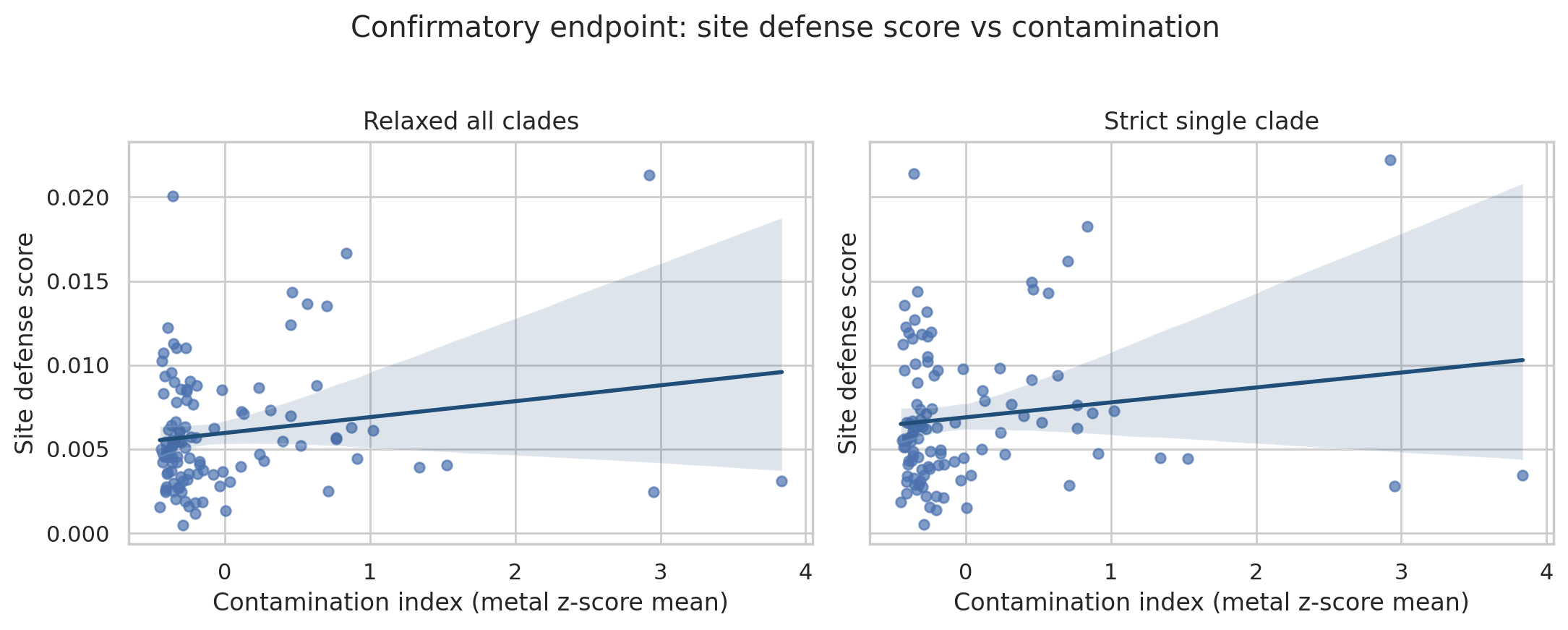 Confirmatory defense score vs contamination index by mapping mode. From enigma_contamination_functional_potential.
The confirmatory null result was robust to four contamination-index definitions: the composite all-metals index, uranium-only, the top-3-variance-metals index, and the first principal component of metal z-scores. All 8 confirmatory variant tests remained non-significant after FDR, with q = 0.546 across the tests, including uranium-only. 1
Exploratory coverage-aware defense associations
Coverage-adjusted ordinary least squares models, adjusting for contamination, depth, latitude, longitude, and mapped abundance fraction, estimated a defense-score beta of 0.000751 with 95% bootstrap CI [0.000224, 0.001779], p = 0.000398, and FDR q = 0.0462 for relaxed_all_clades; the corresponding strict_single_clade estimate was beta = 0.000640, 95% bootstrap CI [0.000169, 0.001538], p = 0.00354, and FDR q = 0.130. These exploratory results support a coverage-sensitive defense association in the relaxed mode but do not establish a robust association across both mapping modes after global FDR. 1
Fraction-aware adjusted models using contamination, mapped abundance fraction, and C(community_fraction_type) estimated beta = 0.000607, 95% bootstrap CI [0.000213, 0.001221], p = 0.00144, and FDR q = 0.0838 for relaxed_all_clades; strict_single_clade estimated beta = 0.000566, 95% bootstrap CI [0.000214, 0.001113], p = 0.00548, and FDR q = 0.130. 1
In the high-coverage subset defined by mapped_abundance_fraction >= 0.25, defense-score Spearman p-values were 0.0207 for the relaxed mode and 0.00980 for the strict mode, but global FDR q-values were 0.301 and 0.189, respectively. Most non-defense outcomes remained non-significant; the one exploratory exception was site_stress_score in the strict high-coverage subset, with rho = 0.2489 and p = 0.0407. 1
Fraction and taxonomic-resolution robustness
To address potential confounding from collapsing multiple community fractions, the analysis retained community_fraction_type parsed from sdt_community_name and ran fraction-aware robustness analyses. Fraction-aware models used 212 sample-fraction rows: 106 for the 0.2_micron_filter fraction and 106 for the 10_micron_filter fraction. Within-fraction defense Spearman tests were non-significant, with p = 0.767 and p = 0.898 for relaxed 0.2- and 10-micron fractions, respectively, and p = 0.780 and p = 0.793 for the corresponding strict fractions. This supports the conclusion that the strong monotonic defense signal is not robustly reproducible within individual fraction strata. 1
Because the available ENIGMA taxonomy stops at genus, the species_proxy_unique_genus mode approximates higher taxonomic resolution using only genera that map to exactly one GTDB species clade. The species-proxy mode retained 150 unique-clade genera versus 530 mapped genera overall, while 380 mapped genera were ambiguous multi-clade genera. Mean mapped abundance fraction was 0.031 in the species-proxy mode versus 0.343 in the strict and relaxed modes. The species-proxy defense trend was positive but non-significant, with rho = 0.169 and Spearman p = 0.081, and no high-coverage test was feasible at mapped_abundance_fraction >= 0.25 because of low retained coverage. 1
Bridge diagnostics showed 8,242 genus-to-clade bridge rows, reflecting many-to-many expansion. The clade-count distribution had a long right tail, with a maximum of 433 clades per genus; the most ambiguous genera were pseudomonas (433), streptomyces (378), prevotella (358), streptococcus (214), and mycobacterium (186). 1
The bridge observed 1,392 ENIGMA genera, mapped 530 and left 862 unmapped; of the mapped genera, 150 were unique-clade (species-proxy resolvable) and 380 were multi-clade ambiguous, and the bridge table had 8,242 rows from many-to-many genus-to-clade expansion. Functional feature rows totaled 3,630 across 3 mapping modes (strict_single_clade, relaxed_all_clades, species_proxy_unique_genus). Mean mapped abundance fraction was 0.343 in strict and relaxed modes, with range 0.031 to 0.854, and 0.031 in species-proxy mode, with range 0.0002 to 0.543. 1
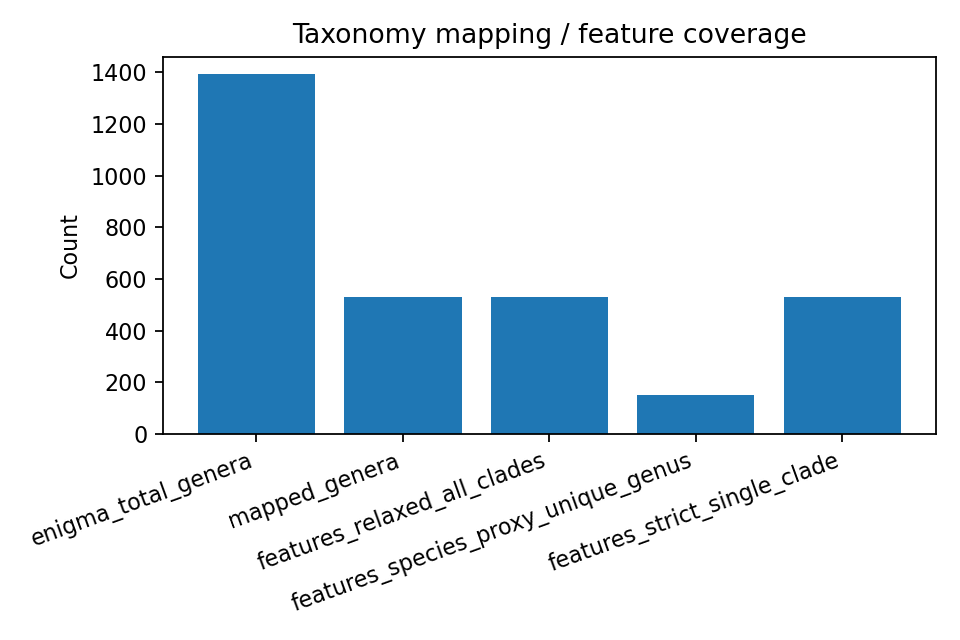 Mapping and feature coverage by mode. From enigma_contamination_functional_potential.
Contamination index and overall interpretation
The contamination index combined 8 metal columns—arsenic, cadmium, chromium, copper, lead, nickel, uranium, and zinc—by per-metal log1p z-scoring followed by a row-wise mean. Across 108 samples, the index ranged from -0.448 to 3.836, with median -0.271 and IQR [-0.363, 0.053]. 1
Overall, the report distinguishes confirmatory evidence that remains null and robust to contamination-index definition from exploratory coverage-aware defense associations that persist with positive effect estimates but are attenuated under global multiple-testing control. Within this ENIGMA subset, contamination gradients did not produce a robust community-level shift in inferred stress-related functional potential when broad COG-category (Clusters of Orthologous Groups, coarse functional classes of orthologous genes) proxies were aggregated at genus resolution. The result is compatible with contamination-driven taxonomic turnover that is functionally redundant or operates at species, strain, or pathway resolution finer than the current mapping; these remain possible interpretations, not established results. 1
The project contributes independent strict-versus-relaxed functional-feature construction, mapped-coverage diagnostics, a unique-clade species-proxy sensitivity mode, and multi-tier modeling beyond basic univariate association tests. 1
Literature context
As literature context, the report describes its results as directionally aligned with Hemme et al. (2015; PMID: 26583008), who reported strong contamination-linked taxonomic restructuring in Oak Ridge groundwater with reduced functional breadth in stressed communities; it interprets its own confirmatory null genus-aggregated Spearman results as consistent with contamination effects that do not collapse into one robust monotonic community-wide proxy. It also cites Fan et al. (2025), who reported pronounced compositional shifts but only modest functional-diversity decline in a mixed waste-contaminated Oak Ridge aquifer, as matching a pattern in which ecological differentiation is detectable while broad functional summaries show weaker confirmatory monotonic response. Relative to Carlson et al. (2019; PMID: 30523276), the report positions its strict, relaxed, and species-proxy bridge-aware functional sensitivity modeling as an extension from taxa-abundance association that quantifies where inference remains coverage-limited. These are literature comparisons drawn by the report, not new measurements. 1
Caveats and Limitations
The ENIGMA taxonomy table ddt_brick0000454 provides labels through Genus but no species or strain labels, so direct species-level bridge testing is not possible for this dataset slice. Genus-level mapping may therefore mask strain-level adaptation. 1
A total of 862 of 1,392 observed genera were unmapped to the current pangenome bridge, and the bridge includes substantial ambiguity, including 380 multi-clade genera and a maximum of 433 species clades per genus. 1
COG-fraction proxies are coarse summaries rather than curated metal-resistance pathways. Exploratory sensitivity significance was concentrated in defense and depended on coverage and covariate specification; broader effects across outcomes are not established. The bridge and annotation stack depends on GTDB and eggNOG conventions, and at genus-level aggregation broad COG-style signals can dilute pathway-specific metal-response effects. 1
Site structure was represented by coarse location_prefix effects rather than full hierarchical or random-effects modeling. The analysis therefore does not yet establish whether the exploratory defense associations persist under richer well- or location-level structure control. 1
The document identifies five next analyses: replace COG-fraction proxies with curated metal-stress gene sets and pathway-level summaries; increase taxonomic resolution using species- or strain-level ENIGMA or metagenomic data; fit models with depth, location cluster, sampling date, and compositional controls; investigate unmapped-genera contributions and bridge expansion; and add mixed-effects or hierarchical site models. 1
Data Sources and Figures
The enigma_coral collection (enigma-coral) supplied geochemistry, community composition, taxonomy linkage, and sample metadata from ddt_brick0000010, ddt_brick0000459, ddt_brick0000454, sdt_sample, sdt_community, and sdt_location. The kbase_ke_pangenome collection (kbase-ke-pangenome) supplied gtdb_species_clade, pangenome, gene_cluster, and eggnog_mapper_annotations for the taxonomy bridge and COG-derived functional feature construction. The report cites GTDB (gtdb; Parks et al. 2022) as a phylogenetically consistent, rank-normalized, genome-based taxonomy of bacterial and archaeal diversity, and eggNOG-mapper v2 (eggnog; Cantalapiedra et al. 2021) as a tool for functional annotation, orthology assignment, and domain prediction at the metagenomic scale. 1
Figures referenced by the report 1:
figures/confirmatory_defense_vs_contamination.png— confirmatory defense score versus contamination index, faceted by strict and relaxed mapping mode. 1figures/contamination_vs_functional_score.png— exploratory stress score versus contamination index, faceted by mapping mode. 1figures/contamination_index_distribution.png— histogram of contamination-index values across 108 samples. 1figures/mapping_coverage_by_mode.png— number of feature-covered genera per mapping mode. 1
Slots Into
- environmental-resistome — contamination-index analyses test whether metal gradients correspond to broad community defense and stress functional potential, while showing that confirmatory genus-level associations remain null. 1
- pangenome-integration — the project quantifies strict, relaxed, and species-proxy bridges from 1,392 ENIGMA genera to GTDB clades and documents coverage and ambiguity constraints. 1
- ecotype-environment-gene-content — the findings distinguish detectable contamination-linked ecological differentiation from weaker broad functional shifts and motivate higher-resolution taxonomic and pathway analyses. 1
- multi-omics-integration — the workflow integrates geochemistry, community composition, taxonomy, pangenome clades, and eggNOG-derived functional features, while exposing limits of cross-dataset coverage. 1
- confirmatory-exploratory-ecological-association-discordance — predeclared Spearman contamination–defense tests were null and robust to four index variants, while exploratory coverage-adjusted and fraction-aware models gave positive defense coefficients attenuated by global FDR and absent within fraction strata. 1
- taxonomic-resolution-dependent-functional-inference — genus-only ENIGMA taxonomy, 380 multi-clade genera, up to 433 clades per genus, and a species-proxy mode with mean mapped abundance fraction 0.031 show how resolution limits functional inference. 1
- composite-resistance-score-limitations — the eight-metal log1p z-score contamination index and coarse COG-fraction proxies are composite summaries rather than curated resistance pathways. 1
- cross-tenant-data-bridging — the ENIGMA-to-pangenome bridge mapped 530 genera and left 862 of 1,392 unmapped, with 8,242 many-to-many bridge rows. 1
- taxonomic-nomenclature-reconciliation — genus-to-GTDB-clade mapping showed a long right tail of ambiguity led by
pseudomonas(433). 1 - functional-marker-validation — broad COG-style features may dilute pathway-specific metal-response signals, motivating curated metal-stress gene sets. 1
- study-batch-confounding-of-environmental-associations — site structure was controlled only through coarse
location_prefixeffects, not hierarchical or random-effects models. 1