The COG comparison reports consistent functional partitioning between core and novel genes, while the ENIGMA community analysis does not detect a robust contamination-associated shift in coarse COG proxies at genus resolution. Here COG means Clusters of Orthologous Groups, a scheme that sorts genes into broad functional categories. 1 2 The disagreement matters for taxonomic-resolution-dependent-functional-inference because it bears on a practical question: is coarse COG-category structure a dependable signal in general, or only under certain analytical framings? The TENSION text itself says this is not a direct contradiction, because the two studies test different signals. 1 2 This page records both sides without choosing between them.
Evidence Sides
Side A: consistent functional partitioning by gene novelty The COG comparison found consistent core-versus-novel functional partitioning across 32 species. 1 The signal tested is broad evolutionary partitioning by gene novelty. 1
Side B: no robust contamination-associated shift at genus resolution The ENIGMA analysis did not find a robust contamination-associated shift in coarse COG proxies at genus resolution. 2 The signal tested is a site-level ecological association. It is measured after taxonomic bridging, meaning community taxa are linked to pangenome clades. 2 This is a null result for that association. It is not evidence that no shift exists.
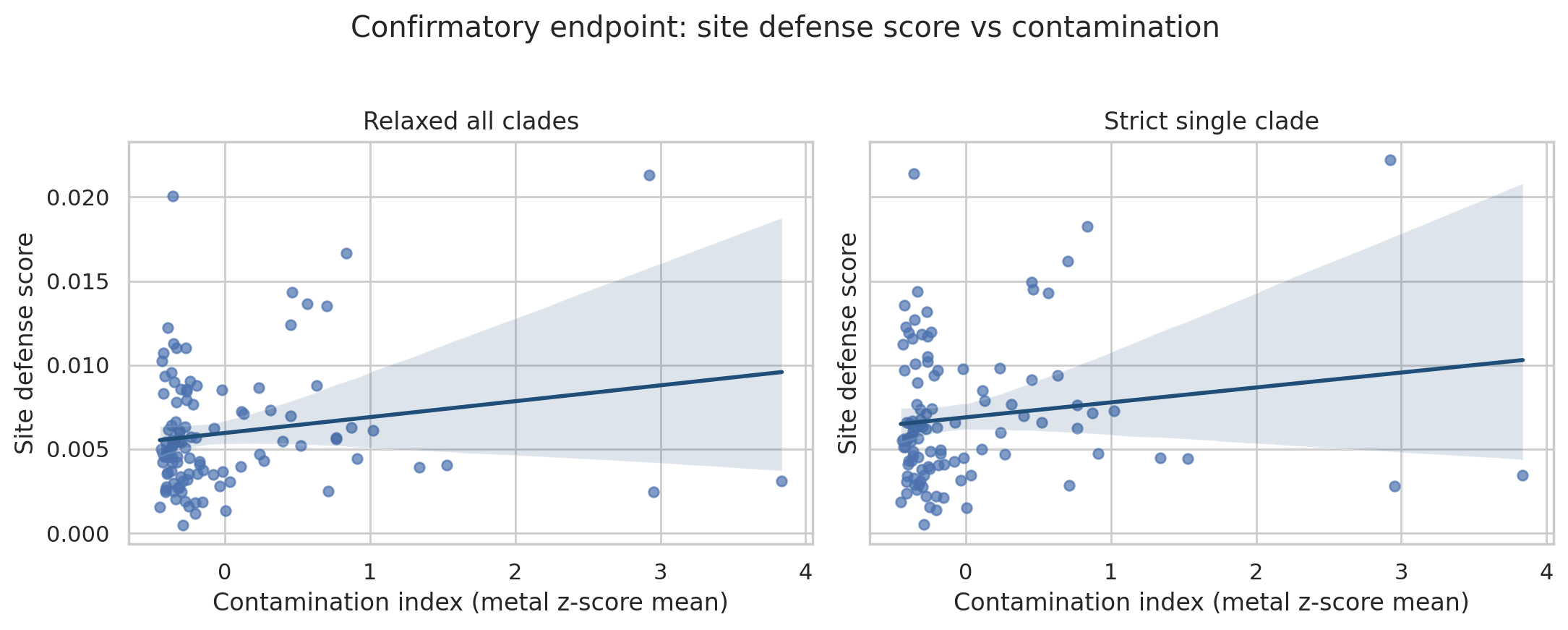 Confirmatory defense score vs contamination index by mapping mode. From enigma_contamination_functional_potential.
Possible Reconciliations
- Hypothesis: different signals. Partitioning by gene novelty within genomes and association with site contamination across communities may be independent properties. If so, finding one does not predict finding the other. 1 2
- Hypothesis: resolution and bridging attenuate the signal. Aggregation determines how community taxa are bridged to clades and how much abundance is retained for functional scoring, so community-level results may reflect representation rather than biological shifts. 2 Whether this explains the null result is untested here.
- Hypothesis: functional redundancy. Contamination might change which taxa are present while aggregated COG summaries stay stable, because different taxa supply overlapping functions. The ENIGMA data do not directly demonstrate this. 2
Resolving Work
- Novelty partitioning inside ENIGMA communities: Apply the core-versus-novel COG partitioning to genomes bridged from ENIGMA communities. This asks whether the Side A pattern is present in the very taxa where Side B found no site-level shift.
- Contamination test at finer resolution: Rerun the contamination association at finer-than-genus taxonomic resolution, using coverage-aware models (models that account for mapped coverage, the fraction of community abundance linked to the functional features). This asks whether the genus-resolution null depends on the chosen resolution and its mapped coverage.
- Accessory-fraction scores: Stratify ENIGMA functional scores into core-derived and novel-derived COG fractions, then test each against contamination. This asks whether a shift is confined to novel-gene categories that whole-genome proxies would mask.
- Redundancy test: Test, across ENIGMA sites, whether community membership varies with contamination and whether aggregated COG profiles do. This asks whether functional redundancy could explain the absence of a robust shift in COG proxies.