Whole-genome and functional analyses support different readings of within-species gene-content structure. Comparing phylogeny (evolutionary relatedness among genomes) with environmental similarity, one analysis found that phylogeny dominated gene-content similarity in 60.5% of species, while environment dominated in 39.5%, and significant environmental effects appeared in only 16 of 172 species 1. A separate study reports functional subset differentiation in COG categories (Clusters of Orthologous Groups, a standard scheme for classifying gene function) between ecotypes, meaning within-species gene-content groups that may or may not be adaptive 2. That study lacked phylogenetic controls, so its COG differences may reflect adaptive ecotypes or lineage-linked gene-content structure 2. The answer affects how phenotype-database-coverage-bias treats lineage composition as a confounder, and whether weak whole-genome environmental effects can count as evidence that ecological structuring is absent 1.
Evidence Sides
Side 1: Lineage is often dominant at genome-wide scale
In the ecotype analysis, phylogeny dominated gene-content similarity in 60.5% of species and environment dominated in 39.5%, with significant environmental effects in only 16 of 172 species 1. The concept page reads this as a refinement of the phenotype database result rather than a contradiction: lineage is often dominant at genome-wide scale 1. Even so, the nonzero environment-dominant subset and the possibility of subset-specific adaptation caution against treating weak whole-genome environmental effects as universal evidence of no ecological structuring 1.
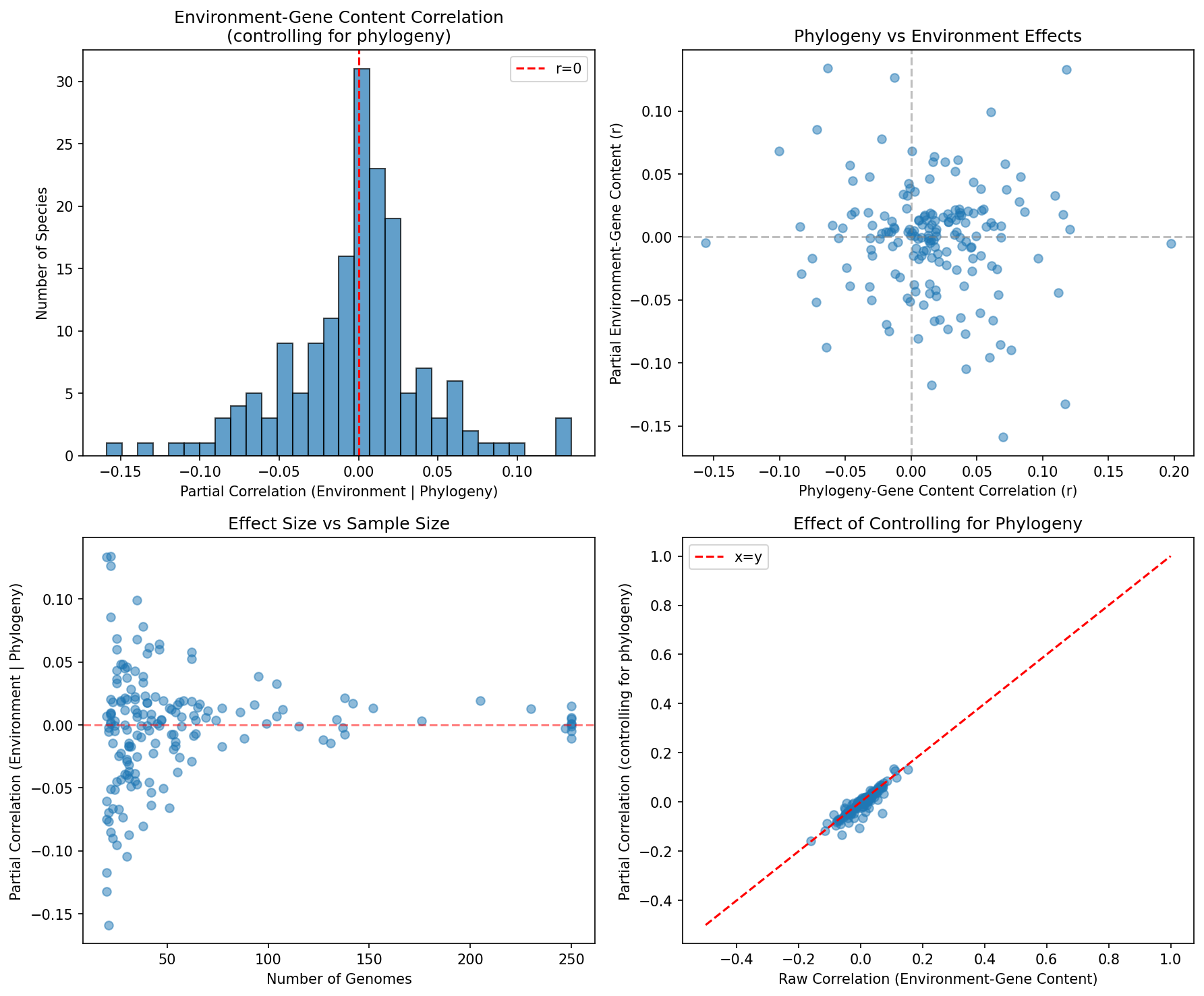 Ecotype correlation summary. From ecotype_analysis.
Side 2: Functional subsets differentiate between ecotypes
The ecotype-functional study supports functional subset differentiation, with COG differences observed between ecotypes 2. The study lacks phylogenetic controls. Its COG differences are therefore ambiguous: they may represent adaptive ecotypes, or they may represent lineage-linked gene-content structure 2.
Possible Reconciliations
- Hypothesis: Both observations may hold at different scales: lineage may dominate genome-wide similarity 1, while environmental adaptation acts on specific functional subsets that whole-genome metrics dilute 1,2.
- Hypothesis: The COG differences may be lineage-linked 2; if ecotypes coincide with clades, the functional study would align with the lineage-dominant result rather than reveal adaptation 1.
- Hypothesis: Adaptive ecotypes may concentrate in the species where environment dominated 1, so both projects would describe a heterogeneous set of species rather than one universal rule 1,2.
Resolving Work
- Data: ecotype assignments and auxiliary gene presence/absence matrices from the ecotype-functional study. Method: test COG differences with phylogenetic controls, such as clade-stratified permutation (shuffling ecotype labels only within clades, groups sharing a common ancestor) or phylogenetic regression (regression that accounts for expected similarity among relatives) on a core-genome tree (built from genes shared by all genomes). Question: does COG differentiation between ecotypes persist once lineage is accounted for?
- Data: the species where environment dominated in the ecotype analysis. Method: apply ecotype clustering and COG comparison to those species specifically. Question: are functional ecotypes more frequent or stronger where environment dominates whole-genome similarity?
- Data: gene-content matrices partitioned by COG category for the ecotype-analysis species. Method: compute partial correlations (association between two variables while controlling for a third) of environment and phylogeny with gene content separately for each functional subset. Question: do particular functional subsets show environment dominance that the whole-genome signal masks?
- Data: genomes with environmental metadata in both projects’ species overlap. Method: test whether ecotype membership is nested within phylogenetic clades or cross-cuts them. Question: are gene-content ecotypes independent of lineage, or lineage proxies?