Two related projects agree on the direction of a null result but disagree on the absolute size of the effect they measure. That effect is a partial correlation, meaning a correlation measured after removing the influence of another variable. The reanalysis found no stronger correlations for environmental species (p=0.83, where the p-value is the probability of a result at least this extreme if no true difference exists). It also reported a 27x higher overall median partial correlation than the original analysis. The comparator it used for the original does not match the median the original analysis itself reports 1,2. This matters because, without a demonstrated cause, the absolute correlation difference must not be read as a biological contradiction 1,2. It also bears on a broader question raised in classifier-database-compatibility-in-taxonomic-quantification: whether quantities produced by different pipelines can be compared directly.
Evidence Sides
Side 1: Ecotype reanalysis (genome-level environmental comparison)
- Its genome-level environmental comparison found no stronger correlations for environmental species (p=0.83). This is a null result, not evidence of an opposite effect 1,2.
- It reported a 27x higher overall median partial correlation than the original analysis 1,2.
- It used 0.003 as its comparator value for the original analysis 1,2.
- It lists full-genome extraction without downsampling (reducing data to a smaller subsample before analysis) as one of several methodological differences. It does not demonstrate that this difference is the cause 1,2.
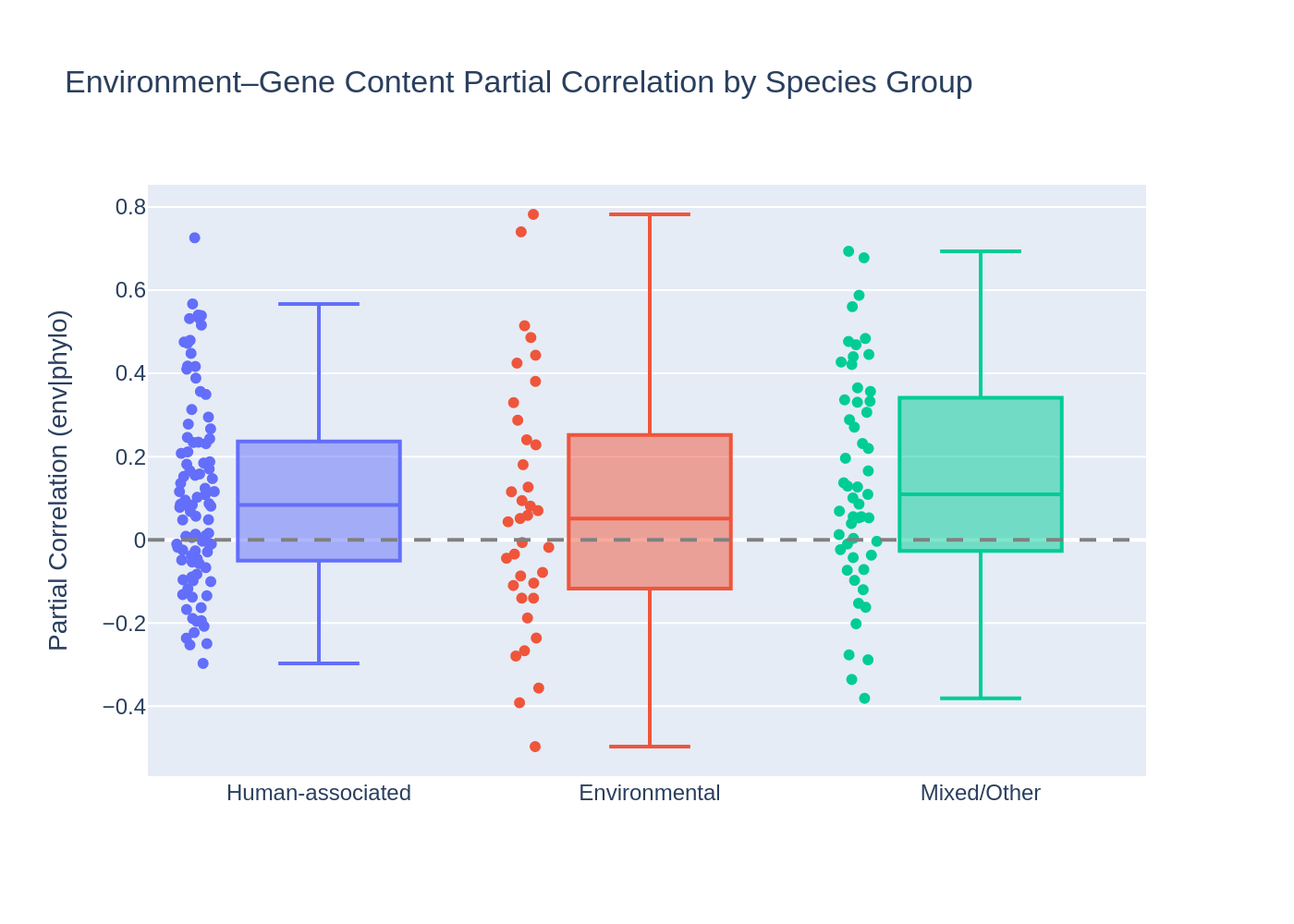 Partial correlations by species group. From ecotype_env_reanalysis.
Side 2: Original ecotype analysis
- It reports a median of 0.0025, which differs from the 0.003 comparator the reanalysis used 1,2.
- Its magnitude has not been reconciled with the reanalysis. The discrepancy remains open 1,2.
Possible Reconciliations
- Hypothesis A: pipeline-driven magnitude. The magnitude gap may come from methodological differences, such as full-genome extraction without downsampling, rather than from biology. The reanalysis lists this difference but does not demonstrate it as the cause 1,2.
- Hypothesis B: comparator mismatch. Part of the stated fold difference may depend on which original median is used as the baseline, 0.003 or 0.0025 1,2. This page does not compute an alternative fold difference.
Resolving Work
- Downsampling ablation. Rerun the reanalysis pipeline on the same genomes with and without the original downsampling step, and compare median partial correlations. Does full-genome extraction alone shift the magnitude?
- Baseline audit. Trace the 0.003 comparator in the reanalysis back to the original analysis outputs. Was it taken from a different table, species subset or rounding than the reported 0.0025 median 1,2?
- Matched-species comparison. Restrict both analyses to an identical species list and identical environment classifications, then recompute medians. Does the magnitude gap persist under matched inputs?
- One-factor-at-a-time methods comparison. Switch each listed methodological difference individually, holding the others fixed. Which single change, if any, accounts for the reported 27x difference 1,2?
- Null-result robustness. Repeat the reanalysis’s environmental-species comparison, with its original comparison group unchanged, under each pipeline variant. Does the null finding (p=0.83 in the reanalysis) hold regardless of magnitude changes 1,2?