Two analyses of Acinetobacter baylyi ADP1 single out aromatic degradation genes but read them differently. The deletion-phenotype analysis treats aromatic degradation as a concentrated quinate-specific module. The triple-essentiality analysis finds the same functional class strongly enriched among genes where FBA (flux balance analysis, a constraint-based model that predicts growth from metabolic network stoichiometry) disagrees with experiment, and it reports directional FBA under-prediction 1 2. The findings are compatible, but it remains unresolved whether the apparent pathway-specific requirement mainly reflects biological substrate dependence, missing model inputs, or both 2. The answer bears on how condition-space-dimensionality interprets the discrete pathway-specific module.
Evidence Sides
Side A: a concentrated, quinate-specific biological module
The deletion-phenotype analysis identifies aromatic degradation as a concentrated quinate-specific module 1. One interpretation, not established by the evidence, is that this module reflects a discrete, substrate-dependent requirement of ADP1 metabolism.
Side B: enrichment among FBA-discordant genes with directional under-prediction
The triple-essentiality analysis finds aromatic degradation strongly enriched among FBA-discordant genes and reports directional FBA under-prediction 2. The analysis proposes trace aromatics and mismatched environmental assumptions as possible causes. It presents these as hypotheses requiring direct testing, not as established explanations 2.
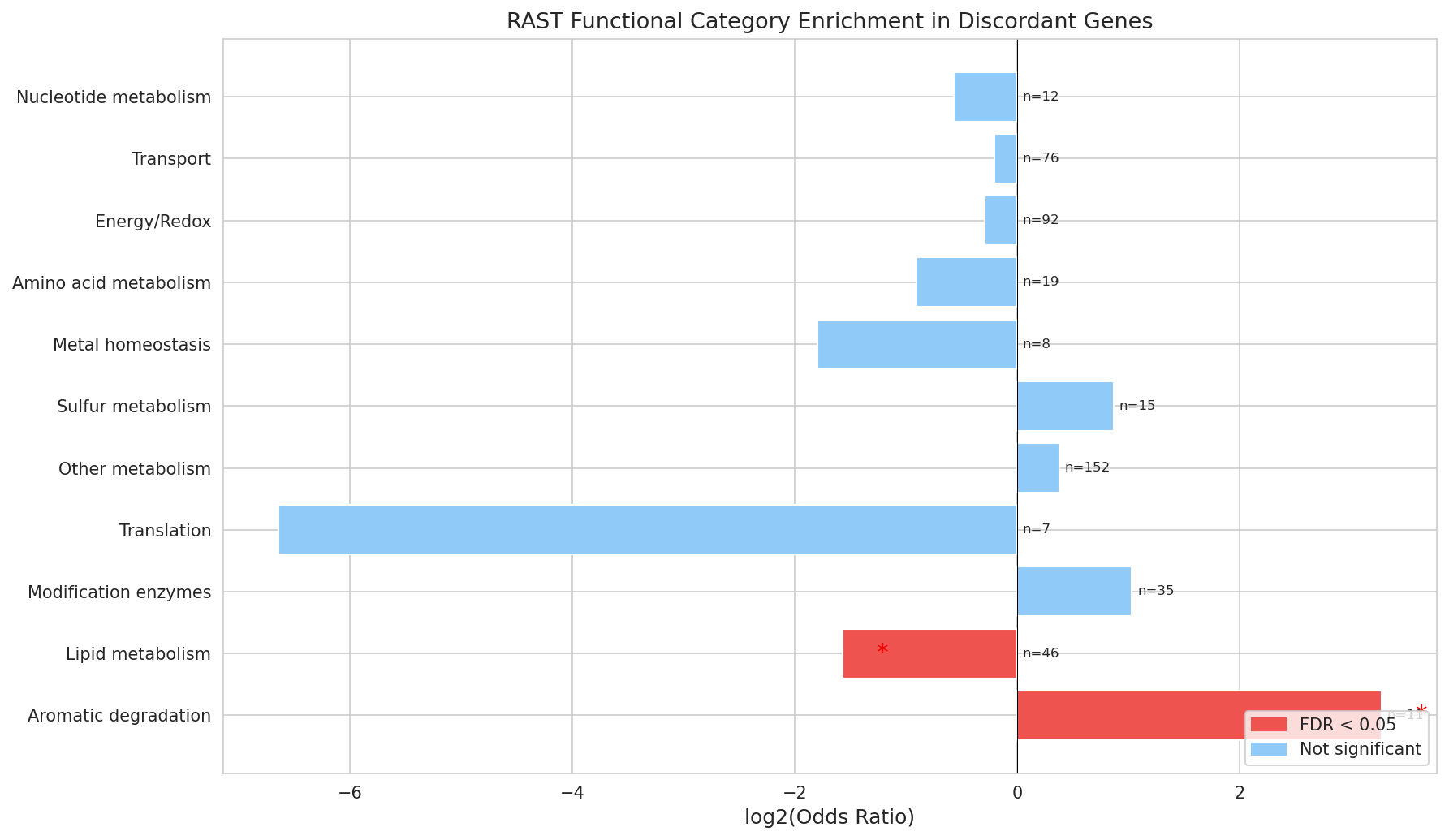 RAST functional category enrichment in discordant genes. From adp1_triple_essentiality.
Possible Reconciliations
- Hypothesis 1: genuine substrate dependence. The quinate-specific module is real biology. FBA discordance arises because the model does not fully capture this dependence. Both observations then describe the same underlying requirement.
- Hypothesis 2: missing model inputs. Trace aromatics or mismatched environmental assumptions in the model’s medium definition produce the discordance 2. Part of the apparent pathway specificity would then reflect model inputs rather than biology.
- Hypothesis 3: both contribute. A real quinate-linked requirement coexists with input mismatches that inflate or misplace FBA discordance in other conditions. Separating the contributions would require condition-by-condition attribution.
None of these is established by the current evidence. The triple-essentiality analysis explicitly frames its explanations as hypotheses 2.
Resolving Work
- Medium composition audit. Compare the measured composition of growth media, including trace aromatic contaminants quantified by targeted metabolomics (quantitative measurement of a predefined set of small molecules), against the FBA medium definitions. Question: do unmodelled aromatics exist in the conditions where under-prediction occurs?
- Model input perturbation. Rerun FBA with trace aromatic uptake enabled and with revised environmental assumptions. Then re-score concordance against deletion phenotypes. Question: does the aromatic-degradation enrichment among discordant genes disappear, shrink, or persist?
- Defined-medium regrowth. Regrow aromatic degradation deletion mutants on rigorously aromatic-free defined media, with and without quinate. Question: is the growth defect strictly quinate-dependent, which would support biological substrate dependence?
- Cross-condition attribution. Stratify FBA-discordant aromatic degradation genes by carbon source using the deletion collection’s per-condition growth data. Question: is discordance confined to the quinate condition or spread across conditions where no aromatic substrate is supplied?