Translational microbiome work asks a harder question than which taxa differ in disease: which organism, in which patient, should be removed or added, by what agent, and at what cost to the rest of the community. This corpus addresses it from two body sites and two intervention modalities. A Crohn’s disease (CD) gut project carries the argument end to end — differential abundance, mechanism annotation, phage cocktail drafts — returning 6 actionable candidates of 71 scored and per-patient drafts for 14 of 23 UC Davis Crohn’s disease patients 1. A cystic fibrosis (CF) airway project runs the mirror-image problem, building protective consortia to exclude a pathogen rather than phages to delete one, over six evidence streams including planktonic inhibition on 220 isolates and carbon-source profiling of 430 isolates × 21 substrates 2. The five sub-themes below trace what transfers; Tensions records where the corpus disagrees with itself.
Literature Context
Adherent-invasive Escherichia coli (AIEC) is a Crohn’s disease (CD)-associated pathobiont with characterized FimH/CEACAM6 adhesion and macrophage survival; reviews list phages, bacteriocins and anti-adhesives as therapeutic options (PMID 29141957, PMID 32466328). Preclinical phage work is substantial: a three-phage cocktail reduced LF82 in faeces and adherent flora of CEABAC10 mice after one day of oral dosing and reduced dextran sodium sulphate (DSS)-induced colitis (PMID 28130329); the seven-phage EcoActive cocktail lysed 95 % of 210 clinical AIEC strains and none of 43 non-E. coli commensal strains, protecting mice only when given twice daily for 15 days — a single administration failed (PMID 35997152); phage HER259 attenuated AIEC virulence by inverting the fimS promoter off, with colitis reactivating on withdrawal (PMID 42418560); and CD trials are ongoing (PMID 31696976). The corpus’s placement of escherichia-coli at clinical-trial-stage phage evidence is consistent with this literature, not a new claim.
Where the corpus extends this base is in treating the target itself as unsettled. Its scored six-of-71 list — lytic-phage evidence for E. lenta and E. bolteae, temperate-only evidence for mediterraneibacter gnavus, coverage gaps for hungatella hathewayi and flavonifractor plautii — has no counterpart among the candidate papers, whose named gut targets are AIEC, Clostridioides difficile, Fusobacterium nucleatum and Enterococcus faecalis (PMID 37770177). The temperate caveat is independently reasonable: LF82’s five prophages all form virions, yet its most active prophage stays repressed upon macrophage infection, making induction host-environment-dependent (PMID 36730457). Per-patient drafting is likewise supported: in compassionate-use mycobacterial phage therapy, isolates from 200 culture-positive patients were screened, one or more lytic phages were identified for 55 isolates, and 11 of the 20 patients treated showed favourable clinical or microbiological responses (PMID 35676823). The corpus’s E. coli within-carrier CD-down pathway signal sits alongside metagenomic evidence that CD-characteristic E. coli carries AIEC virulence factors and efflux-type resistance genes (PMID 39604394) — compatible with its strain-mediated reading.
The corpus’s ecological-cost argument concerns a price these papers do not measure. Where collateral effects are reported they are negative: EcoActive lysed none of 43 non-E. coli commensal strains and did not induce dysbiosis in healthy mice by metagenomics (PMID 35997152); compassionate-use nebulized phage therapy in nine adults with cystic fibrosis (eight women, one man, median age 32) lowered sputum Pseudomonas by a median of 104 CFU ml-1 at five to 18 days (P = 0.006) and improved median predicted forced expiratory volume in one second (FEV₁) by 6 % at 21–35 days (P = 0.004) without altering the sputum microbiome, which the authors state must be evaluated in larger clinical trials (PMID 40301561). The corpus’s bile-acid 7α-dehydroxylation cost is instead loss of the target’s own metabolic function — an inference from substrate–product correlation, not a measured outcome. The additive CF strategy has frames in engineered live biotherapeutics, whose efficacy is limited by performance in the nutrient-limited gut (PMID 38432422), and in bacterial consortium transplantation (PMID 30087270); that planktonic inhibition does not establish protection against structured biofilms is consistent with Streptococcus anginosus thickening its cell wall and inducing cell-envelope biogenesis genes when cultured in a multispecies biofilm with P. aeruginosa and Staphylococcus aureus — not a measurement of protection in patient airways (PMID 29901811).
What the Corpus Shows
Target selection is a scored, multi-attribute decision, and therapeutic tractability is a separate axis from disease association. The CD project’s six actionable Tier-A species reached threshold together, yet phage evidence ranges from clinical-trial-stage for escherichia-coli, through lytic-phage (host-lysing) literature for eggerthella lenta and enterocloster bolteae, to temperate-only evidence (temperate phages can integrate as prophages) for mediterraneibacter gnavus, to coverage gaps for hungatella hathewayi and flavonifractor plautii; hence a hybrid cocktail retaining non-phage options 1. One module holds 4–5 of the 6 candidates in every subnet 1 (phage-therapy-evidence-translation, species-cooccurrence-modules-as-intervention-units). The CF analogue inverts the sign: inhibition, coverage, safety, compatibility and engraftability can favour different species or sizes 2 — competitive-exclusion-consortium-design.
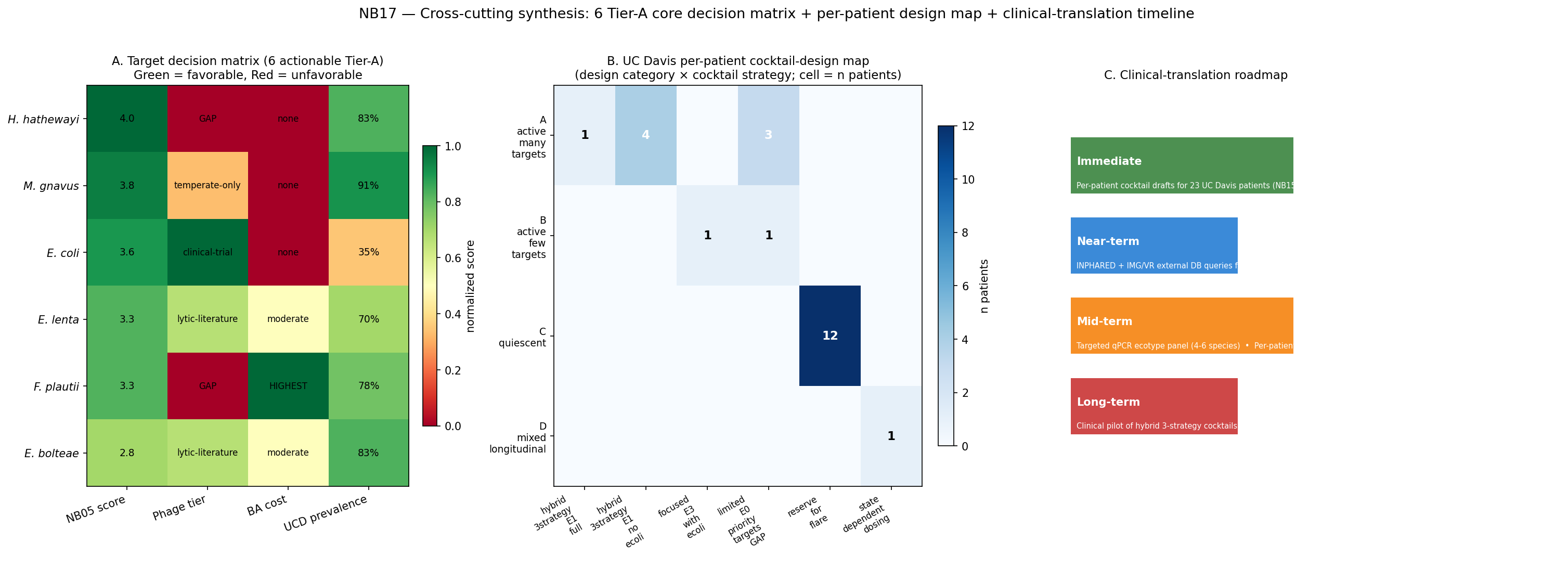 NB17 — Cross-cutting synthesis: target decision matrix + per-patient design map + clinical-translation roadmap. From ibd_phage_targeting.
A species-level association decomposes into carriage, within-carrier function and strain content, and the levels can point opposite ways. Within-carrier pathway testing finds 33 passing CD-versus-non-IBD (inflammatory bowel disease) pathways in H. hathewayi and 20 in E. coli, while four other Tier-A core species show at most 4 passing pathways each — a null at the pathway level the report attributes to carriage prevalence rather than within-carrier metabolic shift 1. The E. coli case is the sharpest warning: its within-carrier per-pathway abundance is CD-down, opposite to the cohort-level CD-up direction stated for E. coli relative abundance, with alternative-electron-acceptor and niche-specialization pathways depleted inside carriers 1. Two readings — an adherent-invasive E. coli (AIEC) subset trading generalist metabolism for iron and invasion machinery, or competition from co-abundant Enterobacteriaceae — are not distinguished by the data reported 1. See carriage-prevalence-versus-within-carrier-function.
Mechanism attribution is bounded by the annotation catalog, and the catalog is unevenly populated. Iron and heme acquisition is the dominant CD-up pathway theme: background 32 / 409, CD-up 15 / 52 (29 %), expected 4.07, odds ratio (OR) 8.11, p = 5.8e-7, false discovery rate (FDR, the expected share of false positives among calls) = 7.4e-6 1. Genomic content concentrates that signal in one organism: E. coli carries 54 iron plus 25 genotoxin matches to MIBiG (the curated reference of experimentally characterized clusters), the other species 0+0 1. The remaining five Tier-A core species sit in MIBiG dark matter, carrying substantial unannotated biosynthetic gene cluster (BGC — a contiguous gene set predicted to make a secondary metabolite) content (E. lenta 41 BGCs; M. gnavus 58 BGCs, 31 lanthipeptides) that MIBiG-themed analysis does not capture 1. Metabolite-class aggregation adds two axes under a pre-set gate of FDR < 0.10 and OR > 1.5 — polyamines (OR 14.6, FDR 0.008) and long-chain polyunsaturated fatty acids (OR 7.9, FDR 0.009) — but on one paired dataset in a cohort-level, subject-averaged contrast, so both await replication 1. Follow iron-acquisition-and-pathobiont-expansion, pathobiont-biosynthetic-gene-cluster-repertoires and metabolite-class-signatures-of-gut-inflammation.
Removing a target has an ecological price, and the corpus measures it only correlationally. Three actionable targets — F. plautii, E. lenta, E. bolteae — form a bile-acid-7alpha-dehydroxylation network, the conversion of primary bile acids into secondary, unconjugated forms, showing the predicted substrate–product signature in 468 paired HMP2 samples (F. plautii versus cholate at ρ = −0.26; lithocholate at +0.18 for E. bolteae, +0.15 for F. plautii; deoxycholate +0.17 for E. bolteae), while M. gnavus and E. coli show the opposite pattern and are not in the network 1. Depleting an active dehydroxylator is therefore expected to shift the bile-acid pool toward inflammatory primary tauro-conjugated forms — an inference from substrate–product structure, not a measured outcome 3. The digest requires three per-target annotation axes alongside the headline score: iron/AIEC versus other mechanism, bile-acid coupling cost, and whether an association is abundance- or strain-mediated 3. See ecological-cost-of-microbiome-target-depletion.
Stratification is available but unstable, and the one cheap proxy actually tested failed. A K = 4 consensus (K being the number of clusters) over 8,489 curated metagenome samples (5,333 healthy controls plus 3,156 IBD/other) yields four ecotypes — reproducible compositional community states — that separate disease from healthy, and across which CD and ulcerative colitis distribute rather than collapsing onto one state 3. Stability is modest: per-sample agreement between the two clustering methods at K = 4 is 48.9 %, and leave-one-study-out adjusted Rand index (ARI, agreement between two clusterings) is 0.113 1. A clinical-covariate classifier reached macro one-versus-rest AUC 0.799 (area under the receiver-operating curve, each ecotype scored against all others pooled) in pooled cross-validation but only 41 % patient-level agreement (9/22) with metagenomics on UC Davis; the verdict was that metagenomics remains required 1. A 4–6-species qPCR (quantitative PCR of selected taxa) panel is an unvalidated design proposal resting on one patient’s 14× M. gnavus expansion, not a failed test 1. Read gut-microbiome-ecotypes-as-patient-strata and proxy-assays-for-community-state-assignment.
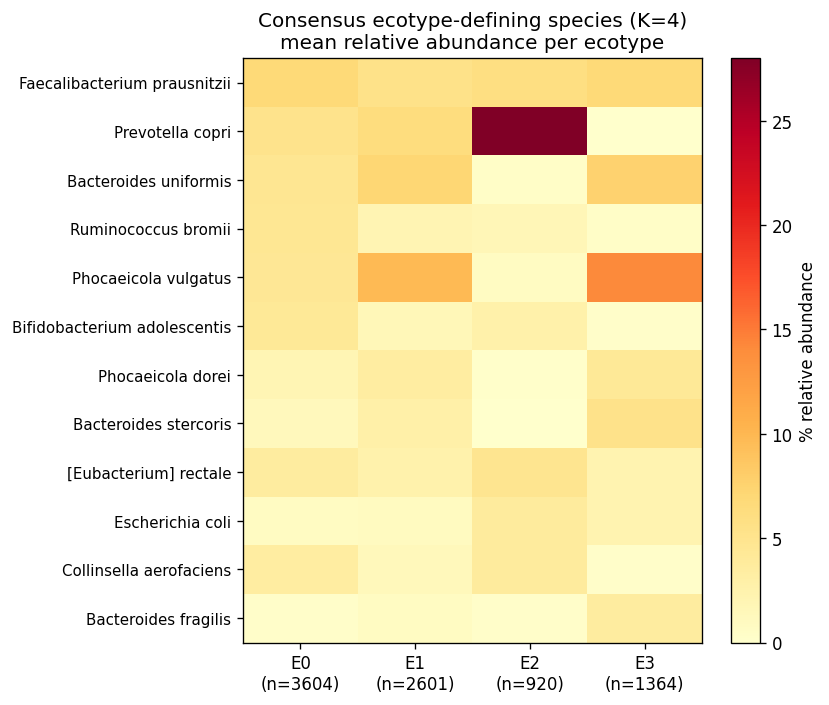 Ecotype-defining species (mean abundance per ecotype). From ibd_phage_targeting.
Tensions and Caveats
The load-bearing disagreement is over the within-ecotype target list: the cross-project digest reports 33 within-ecotype candidates collapsing to 3 under a stricter agreement filter and declares the list not usable 3, while the revised meta-analysis reports 51 E1 candidates and 40 provisional E3 candidates 1 — see conflicts/conflict—compositional-robustness-of-differential-abundance-calls—b440b98c. Upstream of any list, normalization can reverse a call: a raw Mann–Whitney test mis-directs 4+ of 8 protective species, Roseburia intestinalis flips raw CD↑ → CD↓ under the centred log-ratio (CLR) transform, which rescales each taxon against the sample’s geometric mean, and clostridium-scindens stays CD-enriched under both (raw log₂FC +5.66; CLR Δ +1.25), so compositional correction alone is insufficient 1 — compositional-robustness-of-differential-abundance-calls.
Several claims are weaker than their headline numbers. The genomic iron enrichment (OR = 44) rests on an unmatched comparator the report itself disowns, and the formal species × BGC interaction test was dropped as a project-scope limitation, leaving the verdict PARTIALLY SUPPORTED 1. The module-as-intervention-unit test failed its own bar — mean actionable-per-module 1.38 against a ≥ 2 criterion — passing only on inspection that one module holds 4–5 of the 6 targets 1. Nulls stay null: the short-chain fatty acid theme returned 0 CD-up of 14 members at FDR 1.0, with LC-MS (liquid chromatography–mass spectrometry) undersampling of volatile polar compounds, subject-averaged masking of within-subject variation, and gross pool differences smaller than within-subject variability all left open 1. Portability is the other hard limit: pooled metabolomics clustering separated completely by cohort, the first principal component explaining 79 % of variance with leave-one-study-out ARI 0.000 against the taxonomic 0.113 3 — though that verdict covers raw m/z-bridge clustering on 111 unique features, no batch correction, K = 4 plan-imposed, so it is not a general limit on metabolite features 1. Namespace identity matters too: only 69 of 257 identified Web of Microbes compounds (26.8 %) carry definitive ModelSEED links 4. See cross-cohort-microbiome-portability.
In CF, metabolic overlap with PA14 weighted by PA14’s substrate preferences significantly predicted planktonic inhibition across the 142 isolates with both inhibition and carbon-utilization measurements (r = 0.384, p = 2.3×10⁻⁶), yet a four-feature model’s training R² = 0.274 falls to cross-validated R² = 0.145 ± 0.142, and planktonic inhibition does not establish protection against the structured pseudomonas-aeruginosa biofilms that primarily occupy CF airways 2. The assay organism is also unrepresentative: CF P. aeruginosa is 94 % ExoS+ across 291 CF genomes (ExoS and ExoU being alternative type III secretion system effectors), while PA14’s ExoU+ genotype is reported as 5 % among those 291 genomes and as <5 % of CF isolates in the synthesis and limitations — a discrepancy the source leaves unresolved 2 — reference-strain-representativeness.
Where to Go Deeper
- phage-therapy-evidence-translation — how a scored target list becomes per-patient cocktail drafts 1.
- carriage-prevalence-versus-within-carrier-function — when a species needs strain-level targeting 1.
- ecological-cost-of-microbiome-target-depletion — the bile-acid cost of depleting a target 3.
- competitive-exclusion-consortium-design — the additive counterpart, measured against PA14 2.
Key entities: escherichia-coli, mediterraneibacter gnavus, flavonifractor plautii, pseudomonas-aeruginosa, bile-acid-7alpha-dehydroxylation, curatedmetagenomicdata, metaphlan3, phagefoundry.
Reports: Metagenome-Prioritized Phage Cocktails for Crohn’s Disease and IBD, Rational Design of Protective Microbiome Formulations for Competitive Exclusion of *Pseudomonas aeruginosa* in Cystic Fibrosis Airways, Web of Microbes Data Explorer, discoveries.