Two analyses in the corpus measure how many metal-important genes are also important under salt or osmotic stress, and they report different overlap fractions 1 2. The difference matters because shared-stress genes could inflate the apparent core-genome enrichment of metal fitness genes, a claim tied to gene-essentiality.
Evidence Sides
Side A: counter-ion analysis (larger overlap)
The counter-ion analysis found 39.8% overlap between metal-important and NaCl-stress genes 1. NaCl is sodium chloride, used here as a general salt/ionic stress. Despite this large overlap, removing the shared-stress genes preserved core enrichment for 12 of 14 metals 1. It also preserved the original conclusion: 87.4% of metal-important genes are core, with OR=2.08 1. OR is an odds ratio, the odds of being core among metal-important genes relative to the odds among the comparison set.
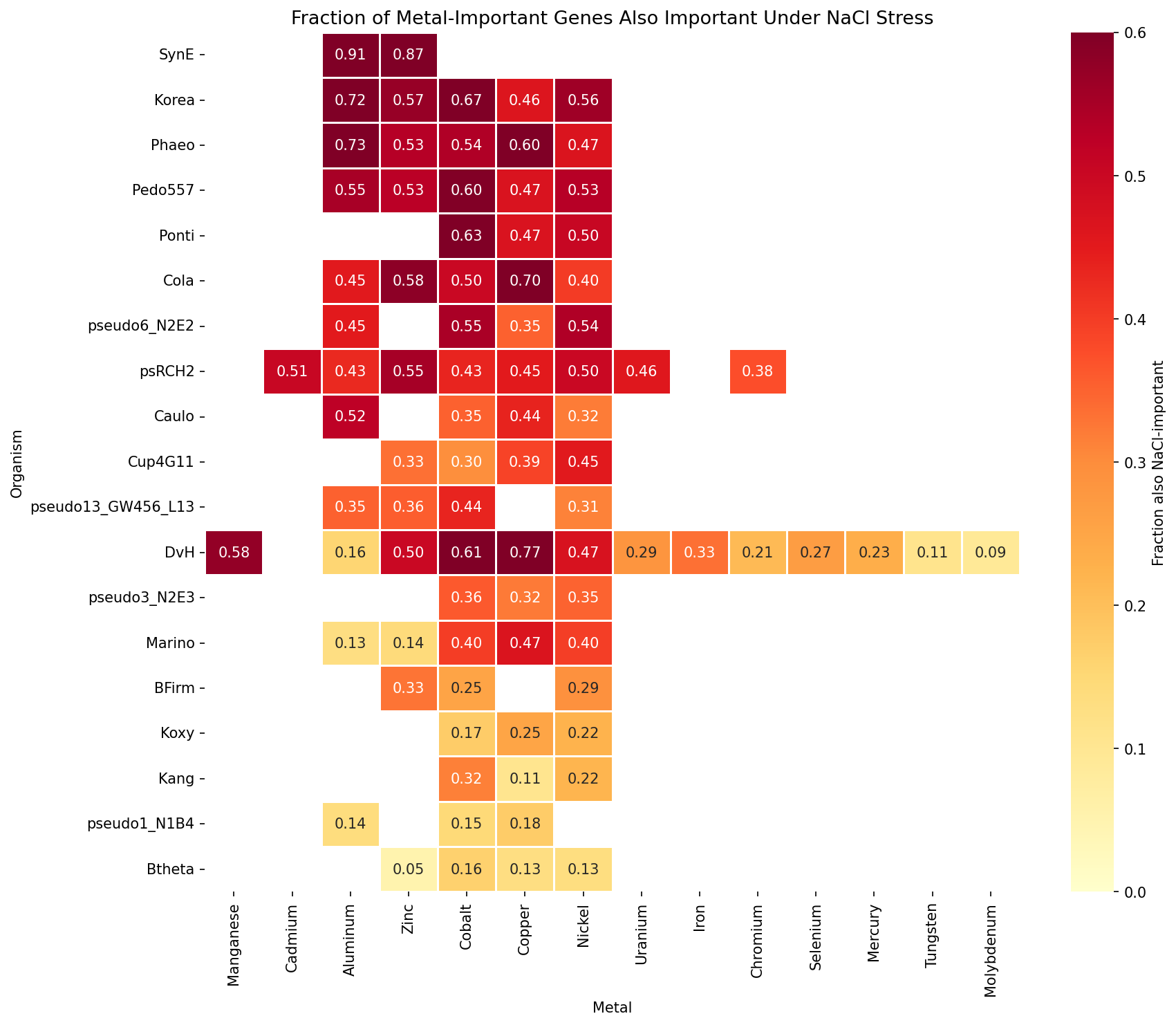 Heatmap of metal-NaCl gene overlap by organism and metal. From counter_ion_effects.
Side B: separate metal-specificity analysis (smaller overlap)
A separate analysis found 14.7% of metal-important genes sick under osmotic stress 2. “Sick” means a gene’s mutants show reduced fitness under that condition. The tension text attributes the 2.7× discrepancy between the two estimates to stricter thresholds and different organism sets 1 2.
The two figures rest on different thresholds and different organism sets 1 2. Neither figure should be treated as the corrected value of the other.
Possible Reconciliations
- Hypothesis 1: threshold stringency. The stricter threshold in the separate analysis may exclude weaker fitness defects that the counter-ion analysis’s threshold would count as shared stress. On this hypothesis, both figures are valid estimates of differently defined quantities.
- Hypothesis 2: organism composition. The two analyses cover different organism sets 1 2. Organisms with unusually high or low shared-stress fractions could shift either pooled estimate.
- Hypothesis 3: condition definition. “NaCl stress” and “osmotic stress” may not denote the same set of experiments in both projects. If they differ, the overlap is being measured against different stress panels.
Resolving Work
- Re-run the separate analysis’s overlap calculation using exactly the counter-ion analysis’s threshold, on the same fitness data. This asks whether threshold stringency alone accounts for the 2.7× gap.
- Restrict both analyses to their shared organism set and recompute both overlap fractions. This asks whether organism composition, rather than method, drives the difference.
- Compute per-organism overlap under each threshold and test for outlier organisms with a leave-one-organism-out analysis. This asks whether any single organism dominates either pooled estimate.
- Tabulate the stress experiments counted as “NaCl” versus “osmotic” in each project and recompute overlap on a harmonized condition list. This asks whether condition definitions differ.
- Repeat the core-enrichment test, including the odds ratio, after removing shared-stress genes defined under each threshold. This asks whether the core conclusion is robust across both overlap definitions.