The core-gene trade-off analysis sorts genes into categories such as “Costly + Conserved” from laboratory burden and conservation across a pangenome (the full gene set of related genomes) 1. The disagreement is about what that category shows. One reading treats it as a signature of genes kept by natural selection. The other holds that, because laboratory measurements can depend on perturbation modality and condition, the category supports only a selection hypothesis, not direct evidence about fitness in nature 1. The answer determines whether these gene sets, 28,017 costly-and-conserved and 5,526 costly-and-dispensable genes 2, can serve as evidence about natural environments or only as candidates for ecological testing. The tension comes from essentiality-assay-discordance.
Evidence Sides
Selection-signature reading: costly conservation as a marker of maintained genes
The core-gene trade-off analysis builds its Costly + Conserved category from laboratory burden and pangenome conservation, and this refines how costly conserved genes are interpreted 1. The synthesis identifies 28,017 genes as both costly and conserved and 5,526 as costly and dispensable, and frames these categories as selection signatures 2.
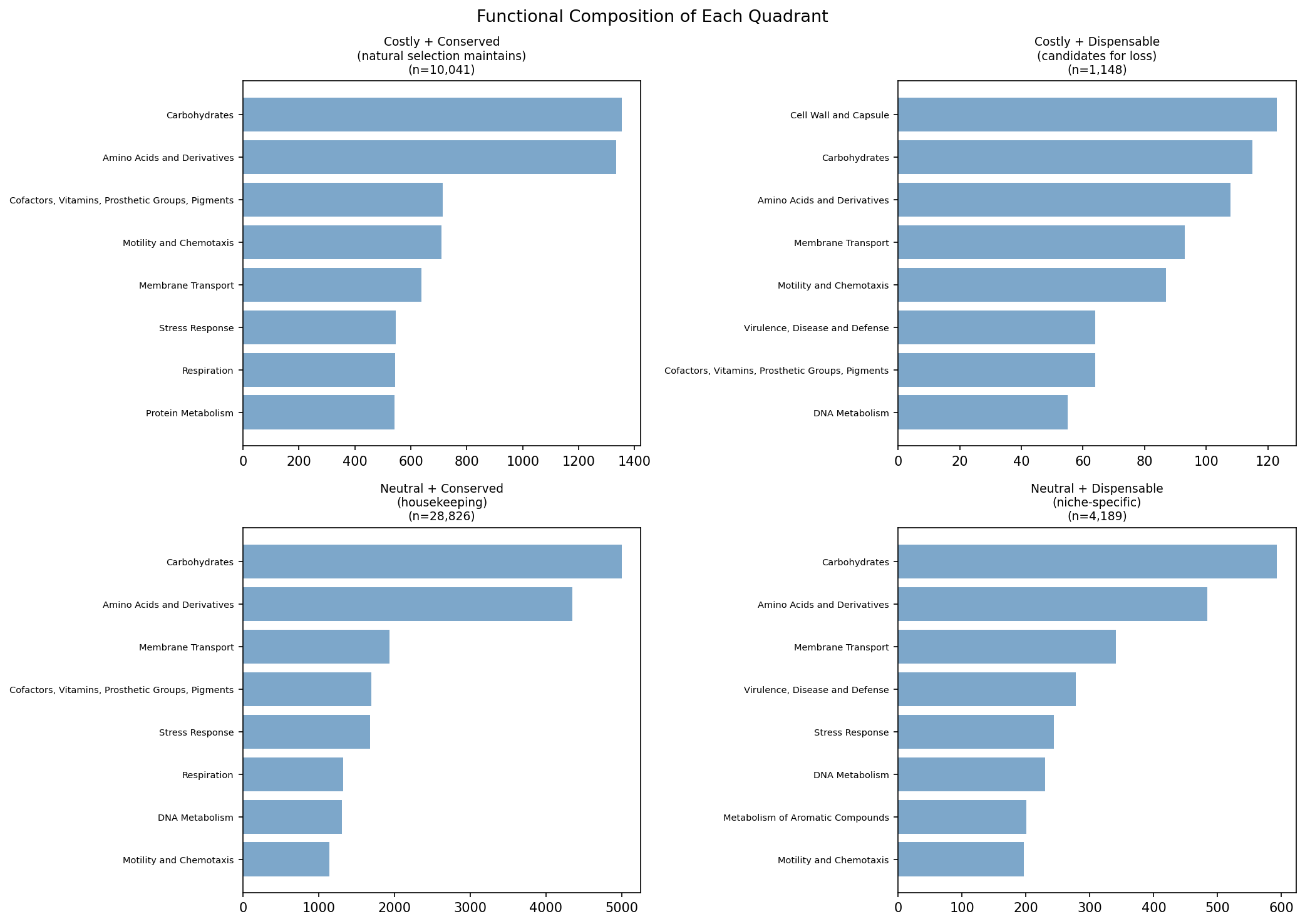 Selection Signature Matrix. From core_gene_tradeoffs.
Assay-dependence reading: lab cost cannot directly establish natural selection
The Costly + Conserved category is inferred from laboratory burden and conservation, and the assay-discordance evidence shows that laboratory measurements can depend on perturbation modality (for example, transposon insertion, which disrupts a gene by inserting a mobile DNA segment, versus complete knockout, which removes the entire gene) and on condition 1. On this reading, costly conservation should be treated as a selection hypothesis that needs ecological validation, not as direct evidence that a gene is essential in nature 1. The synthesis supports this caution: it explicitly treats its categories as selection signatures rather than direct measurements of natural fitness 2.
Possible Reconciliations
- Hypothesis: The two readings may operate at different evidential levels. “Selection signature” could describe a statistical pattern, while “essential in nature” is a separate claim the laboratory data cannot reach. If so, both sides could hold once the wording is kept distinct.
- Hypothesis: Some Costly + Conserved genes may be costly only under particular laboratory perturbations or conditions. If so, their cost calls would be assay-dependent, and ecological validation would still be needed to judge selection.
- Hypothesis: Costs that appear consistently across perturbation modalities and conditions may predict selection in nature better than costs seen in a single assay. If so, a stricter, assay-robust category could support the stronger reading.
Resolving Work
- Data: Costly + Conserved genes with fitness measured by both transposon and complete-knockout methods. Method: Compare each gene’s burden call between the two modalities. Question: What share of the category’s cost survives a change of perturbation modality?
- Data: Per-condition laboratory fitness profiles for the Costly + Conserved set. Method: Classify each gene’s cost as condition-specific or condition-general. Question: Is costly conservation driven by a few conditions or by cost across the whole condition space?
- Data: Environmental metadata for source organisms linked to their laboratory fitness data. Method: Test whether costly-conserved content tracks environmental variability. Question: Does ecological context validate the selection hypothesis?
- Data: The costly-and-dispensable set compared against the costly-and-conserved set. Method: Contrast their functions, mobile-element association and phylogenetic distribution. Question: Do the two sets differ as a selection model predicts?