Raw report: nmdc_context_audit Feeds into: cross-tenant-data-bridging, data-landscape-ownership-and-coverage-bias, provenance-aware-resource-discovery
Overview
This audit evaluates KBase Data Lakehouse resources whose names contain nmdc, distinguishing provenance, tenant placement, scale, currency, and authority. It finds that 20 database names resolve to 7 real, maintained resources across three tenants and six provenance classes, demonstrating that the nmdc label is systematically overloaded rather than a reliable dataset boundary. 1
Key Findings
1. One label spans three tenants and six provenance classes
The 7 maintained resources comprise genuine NMDC resources (nmdc.metadata and nmdc.results), an NCBI re-host (nmdc.ncbi_biosamples), a Pfam re-host (nmdc.ref_data), an Arkin Lab derivative (kbase.nmdc_arkin), an NMDC-derived KBase resource (kbase.nmdc_mags), and a namesake collision representing NEON rather than NMDC (kbase.nmdc_neon). All four predicted confusion modes were observed in actual resources, supporting the audit’s hypothesis that the label is systematically overloaded. 1
2. The nmdc tenant is neither all NMDC nor only NMDC
Two of the four databases in the nmdc tenant are external re-hosts: nmdc.ncbi_biosamples contains an NCBI BioSample harvest with 51,711,888 biosamples and 756,112,544 attribute rows, while nmdc.ref_data contains 27,481 Pfam terms. Three NMDC-related databases—nmdc_arkin, nmdc_mags, and nmdc_neon—are instead located in the kbase tenant. The inventory groups resources by catalog prefix, so it files these three under kbase. As a result, anyone browsing the nmdc tenant cannot see them. 1
The genuine NMDC biosample universe contains 16,640 samples in nmdc.metadata.biosample_set, whereas the co-hosted NCBI mirror contains 51,711,888 biosamples; the report identifies this as a ~3,000× scale trap. 1
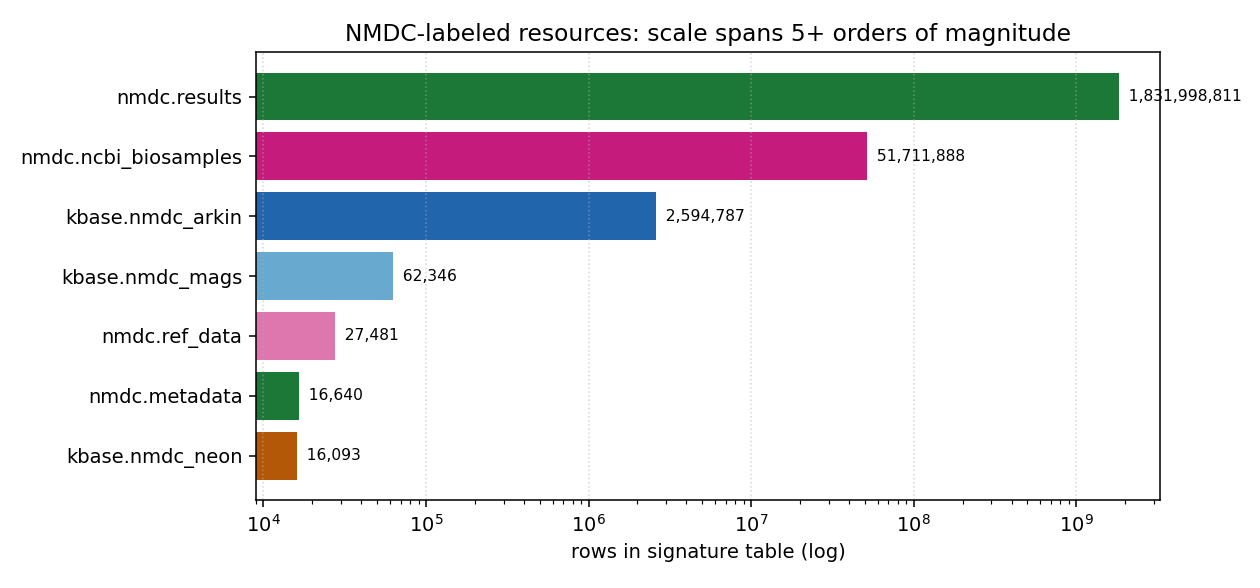 Scale of NMDC-labeled resources by provenance class. From nmdc_context_audit.
The freshest NMDC resource is kbase.nmdc_mags, containing 62,346 MAGs (metagenome-assembled genomes), but it is located in the tenant users are least likely to search when looking for NMDC data. NMDC-derived data is split across two tenant homes, nmdc.* and kbase.nmdc_*, and nothing cross-links them. 1
3. Currency is distributed across months and is not exposed at discovery
Iceberg snapshot ages—the available data-currency signal—span approximately four months across NMDC-labeled resources, yet nothing shows this difference to a user who is choosing a resource. The latest commits are 2026-07-02 for kbase.nmdc_mags and kbase.nmdc_neon, 2026-05-27 for kbase.nmdc_arkin, 2026-05-20 for nmdc.metadata, nmdc.results, and nmdc.ref_data, and 2026-03-09 for nmdc.ncbi_biosamples. 1
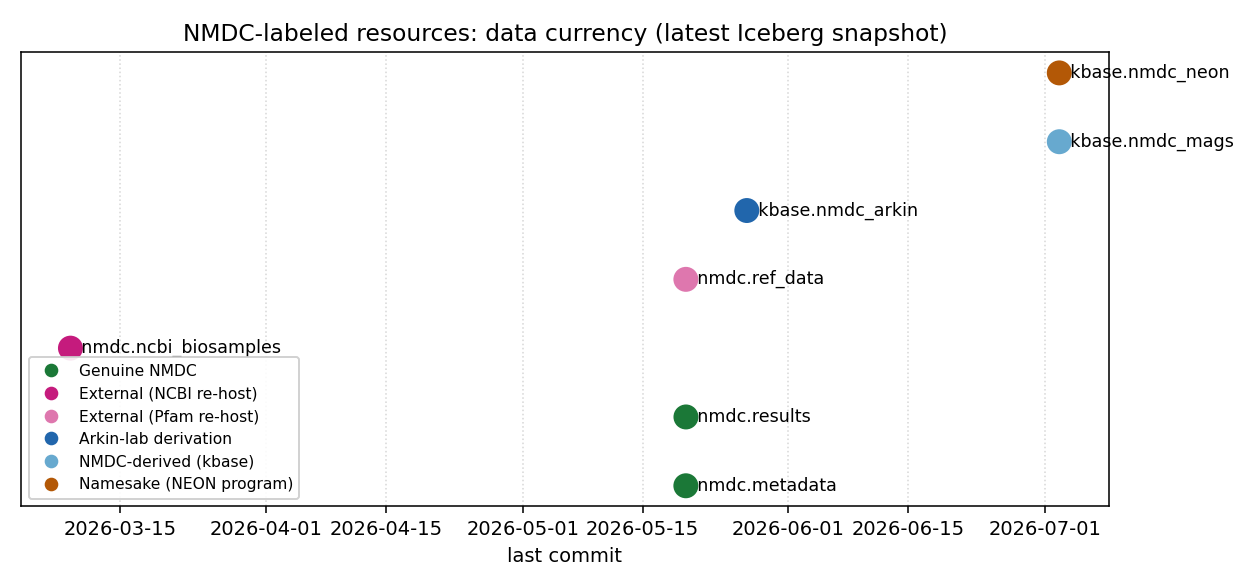 Data currency of NMDC-labeled resources. From nmdc_context_audit.
Iceberg .snapshots.committed_at is the only available data-currency signal. The audit recommends surfacing max(committed_at) in discovery tooling because tables have no comments, databases have empty properties, and no changelog exposes currency. 1
4. Context is missing across catalog, documentation, and tooling layers
Catalog tables carry no Comment, databases have empty Properties with owner tgu2, the canonical docs/schemas/nmdc.md link returns a 404 because docs/schemas/ does not exist, and docs/overview.md does not mention NMDC. The platform’s discovery skill contains zero NMDC-specific content, while the inventory script groups resources by catalog prefix and therefore does not link kbase.nmdc_* resources back to NMDC. 1
The berdl_data_atlas also labels Rhea and Gene Ontology reference ontologies under nmdc_arkin as “NMDC integrated,” creating provenance blur even where documentation exists. 1
5. Names and provenance create concrete attribution hazards
kbase.nmdc_neon represents the National Ecological Observatory Network (NEON), an NSF program distinct from the National Microbiome Data Collaborative (NMDC) and its DOE-BER context. Treating the namesake as NMDC would create an agency-attribution error. 1
The audit characterizes co-hosting as intentional and potentially valuable: the NCBI mirror adds an attribute-harmonization layer to 51,711,888 raw NCBI samples, while the Arkin derivative adds embeddings and traits that do not exist upstream. The recommended remedy is therefore to expose provenance and value together rather than relabeling or removing resources. 1
6. Scale can be catalogued cheaply, but metadata access differs from data access
Row counts for all NMDC tables, including nmdc.results.annotation_kegg_orthology with 1.83B rows, return instantly through Iceberg metadata using SELECT COUNT(*). 1
DESCRIBE DATABASE EXTENDED kbase.nmdc_* raises ForbiddenException for a kesciencero/microbialdiscoveryforge principal even when COUNT(*) on the same tables succeeds, showing that metadata introspection and data reads have different access surfaces. 1
get_databases() returns both dotted Iceberg aliases such as nmdc.metadata and underscore Hive aliases such as nmdc_metadata for every tenant database; consumers must de-duplicate to the dotted form before iteration to avoid double-counting. 1
7. Primary deliverable and proposed remediation
The project’s primary deliverable is a 15-file Open-Knowledge-Format directory containing an index, a thesis on label overload, a goal-to-resource decision guide, resource-specific provenance pages, scale and currency guidance, naming-cruft documentation, and prior-project usage information. 1
The report proposes, but does not apply, seven fixes: repair or repoint the broken schema entry point; add an NMDC module to the discovery skill; cross-link nmdc and kbase.nmdc_* homes in inventory output; surface Iceberg snapshot currency; correct provenance-blur labels; mention NMDC in docs/overview.md; and repair or drop broken user copies and the phantom kbase_nmdc_neon alias through a commit or pull request. 1
Interpretation
The evidence is consistent with the overloaded label contributing to sub-optimal resource selection, but this interpretation is inferred from gap analysis and prior-project usage skew rather than from a directly observed wrong choice. A user seeking NMDC-curated microbiome metadata could select nmdc.ncbi_biosamples, work at the wrong scale, omit the freshest MAG catalog by searching only the nmdc tenant, or misattribute NEON data as NMDC; the report treats the resulting time, compute, and interpretive costs as plausible consequences rather than directly measured outcomes. 1
The authority context is also heterogeneous: NMDC is the National Microbiome Data Collaborative of DOE-BER; NEON is the National Ecological Observatory Network of NSF, with an agency and sampling design distinct from NMDC; NCBI BioSample is the authority for nmdc.ncbi_biosamples; and Pfam/InterPro is the authority for nmdc.ref_data. The NMDC data model is LinkML-based and defines the *_set schema used in nmdc.metadata. 1
Caveats and Limitations
The provenance classes are inferred from schema, table properties, tenant metadata, and prior project usage rather than an ingestion manifest, because no ingestion manifest is exposed in the catalog. 1
Descriptions for kbase.nmdc_* databases are access-restricted by ForbiddenException, so steward-authored notes, if any, could not be captured. 1
Completeness is assessed relative to snapshot timestamps and was not tested by comparison with live upstream NMDC or NCBI record counts; such comparison would require external API calls and was out of scope. 1
The report does not directly observe users choosing the wrong resource. Its interpretation that label overload drives sub-optimal selection is based on gap analysis and prior-project reuse skew, so that causal claim remains inferred. 1
The audit enumerates 7 real, maintained resources among 20 NMDC-named database entries, but also records aliases, test databases including globalusers.nmdc_core_test*, a phantom kbase_nmdc_neon with 0 tables, and broken user copies including mamillerpa/my.nmdc_flattened_biosamples with a dangling Iceberg pointer. 1
Earlier in-repository knowledge covers nmdc_arkin well but leaves the other six resources thinly documented or undocumented. That knowledge is the nmdc_arkin section of the pitfalls document plus the discoveries document. The report presents this as consistent with its gap analysis. 1
Figures
The report includes two figures. figures/nmdc_scale.png plots signature-table row counts by resource on a log scale, colored by provenance class. figures/nmdc_currency.png plots the latest Iceberg snapshot per resource, colored by provenance class. 1
Future Directions
The report proposes applying the documentation and tooling fixes, measuring whether subsequent NMDC projects reach the appropriate resource faster, adding lightweight provenance and currency annotations to inventory output, extending the provenance-audit method to other overloaded KBase Data Lakehouse labels, and comparing nmdc.metadata and nmdc.ncbi_biosamples with live upstream record counts to quantify completeness lag. 1
Slots Into
- provenance-aware-resource-discovery — The audit is the core case for this concept. A shared label hides differences in provenance, scale and snapshot currency. The catalog, documentation and tooling layers carry no context. Metadata and data reads have different access surfaces. The link between label overload and wrong resource choice is inferred, not observed.
- data-landscape-ownership-and-coverage-bias — The audit sorts the resources into six classes: genuine NMDC, an external NCBI re-host, an external Pfam re-host, an Arkin Lab derivation, NMDC-derived
kbasedata and a NEON namesake. It records the authority for each class and the risk of attributing data to the wrong agency. - cross-tenant-data-bridging — The audit directly documents NMDC-related resources split across
nmdcandkbasetenants, prefix-based discovery failure, aliases, and the need for cross-tenant provenance links. - multi-omics-integration — The audit identifies value-added NMDC-related products containing embeddings, traits, metabolomics, omics files, and MAG catalog data, while emphasizing that these derivatives require explicit provenance and authority context.
- pangenome-integration — The audit highlights the scale and currency of the NMDC MAG catalog and distinguishes NMDC-derived resources from external re-hosts and namesake databases.