Key Findings
1. Each carbon source uses a distinct respiratory chain configuration
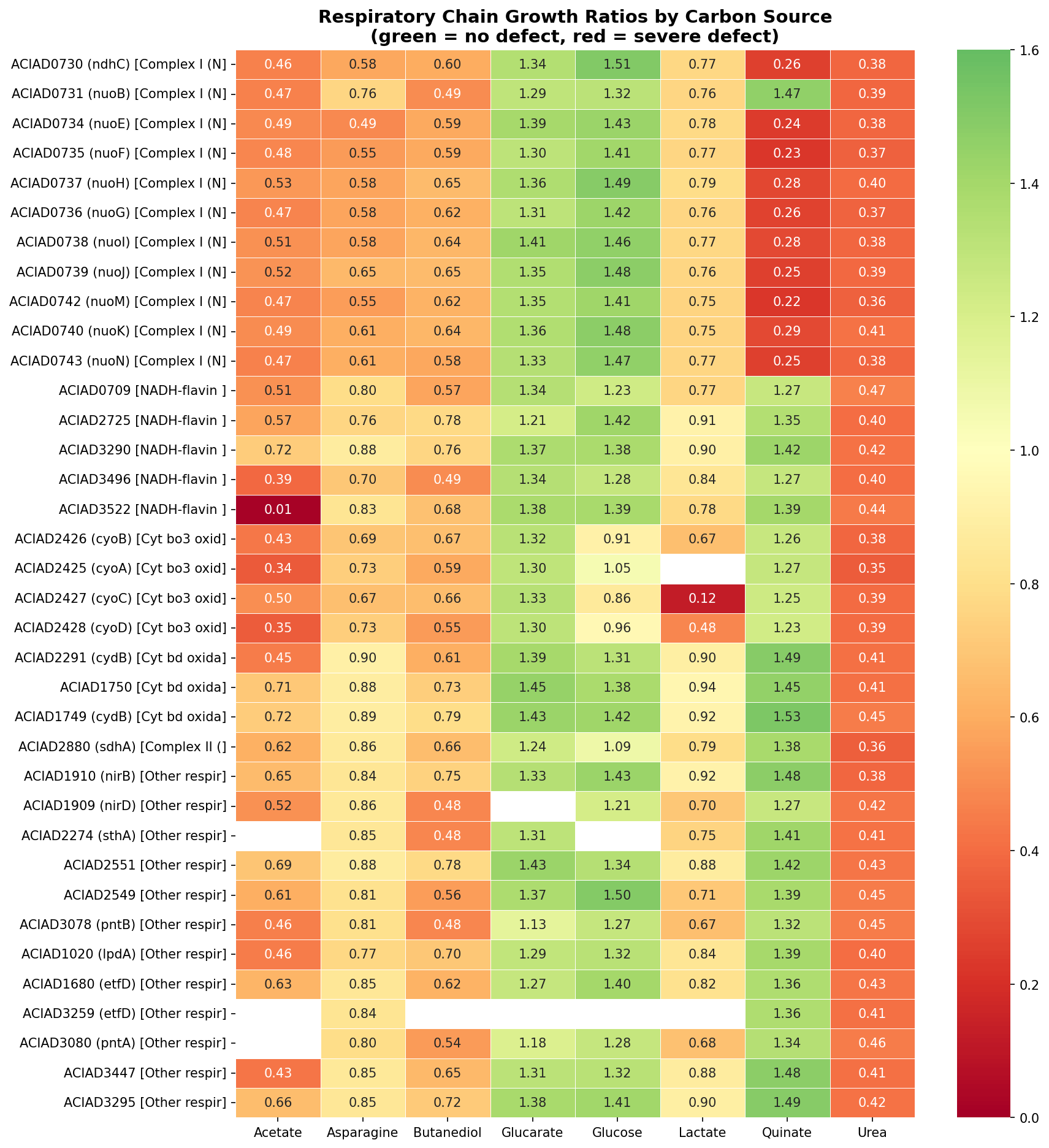
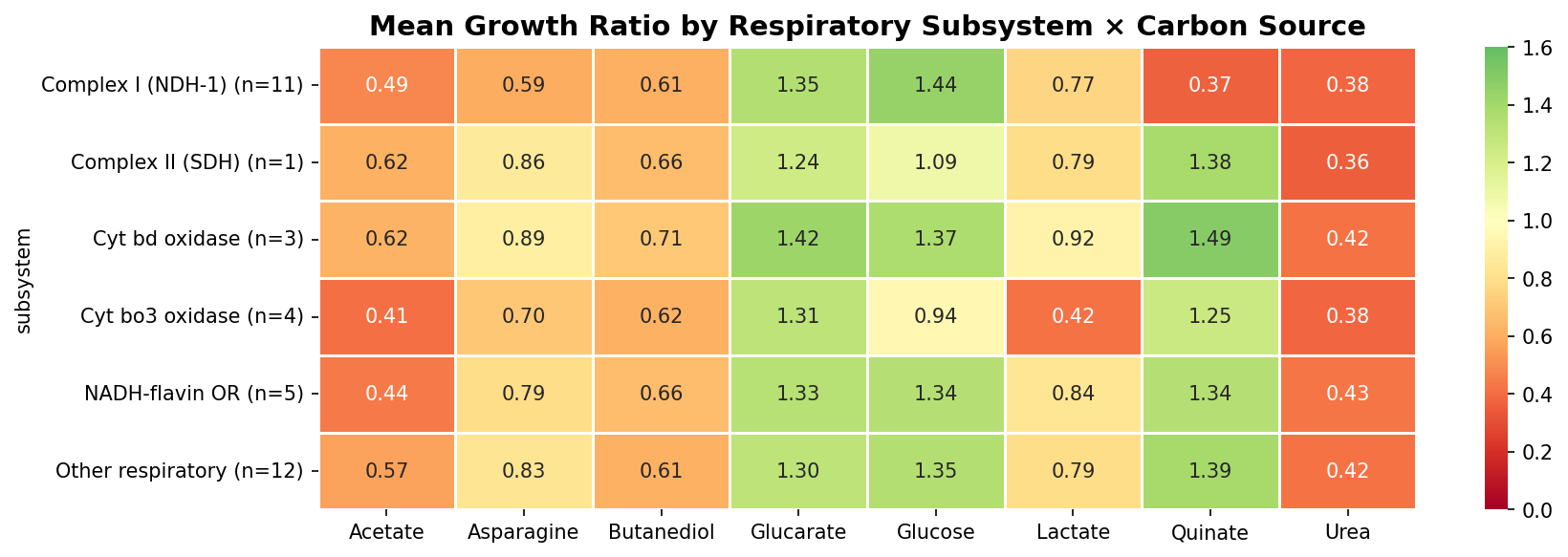
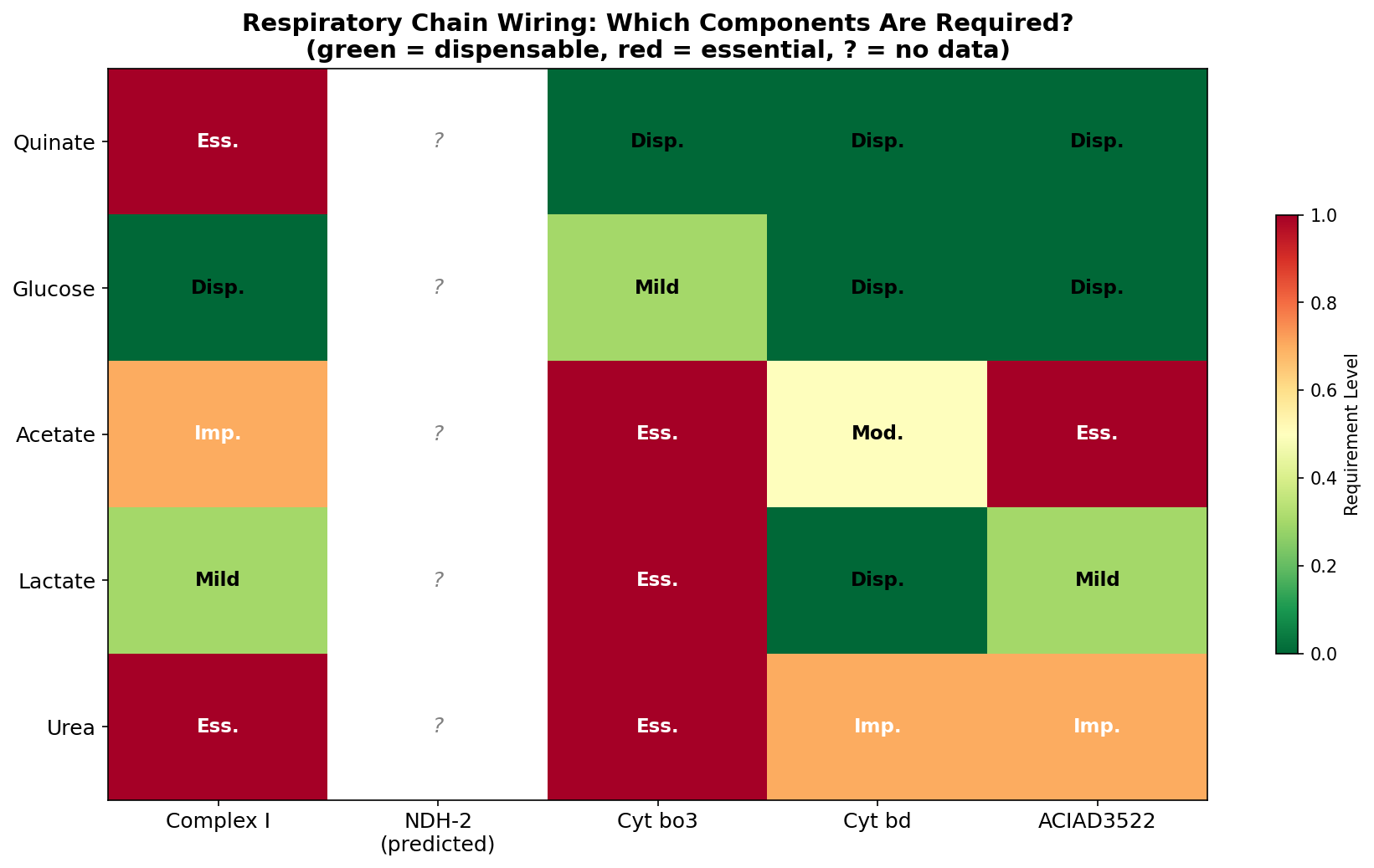
ADP1’s branched respiratory chain (62 genes across 8 subsystems) is wired in a condition-dependent manner. Quinate requires only Complex I; acetate requires Complex I, cytochrome bo3, ACIAD3522, and more; glucose requires no specific respiratory component. This is not a quantitative gradient — it’s qualitatively different respiratory configurations per substrate.
| Carbon Source | Required Components | Dispensable Components |
|---|---|---|
| Quinate | Complex I only | Cyt bo3, Cyt bd, SDH, all others |
| Acetate | Complex I + Cyt bo3 + ACIAD3522 + more | None — most demanding |
| Lactate | Cyt bo3 | Complex I (mild), Cyt bd |
| Glucose | None specifically | All (full redundancy) |
| Urea | Everything (generally demanding) | None |
(Notebook: 01_respiratory_chain_map.ipynb)
2. ADP1 has three parallel NADH dehydrogenases with distinct condition profiles
| Dehydrogenase | Subunits | Proton pumping | Quinate | Glucose | Acetate |
|---|---|---|---|---|---|
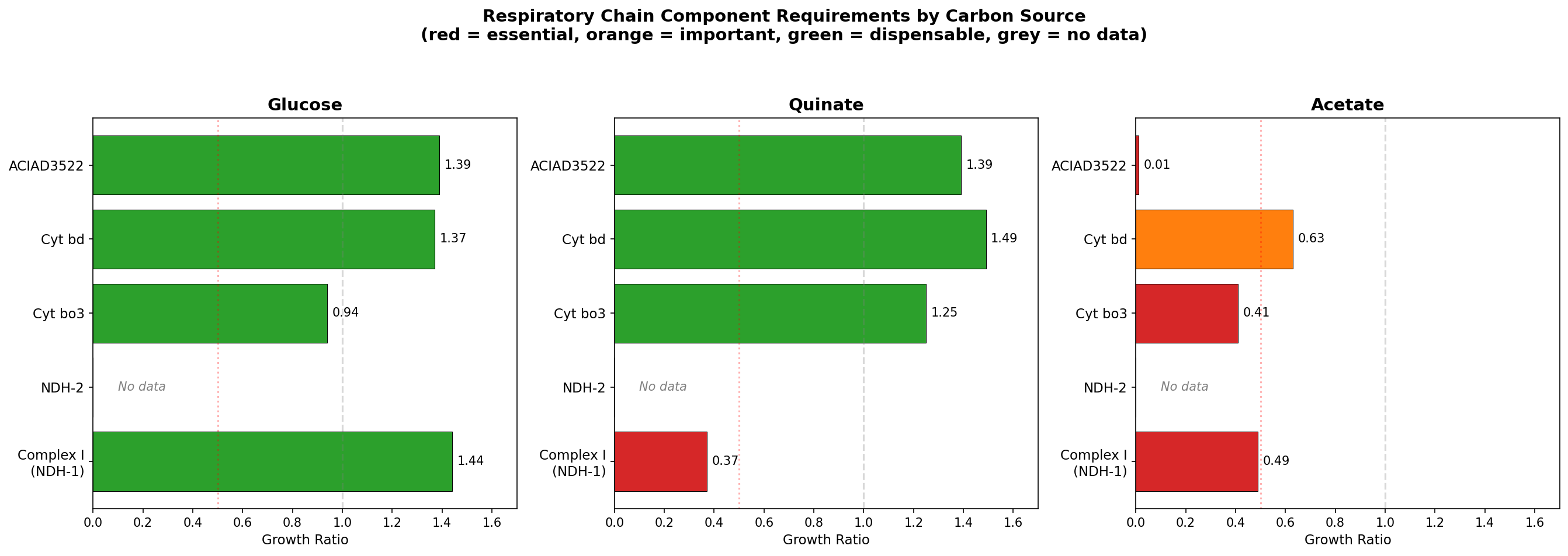
| Complex I (NDH-1) | 13 | Yes (4 H⁺/NADH) | 0.37 (essential) | 1.44 (dispensable) | 0.49 (defect) |
| NDH-2 | 1 | No | No data | No data | No data |
| ACIAD3522 (NADH-FMN OR) | 1 | No | 1.39 (dispensable) | 1.39 (dispensable) | 0.013 (lethal) |
NDH-2 (ACIAD_RS16420, KO K03885) is TnSeq-dispensable but missing from the deletion collection — it has no growth data. FBA predicts zero flux through NDH-2 on all standard carbon sources, routing all NADH through Complex I. NDH-2 is a standalone gene (not in a respiratory operon) and is core genome.
(Notebook: 02_ndh2_indirect.ipynb)
3. The quinate-Complex I paradox is resolved by NADH flux rate, not total yield
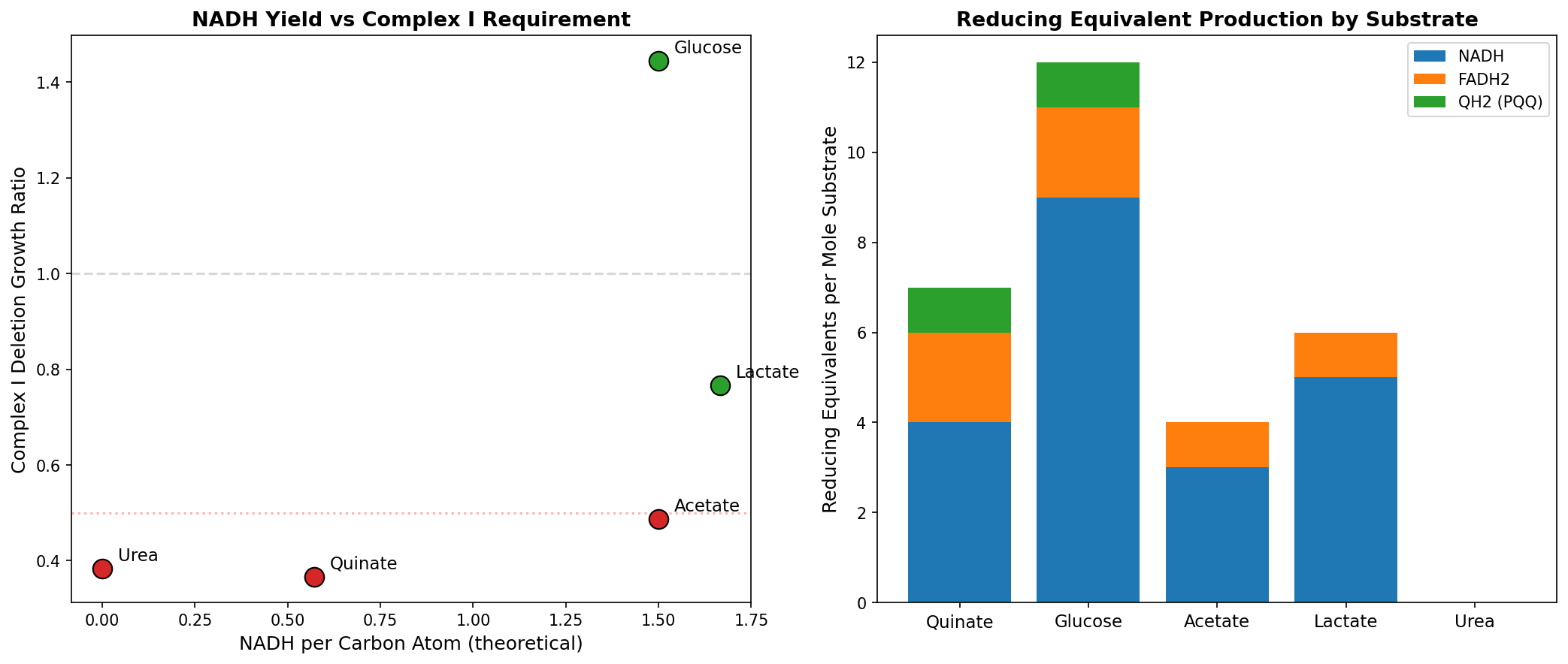
Quinate produces FEWER NADH per carbon atom (0.57) than glucose (1.50) or acetate (1.50), yet Complex I is MORE essential on quinate. The resolution: aromatic ring cleavage via the β-ketoadipate pathway produces succinyl-CoA + acetyl-CoA simultaneously, creating a concentrated NADH burst in the TCA cycle that exceeds NDH-2’s reoxidation capacity. Glucose distributes NADH production across Entner-Doudoroff pathway steps plus TCA, staying within NDH-2’s capacity.
| Substrate | Total NADH | NADH/Carbon | Pathway Distribution | Complex I Growth |
|---|---|---|---|---|
| Quinate | 4 | 0.57 | Concentrated TCA burst | 0.37 (essential) |
| Glucose | 9 | 1.50 | Distributed (ED + TCA) | 1.44 (dispensable) |
| Acetate | 3 | 1.50 | All through TCA | 0.49 (defect) |
| Lactate | 5 | 1.67 | Pyruvate + TCA | 0.77 (mild) |
(Notebook: 03_stoichiometry.ipynb)
4. Cross-species: NDH-2 presence does NOT predict reduced Complex I aromatic dependency
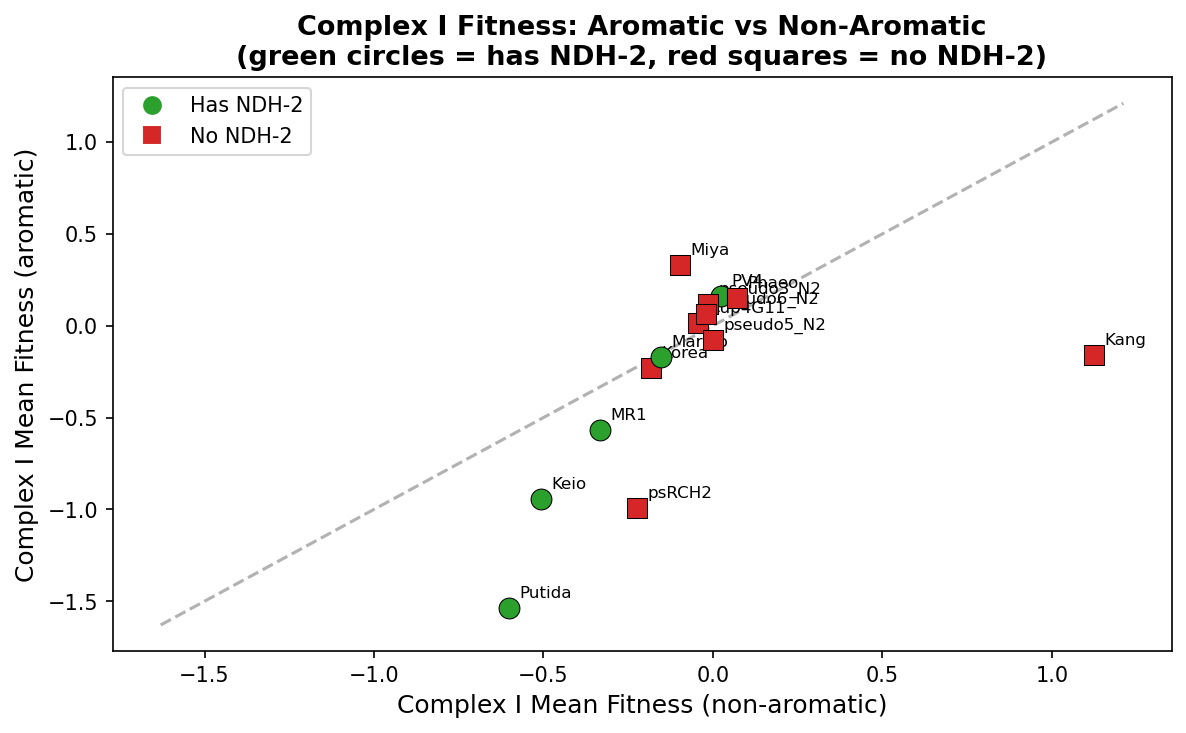
After correcting for likely false positives in NDH-2 identification (filtering to organisms with 1-2 NDH-2 hits, excluding those with >2 hits that likely represent misannotated Complex I subunits), 5 of 14 organisms have validated NDH-2. Organisms WITH NDH-2 show LARGER Complex I aromatic deficits (mean = -0.297) than those WITHOUT (mean = -0.156), the opposite of the compensation prediction (p = 0.52, not significant). The NDH-2 compensation hypothesis is not supported by cross-species fitness data — NDH-2 presence does not predict whether Complex I is dispensable on aromatics. The ADP1 respiratory wiring pattern may be species-specific rather than a general rule.
(Notebook: 04_cross_species_respiratory.ipynb)
5. Proteomics: respiratory wiring is metabolic, not transcriptional
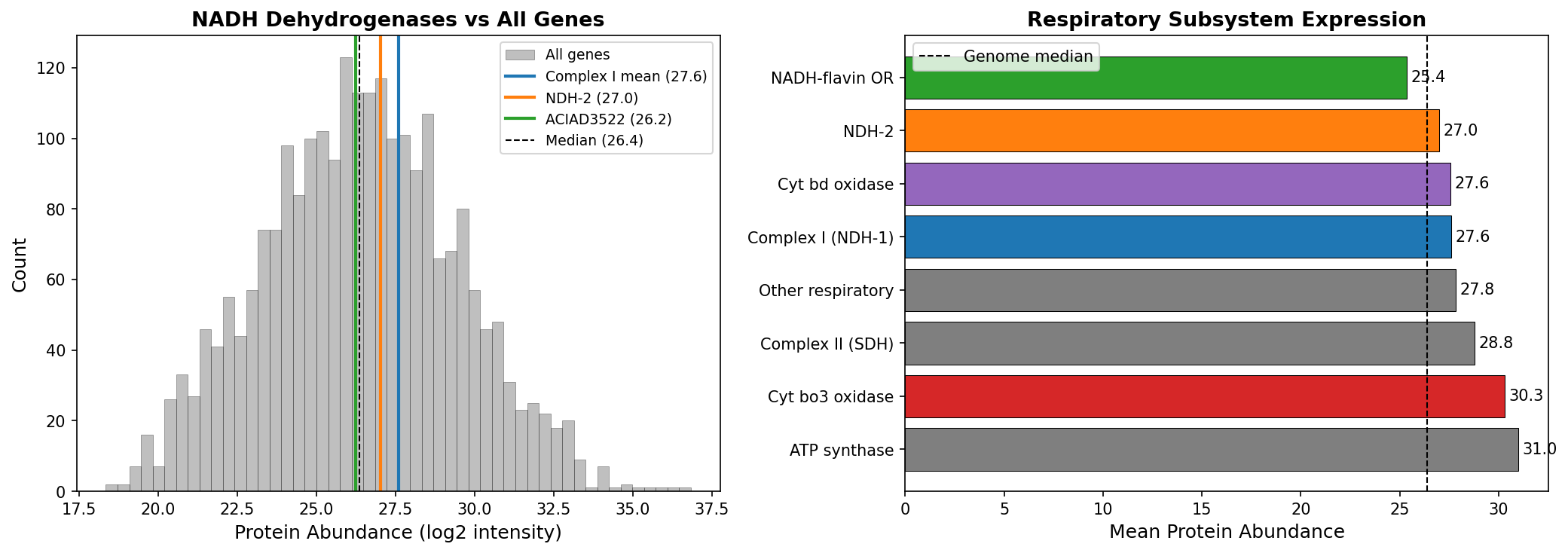
All three NADH dehydrogenases are expressed at similar protein levels under standard growth conditions: Complex I mean 27.6 (66th percentile), NDH-2 27.0 (59th percentile), ACIAD3522 26.2 (48th percentile), genome median 26.4. The spread is only 1.4 units. NDH-2 is NOT repressed — it is constitutively co-expressed with Complex I. This means the condition-specific respiratory wiring operates at the metabolic level: all three dehydrogenases are present simultaneously, and which one becomes limiting depends on the NADH flux rate from the carbon source being catabolized. The cell uses a passive, flux-based wiring system rather than an active transcriptional switch.
(Notebook: 05_proteomics_expression.ipynb)
Results
Respiratory Chain Inventory
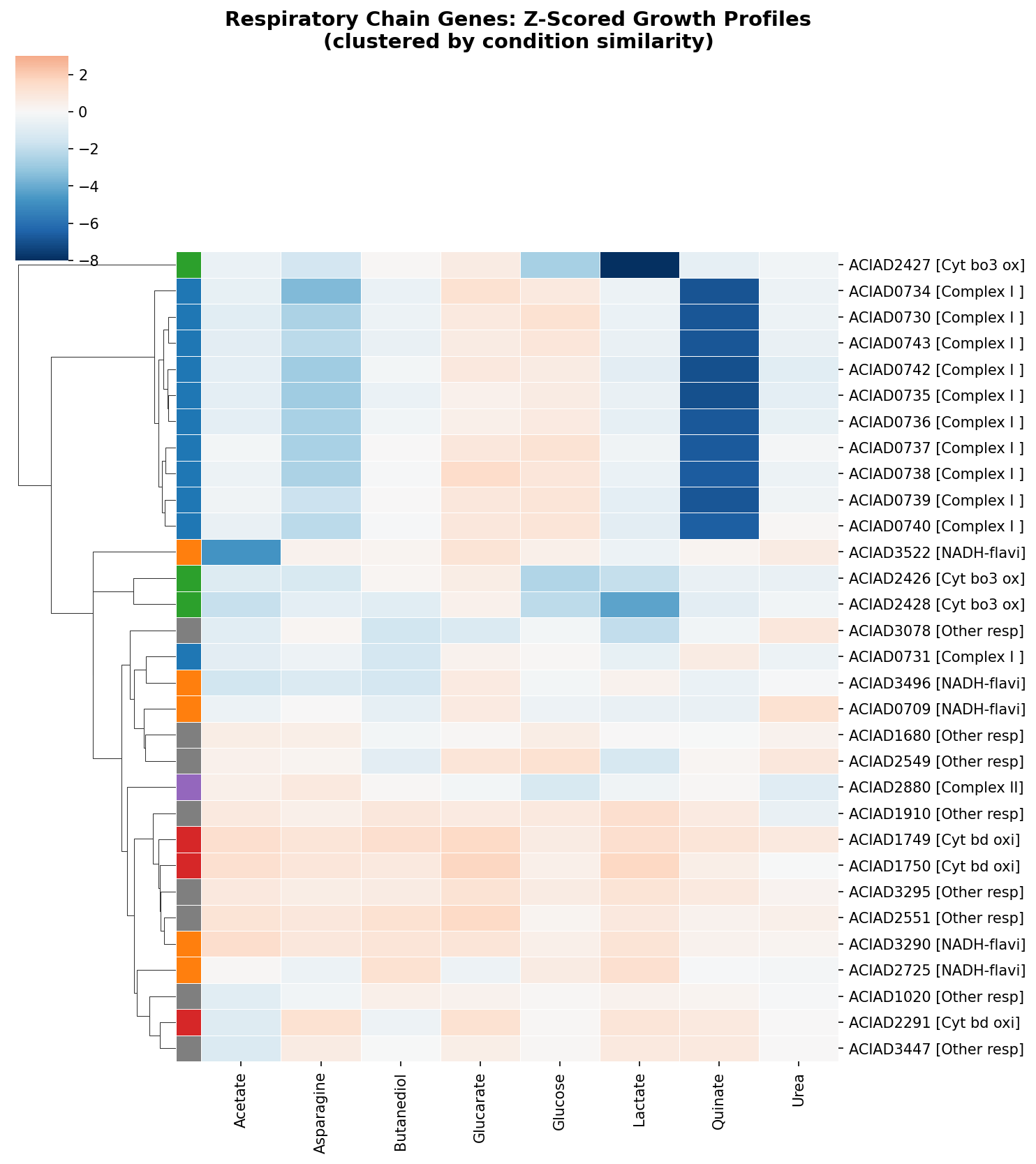
ADP1 has 62 respiratory chain genes across 8 subsystems: Complex I (13 genes), NDH-2 (1), NADH-flavin oxidoreductases (5), cytochrome bo3 (4), cytochrome bd (5), Complex II/SDH (5), ATP synthase (9), and other respiratory components (20). Of these, 36 have growth data and 26 do not (including NDH-2 and several ATP synthase subunits).
The Wiring Model
The condition-specific wiring follows a biochemical logic:
- Quinate: aromatic ring cleavage → TCA burst → Complex I bottleneck. Cyt bo3 and cyt bd are dispensable because the terminal oxidase step is not the bottleneck — NADH reoxidation is.
- Acetate: direct TCA entry → continuous NADH production requiring all available dehydrogenases + cyt bo3 as the primary terminal oxidase. ACIAD3522 is specifically lethal (0.013 growth ratio).
- Lactate: pyruvate entry → moderate NADH flux + specific cyt bo3 requirement. Complex I is only mildly important (0.77), suggesting NDH-2 partially compensates.
- Glucose: Entner-Doudoroff → distributed NADH across multiple steps → NDH-2 capacity sufficient → no specific respiratory component required.
FBA Model Limitations
The FBA model predicts zero flux through NDH-2 and ACIAD3522 on all standard media, because FBA optimizes for growth rate and preferentially routes NADH through Complex I (which generates more ATP per NADH). This is the fundamental reason FBA models fail to predict condition-specific respiratory requirements — they assume the optimal pathway is always used, missing the capacity constraints that force cells to use alternative, suboptimal pathways under high flux.
Interpretation
Literature Context
-
The branched respiratory chain architecture is consistent with Melo & Teixeira (2016), who described bacterial respiratory supercomplexes with multiple entry and exit points for electrons. Our data shows this branching is not just structural redundancy — it’s functionally specialized by substrate.
-
NDH-2 as a low-capacity backup for Complex I is consistent with Lencina et al. (2018), who showed NDH-2 can be the sole NADH dehydrogenase in some organisms (S. agalactiae). ADP1 has both, with Complex I as the high-capacity primary system.
-
The P. putida aromatic fitness data aligns with published knowledge of Pseudomonas aromatic catabolism — P. putida KT2440 is a well-studied aromatic degrader that channels diverse aromatic compounds through the β-ketoadipate pathway.
Novel Contribution
-
Condition-specific respiratory wiring map: First systematic demonstration that a single bacterium uses qualitatively different respiratory configurations for different carbon sources, not just quantitative flux adjustments.
-
Rate vs yield resolution: The paradox that quinate (lower NADH yield) requires Complex I more than glucose (higher NADH yield) is resolved by NADH flux rate — concentrated TCA burst vs distributed production. This principle should apply to any substrate whose catabolism produces concentrated reducing equivalents.
-
Three-dehydrogenase system: ADP1’s three NADH dehydrogenases (Complex I, NDH-2, ACIAD3522) with non-overlapping condition requirements demonstrate metabolic division of labor in electron transport.
-
Cross-species NDH-2 compensation NOT supported: After correcting NDH-2 false positives, organisms with validated NDH-2 show LARGER Complex I aromatic deficits than those without. The compensation is likely ADP1-specific, not a general cross-species pattern.
Limitations
- NDH-2 has no growth data — the central prediction (NDH-2 compensates on glucose) cannot be directly tested with this dataset
- The stoichiometry analysis uses theoretical pathway biochemistry, not measured flux distributions
- Cross-species comparison has only 4 organisms without NDH-2, insufficient for statistical significance
- The NDH-2 gene search in FB organisms may miss some orthologs due to variable annotation
- ACIAD3522 may not be a true NADH dehydrogenase in the respiratory sense — “NADH-FMN oxidoreductase” could serve other metabolic functions
- The NDH-2 identification in NB04 uses text matching on gene descriptions, which likely produces false positives for organisms with incompletely annotated Complex I subunits (e.g., pseudo3_N2E3 with 8 “NDH-2” hits that are probably a Complex I operon). KO-based identification (K03885) would be more reliable.
- The planned pangenome KO co-occurrence analysis (RESEARCH_PLAN Aim 2) was not performed; NDH-2/Complex I co-occurrence across Acinetobacter species remains untested. This is listed as Future Direction #3.
Data
Sources
| Collection | Tables Used | Purpose |
|---|---|---|
User-provided SQLite (berdl_tables.db) | genome_features, gene_phenotypes, gene_reaction_data, genome_reactions | Growth ratios, FBA predictions, reaction stoichiometry |
kescience_fitnessbrowser | experiment, gene, genefitness | Cross-species aromatic experiments, Complex I/NDH-2 fitness |
Generated Data
| File | Rows | Description |
|---|---|---|
data/respiratory_chain_genes.csv | 62 | All respiratory chain genes with growth data and subsystem assignments |
data/subsystem_profiles.csv | 6 | Mean growth per subsystem × condition |
data/ndh2_comparison.csv | 3 | Comparison of Complex I, NDH-2, and ACIAD3522 |
data/nadh_stoichiometry.csv | 5 | Theoretical NADH yield per substrate |
data/cross_species_respiratory.csv | 14 | Complex I aromatic fitness across FB organisms |
data/fb_aromatic_experiments.csv | 33 | FB experiments with aromatic substrates |
Supporting Evidence
Notebooks
| Notebook | Purpose |
|---|---|
01_respiratory_chain_map.ipynb | Extract 62 respiratory genes, build condition × subsystem heatmap |
02_ndh2_indirect.ipynb | NDH-2 characterization via FBA, genomic context, ortholog fitness |
03_stoichiometry.ipynb | NADH/ATP balance calculations, rate vs yield resolution |
04_cross_species_respiratory.ipynb | FB Spark queries: aromatic experiments, NDH-2 compensation test |
05_proteomics_expression.ipynb | Baseline protein abundance of respiratory chain components |
Figures
| Figure | Description |
|---|---|
respiratory_chain_heatmap.png | All 36 respiratory genes × 8 conditions (raw growth ratios) |
subsystem_profiles.png | Mean growth by subsystem × condition |
respiratory_clustermap.png | Z-scored respiratory gene profiles clustered by similarity |
wiring_model.png | Side-by-side comparison: glucose vs quinate vs acetate requirements |
nadh_stoichiometry.png | NADH yield vs Complex I requirement, reducing equivalent bar chart |
wiring_matrix.png | Summary matrix: substrate × component requirement level |
ndh2_vs_complex_I.png | Cross-species: Complex I aromatic vs non-aromatic fitness by NDH-2 status |
proteomics_respiratory.png | NADH dehydrogenase protein abundance vs genome distribution |
Future Directions
-
Construct an NDH-2 deletion mutant: The central prediction — that NDH-2 deletion makes Complex I essential on glucose — can only be tested experimentally. An NDH-2 knockout in ADP1 would be the definitive test.
-
Measure NADH/NAD⁺ ratios per carbon source: The flux rate hypothesis predicts that quinate-grown cells have higher NADH/NAD⁺ ratios than glucose-grown cells. Metabolomics could test this directly.
-
Expand cross-species analysis: With only 4 organisms lacking NDH-2, the compensation test is underpowered. Querying the full BERDL pangenome for NDH-2 (K03885) and Complex I (K00330-K00343) co-occurrence across 27K species would provide a much larger sample.
-
Characterize ACIAD3522: Is it a true respiratory NADH dehydrogenase or a metabolic enzyme? Its acetate-lethality and FMN cofactor suggest a specific role in acetate catabolism that deserves further investigation.
-
Respiratory chain proteomics: Does ADP1 upregulate Complex I on aromatic substrates and NDH-2 on glucose? Stuani et al. (2014) did quinate vs succinate proteomics — reanalyzing their data for respiratory chain proteins could test the wiring model.
References
- de Berardinis V et al. (2008). “A complete collection of single-gene deletion mutants of Acinetobacter baylyi ADP1.” Molecular Systems Biology 4:174. PMID: 18319726
- Lencina AM et al. (2018). “Type 2 NADH dehydrogenase is the only point of entry for electrons into the Streptococcus agalactiae respiratory chain.” mBio 9(4):e01034-18.
- Melo AMP & Teixeira M (2016). “Supramolecular organization of bacterial aerobic respiratory chains.” BBA - Bioenergetics 1857(3):190-197.
- Price MN et al. (2018). “Mutant phenotypes for thousands of bacterial genes of unknown function.” Nature 557:503-509.
- Sena FV et al. (2024). “The two alternative NADH:quinone oxidoreductases from Staphylococcus aureus.” Microbiology Spectrum 12(4):e04152-23.
- Stuani L et al. (2014). “Novel metabolic features in Acinetobacter baylyi ADP1 revealed by a multiomics approach.” Metabolomics 10(6):1223-1238. PMID: 25374488