Key Findings
High Conservation of Amino Acid Biosynthesis Pathways
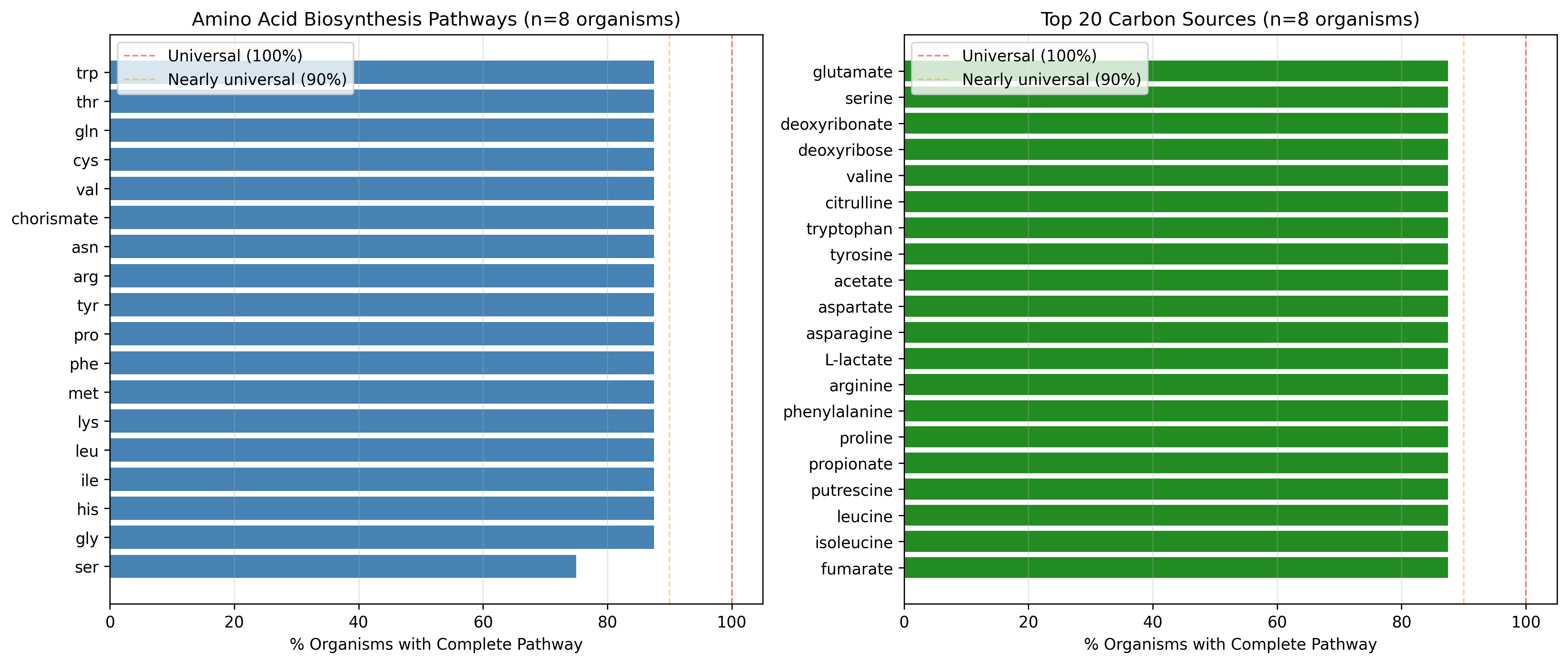
17 of 18 amino acid biosynthesis pathways are present in all 7 organisms analyzed (100% within this sample):
- Complete pathways: arg, asn, chorismate, cys, gln, gly, his, ile, leu, lys, met, phe, pro, thr, trp, tyr, val
One exception: Serine biosynthesis present in only 6 of 7 organisms (85.7%)
The missing organism is Desulfovibrio vulgaris, an anaerobic sulfate-reducing bacterium that appears to lack serine biosynthesis according to GapMind predictions.
(Notebook: 02_gapmind_pathway_analysis.ipynb)
Desulfovibrio vulgaris Serine Auxotrophy
Desulfovibrio vulgaris (DvH) is the only organism among the 7 that lacks a complete serine biosynthesis pathway according to GapMind (score_category: complete or likely_complete).
Biological context:
- D. vulgaris lives in anaerobic, organic-rich environments (sediments, intestinal tracts)
- Serine would be abundant from environmental protein degradation
- This could represent a genuine metabolic auxotrophy where the organism depends on external serine
Organism pathway completeness summary:
| Organism | Species | AA Pathways | % Complete |
|---|---|---|---|
| Caulo | Caulobacter vibrioides | 18/18 | 100% |
| MR1 | Shewanella oneidensis | 18/18 | 100% |
| PS | Pseudomonas aeruginosa | 18/18 | 100% |
| Putida | Pseudomonas putida | 18/18 | 100% |
| Smeli | Sinorhizobium meliloti | 18/18 | 100% |
| azobra | Azospirillum brasilense | 18/18 | 100% |
| DvH | Desulfovibrio vulgaris | 17/18 | 94.4% |
(Notebook: 02_gapmind_pathway_analysis.ipynb)
Conserved Carbon Source Utilization
Most widely conserved carbon sources (present in all 7 organisms, 87.5%):
- TCA cycle intermediates: fumarate, succinate
- Fermentation products: acetate, propionate, L-lactate
- Amino acids as carbon sources: All amino acids can be catabolized
- Nucleotide derivatives: deoxyribose, deoxyribonate
- Polyamines: putrescine
Nearly universal (6 of 7 organisms, 75%):
- ethanol, deoxyinosine
This pattern suggests a shared central catabolic capacity for breaking down common organic compounds, consistent with the diverse ecological niches these bacteria occupy.
(Notebook: 02_gapmind_pathway_analysis.ipynb)
GapMind Coverage Limitation Discovered
E. coli genomes are completely absent from GapMind in the KBase pangenome collection.
Coverage summary:
| Organism | Species | Genome ID | GapMind Predictions | Status |
|---|---|---|---|---|
| Keio | Escherichia coli K-12 | GCF_000005845.2 | 0 | ❌ Missing |
| DvH | Desulfovibrio vulgaris | GCF_000195755.1 | 694 | ✅ Present |
| MR1 | Shewanella oneidensis | GCF_000146165.2 | 694 | ✅ Present |
| Putida | Pseudomonas putida | GCF_000007565.2 | 1,041 | ✅ Present |
| PS | Pseudomonas aeruginosa | GCF_000006765.1 | 745 | ✅ Present |
| Caulo | Caulobacter vibrioides | GCF_000022005.1 | 694 | ✅ Present |
| Smeli | Sinorhizobium meliloti | GCF_000006965.1 | 1,735 | ✅ Present |
| azobra | Azospirillum brasilense | GCF_000011365.1 | 1,786 | ✅ Present |
Reason: E. coli was excluded from GTDB pangenome construction due to having too many genomes for species-level analysis.
Impact: This limits the current analysis to a pilot study with 7 organisms rather than the intended 45 FB organisms with essential gene data.
(Discovery: manual GapMind coverage checking)
Interpretation
Near-Universal Amino Acid Biosynthesis
The finding that 6 of 7 organisms (85.7%) possess complete biosynthesis pathways for all 18 amino acids suggests that amino acid prototrophy is the ancestral state for free-living bacteria. This aligns with the expectation that essential metabolism includes the core biosynthetic pathways.
The high conservation (17/18 pathways at 100% within sample) indicates these biosynthetic routes represent a minimal metabolic repertoire required for independent growth. Organisms lacking these pathways (auxotrophs) depend on external nutrient sources or live in symbiotic/commensal relationships.
Ecological Interpretation of DvH Serine Auxotrophy
Desulfovibrio vulgaris is known for:
- Anaerobic respiration using sulfate as terminal electron acceptor
- Organic acid utilization (lactate, formate, pyruvate)
- Niche: Anaerobic sediments, biofilms, intestinal tracts
The apparent serine auxotrophy makes ecological sense:
- These environments are rich in amino acids from protein degradation
- Streamlining metabolism by losing biosynthetic capacity could be advantageous when nutrients are abundant
- This may represent genomic economy - losing genes that are energetically costly when the product is freely available
Alternative Explanations
GapMind detection limitations:
- DvH may use a non-canonical serine biosynthesis pathway not in GapMind’s reference database
- The pathway may be present but use divergent enzymes that fall below GapMind’s homology threshold
- Genes may be present but unannotated in the genome assembly
Future validation: Experimental testing of DvH growth on serine-free minimal media would confirm auxotrophy.
Hypothesis Outcome
Original H1 (Revised version): “A core set of metabolic pathways is universally complete across bacteria”
Result: Partially supported with significant caveats
✅ Supported:
- High pathway conservation observed (17/18 AA pathways, most carbon sources)
- Minimal metabolic repertoire identified for amino acid biosynthesis
- Central catabolic pathways widely shared
❌ Not supported:
- NO pathways are truly universal (100%) even in this small sample
- Organism-specific gaps exist (DvH serine)
- Analysis limited to 7 organisms (not pan-bacterial)
Conclusion: The data reveal near-universal rather than strictly universal metabolic pathway completeness. Even among organisms with experimental essential gene data, some metabolic diversity exists, likely reflecting ecological adaptation and nutrient availability.
Limitations
Small Sample Size
- 7 organisms analyzed (not 45 as originally planned)
- Limited phylogenetic diversity (mostly Proteobacteria + 1 Deltaproteobacterium)
- Cannot generalize to “pan-bacterial” scale
GapMind Coverage Gaps
- E. coli absent from dataset (major model organism)
- Unknown coverage for remaining 38 FB organisms
- May miss organisms with divergent metabolic genes
Pathway Prediction Limitations
- GapMind predictions are computational, not experimental
- “Complete” and “likely_complete” categories used; may miss partial pathways
- Non-canonical or poorly characterized pathways not detected
Essential Gene Data Dependency
- RB-TnSeq experiments conducted in rich media
- Biosynthetic genes may appear non-essential due to nutrient supplementation
- Cannot distinguish between “essential for biosynthesis” vs “essential for viability”
Data
Sources
| Collection | Tables Used | Purpose |
|---|---|---|
kbase_ke_pangenome | gapmind_pathways, genome | Pathway completeness predictions (305M predictions, 293K genomes) |
projects/essential_genome | essential_families.tsv | Universally essential gene families (859 families, 45 organisms) |
Generated Data
| File | Rows | Description |
|---|---|---|
data/pathway_completeness.tsv | 80 | All pathway completeness across 7 organisms |
data/aa_pathway_completeness.tsv | 18 | Amino acid biosynthesis pathways |
data/carbon_pathway_completeness.tsv | 62 | Carbon source utilization pathways |
data/gapmind_fb_predictions.tsv | 7,389 | Raw GapMind predictions for 7 organisms |
data/fb_genome_mapping_manual.tsv | 8 | FB organism → genome ID mappings |
Supporting Evidence
Notebooks
| Notebook | Purpose |
|---|---|
02_gapmind_pathway_analysis.ipynb | GapMind pathway analysis, organism mapping, visualization |
Figures
| Figure | Description |
|---|---|
pathway_completeness.png | Pathway completeness visualization (amino acids + top carbon sources) |
Future Directions
Immediate Follow-ups
- Literature review: Is D. vulgaris serine auxotrophy documented experimentally?
- Check lower-confidence GapMind predictions: Does DvH have serine pathway with “steps_missing” status?
- Expand organism mapping: Add more FB organisms to increase sample size
Alternative Approaches
- eggNOG pathway analysis: Use EC annotations → KEGG pathways for all 45 FB organisms (including E. coli)
- Hybrid approach: Combine GapMind (pathway-level) with eggNOG (gene-level) for comprehensive coverage
- Essential gene → pathway linkage: Map essential genes directly to metabolic pathways rather than relying on GapMind
Broader Questions
- Pathway essentiality vs completeness: Are “complete” pathways actually essential for viability?
- Conditional essentiality: Which pathways are essential only under specific growth conditions?
- Phylogenetic patterns: Do pathway gaps cluster by phylogeny or ecology?
References
- Price MN et al. (2020). “Filling gaps in bacterial amino acid biosynthesis pathways with high-throughput genetics.” PLoS Genet 16(1):e1008594. DOI: 10.1371/journal.pgen.1008594. PMID: 31951614 (GapMind methodology)
- Heidelberg JF et al. (2004). “The genome sequence of the anaerobic, sulfate-reducing bacterium Desulfovibrio vulgaris Hildenborough.” Nat Biotechnol 22:554-559. DOI: 10.1038/nbt959. PMID: 15077118
- Price MN et al. (2018). “Mutant phenotypes for thousands of bacterial genes of unknown function.” Nature 557:503-509. DOI: 10.1038/s41586-018-0124-0. PMID: 29769716 (Fitness Browser)
- Parks DH et al. (2022). “GTDB: an ongoing census of bacterial and archaeal diversity through a phylogenetically consistent, rank normalized and complete genome-based taxonomy.” Nucleic Acids Res 50:D785-D794. DOI: 10.1093/nar/gkab776. PMID: 34520557 (GTDB/pangenome)
Revision History
- v1 (2026-02-17): Initial findings from 7-organism GapMind analysis