Key Findings
The Gradient
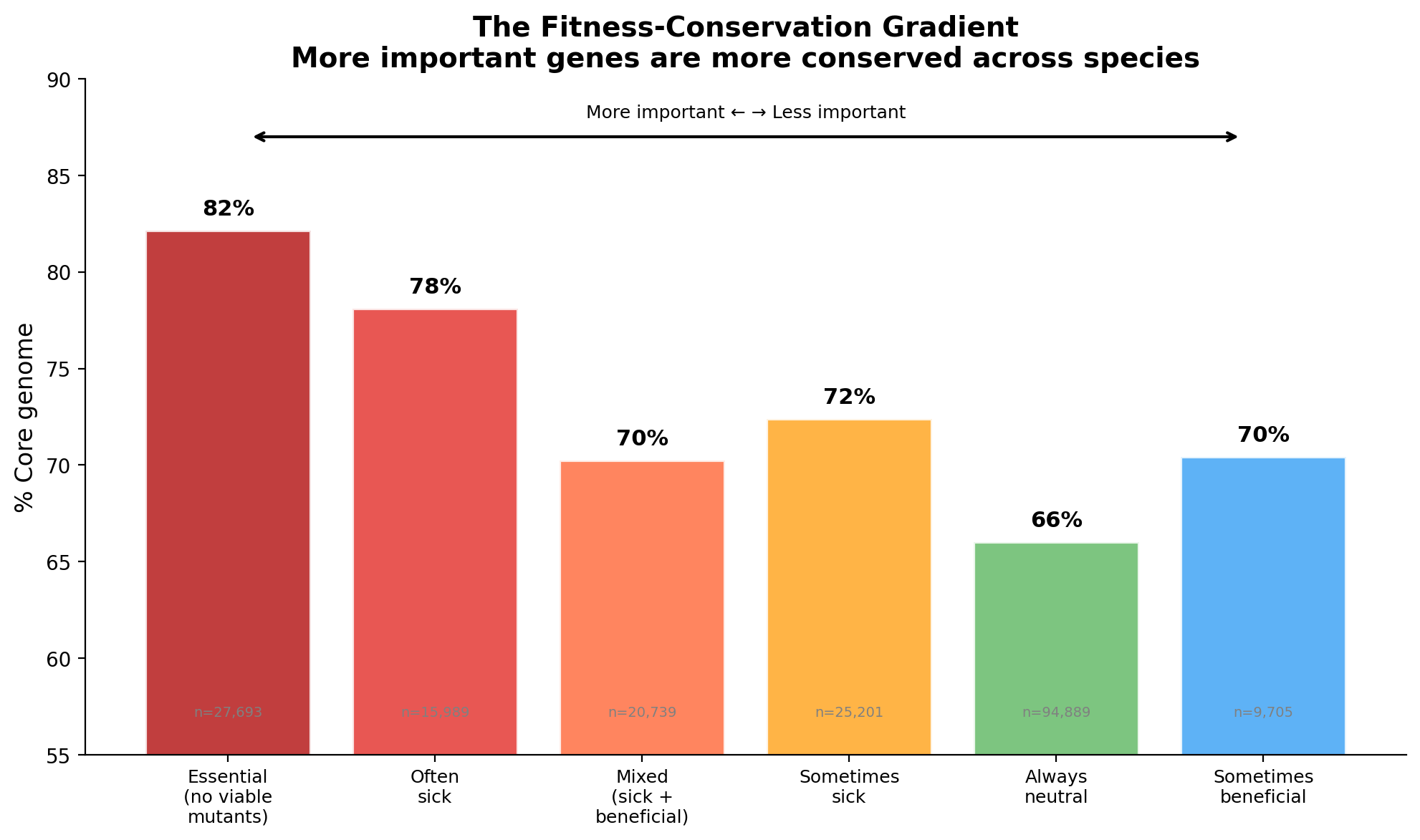
There is a clear, quantitative gradient from essential genes (82% core) to always-neutral genes (66% core). More important genes are more conserved — but the effect is modest. Even genes with no detectable fitness effect in any experiment are 66% core. The gradient spans 194,216 protein-coding genes across 43 diverse bacteria, from archaea (Methanococcus) to plant pathogens (Ralstonia) to gut commensals (Bacteroides).
(Notebook: 01_summary_figures.ipynb)
The Paradox
A naive model predicts that core genes are “boring” housekeeping genes — always needed, never costly. The data shows the opposite:
- Core genes are MORE likely to be burdens — 24.4% show positive fitness when deleted (mutant grows better) vs 19.9% for accessory genes
- Core genes have MORE condition-specific effects — genes with strong specific phenotypes are 1.78x more likely to be core
- Core genes are MORE likely to be trade-offs — genes that are both important AND burdensome (depending on conditions) are 1.29x more likely core
The conserved genome is the most functionally active part of the genome, not the most inert.
(Notebook: 01_summary_figures.ipynb)
The Resolution
Lab conditions are an impoverished proxy for nature.
A gene that shows positive fitness when deleted in rich media may be essential for survival in soil, biofilm, host tissue, or any of the thousands of conditions bacteria face in their natural habitats. The lab captures the cost of maintaining these genes; the pangenome captures the evolutionary pressure to keep them.
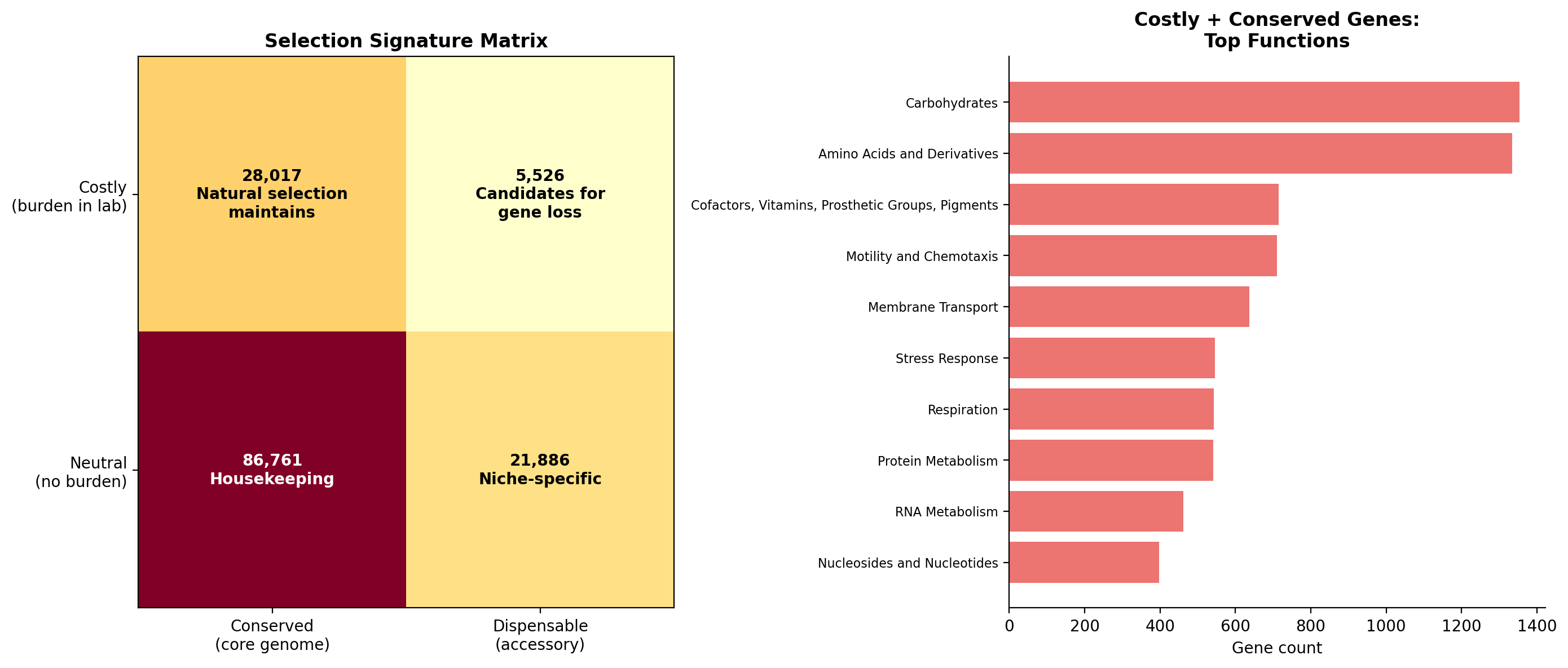
We quantified this with a selection-signature matrix. The 28,017 genes that are simultaneously costly in the lab AND conserved in the pangenome are the strongest evidence for purifying selection in natural environments — nature maintains them despite their metabolic cost. The 5,526 genes that are costly AND dispensable are candidates for ongoing gene loss.
(Notebook: 01_summary_figures.ipynb)
The Architecture
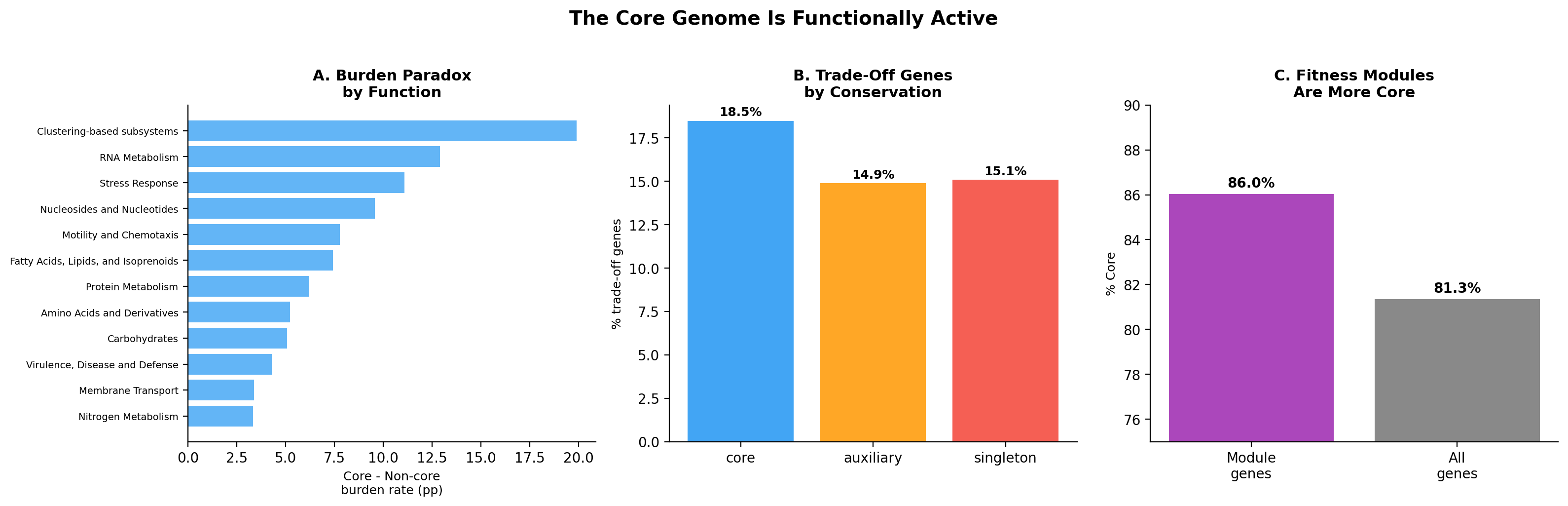
The core genome is not just a collection of individual essential genes — it contains coordinated functional units. ICA decomposition identified 1,116 co-regulated fitness modules across 32 organisms. These modules are enriched in core genes (86% core vs 81.5% baseline, OR=1.46, p=1.6e-87). 59% of modules are >90% core genes.
The burden paradox is function-specific: motility and chemotaxis genes (+7.8pp core-burden excess), RNA metabolism (+12.9pp), and protein metabolism (+6.2pp) drive the effect. Cell wall genes reverse it — non-core cell wall genes are MORE burdensome. This makes biological sense: flagella are energetically expensive but essential for chemotaxis in natural environments; ribosomal components are costly but required for rapid growth responses.
(Notebook: 01_summary_figures.ipynb)
What We Did Not Find
- Family breadth doesn’t predict conservation: Module families spanning more organisms don’t have higher core fractions (rho=-0.01, p=0.91). The baseline is already so high there’s no room for a gradient.
- Accessory genes are NOT systematically burdensome: Contrary to the “streamlining” hypothesis, accessory genes are LESS costly than core genes, not more.
- Condition-specific doesn’t mean niche-specific: Genes with strong condition-specific fitness effects are MORE likely core, not more accessory. Core genes simply have more detectable effects.
Open Questions
- The 5,526 costly + dispensable genes — What are they? Mobile elements? Recently acquired genes on the way out? These are candidates for ongoing gene loss.
- Environmental context — Do organisms from more variable environments have more trade-off genes in their core? Connecting lab fitness to AlphaEarth environmental data could bridge this gap.
- Cross-organism essential families — Are there universally essential gene families across all 43 organisms?
- The 48 accessory modules — What co-regulated functions live exclusively in the flexible genome?
Data
Sources
| Dataset | Description | Source |
|---|---|---|
| Fitness Browser | RB-TnSeq mutant fitness for ~194K genes across 43 bacteria | Price et al. (2018); upstream projects |
| KBase pangenome | Gene cluster conservation across 27,690 species | Parks et al. (2022); upstream projects |
| Upstream fitness stats | Per-gene fitness summary statistics | conservation_vs_fitness/data/, fitness_effects_conservation/data/ |
| ICA fitness modules | 1,116 co-regulated modules across 32 organisms | fitness_modules/data/modules/ |
Generated Data
This synthesis project does not generate new data files; all figures are produced from cached upstream data.
References
- Price MN et al. (2018). “Mutant phenotypes for thousands of bacterial genes of unknown function.” Nature 557:503-509. PMID: 29769716
- Parks DH et al. (2022). “GTDB: an ongoing census of bacterial and archaeal diversity through a phylogenetically consistent, rank normalized and complete genome-based taxonomy.” Nucleic Acids Res 50:D199-D207. PMID: 34520557
- Rosconi F et al. (2022). “A bacterial pan-genome makes gene essentiality strain-dependent and evolvable.” Nat Microbiol 7:1580-1592.
- Hutchison CA 3rd et al. (2016). “Design and synthesis of a minimal bacterial genome.” Science 351:aad6253.
Supporting Evidence
| Type | Path | Description |
|---|---|---|
| Notebook | notebooks/01_summary_figures.ipynb | All synthesis figures |
| Figure | figures/fitness_conservation_gradient.png | Fitness-conservation gradient |
| Figure | figures/selection_signature.png | Selection signature matrix |
| Figure | figures/core_genome_active.png | Core genome architecture |
Revision History
- v1 (2026-02): Migrated from README.md
- v2 (2026-02): Added Data section, notebook provenance, Parks et al. reference