The counter-ion analysis and the primary metal fitness atlas report different per-metal conservation estimates for manganese, zinc and iron 1,2. A counter ion is the partner ion supplied alongside a metal in its salt. The disagreement matters for the framework in shared-stress-versus-stressor-specific-fitness, which separates a shared cellular-stress component from metal-specific requirements before mechanistic interpretation 1. The discrepancy is already present in the uncorrected values, before any shared-stress treatment, so the correction step alone cannot explain it 1,2.
Evidence Sides
Counter-ion analysis (corrected and uncorrected values)
The counter-ion analysis applies a shared-stress correction, which removes genes that respond to stress in general so that metal-specific genes remain. After this correction it reports manganese at +0.182, zinc at +0.115 and iron at +0.182 1. Its own uncorrected values were manganese +0.182, zinc +0.145 and iron -0.040 1. Within this analysis, the correction left manganese unchanged, lowered zinc, and changed the sign of iron from negative to positive 1.
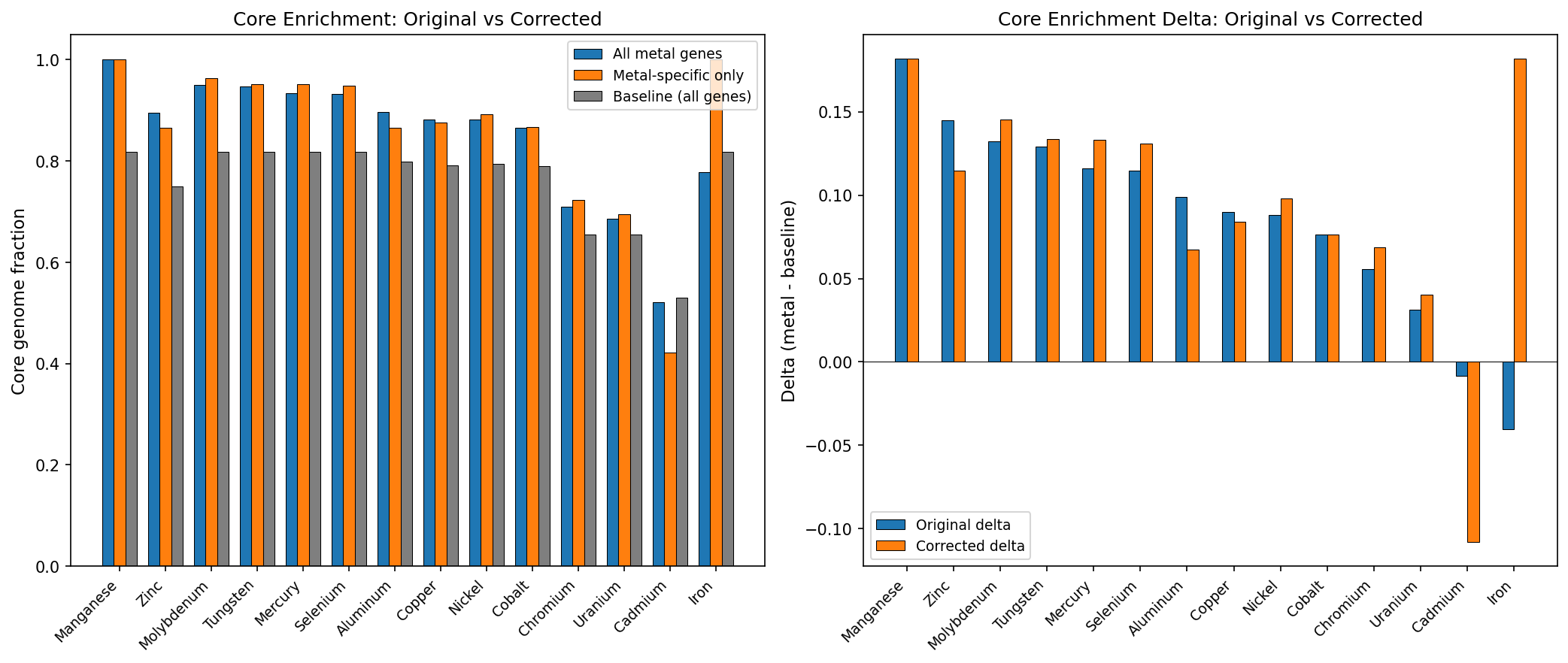 Original vs corrected core enrichment per metal. From counter_ion_effects.
Primary metal fitness atlas (uncorrected values)
The primary atlas reports original, uncorrected estimates of manganese +0.198, zinc +0.151 and iron +0.116 2. These values were not subjected to the counter-ion analysis’s shared-stress correction 2.
Where the sides diverge
Comparing the uncorrected values from the two analyses, the discrepancy is present even before any shared-stress treatment 1,2. The largest qualitative difference is iron. It is negative in the counter-ion analysis’s uncorrected value (-0.040) and positive in the atlas’s (+0.116) 1,2. The values should not be reconciled by averaging. The analyses differ in record sets, organism coverage and procedure 1,2.
Possible Reconciliations
- Hypothesis A (records): The analyses differ in record sets 1,2. If so, the uncorrected discrepancy may reflect which records were included rather than biology. This is untested.
- Hypothesis B (coverage): The analyses differ in organism coverage 1,2. Different contributing organisms could shift per-metal estimates. This is untested.
- Hypothesis C (procedural): The analyses differ in procedure 1,2. How each defines gene sets or computes the estimate could produce the gap independently of the shared-stress correction. This is untested.
- Hypothesis D (biological): The discrepancy could reflect a real biological difference that one record set captures and the other does not 1,2. This is untested.
None of these is established. Matched-data reanalysis is required to decide whether the discrepancy is methodological or biological 1,2.
Resolving Work
- Matched records: Recompute uncorrected manganese, zinc and iron estimates using one identical gene–condition record set and the same procedure. Does the uncorrected discrepancy persist when the inputs are matched?
- Organism coverage: Restrict both pipelines to the organisms they share for each metal, then recompute the iron estimate. Does the sign difference between the uncorrected iron values disappear?
- Procedure: Run the atlas procedure and the counter-ion procedure in turn on each analysis’s own records, swapping one at a time. Is the gap driven by the procedure or by the records?
- Correction: Apply the shared-stress correction to the atlas’s records under the matched setup. Does iron show the same negative-to-positive shift that the counter-ion analysis reports?